On this page
How to identify it
- A looper or inchworm: slender, hairless, with only two pairs of legs at the hind end, so it walks by stretching out, gripping with the front legs and drawing the rear end forward. Young larvae are light brown with a whitish stripe along each side and another down the middle of the back; full-grown larvae are a little over an inch long and usually grayish brown, though the shade varies and the stripes can become indefinite. Wisconsin describes five instars, pale to light green above and brown below when young and completely brown later, reaching 18 to 23 mm.[1][3]
- When disturbed, the caterpillars cling to their support by the hind legs and stay straight and motionless.[1]
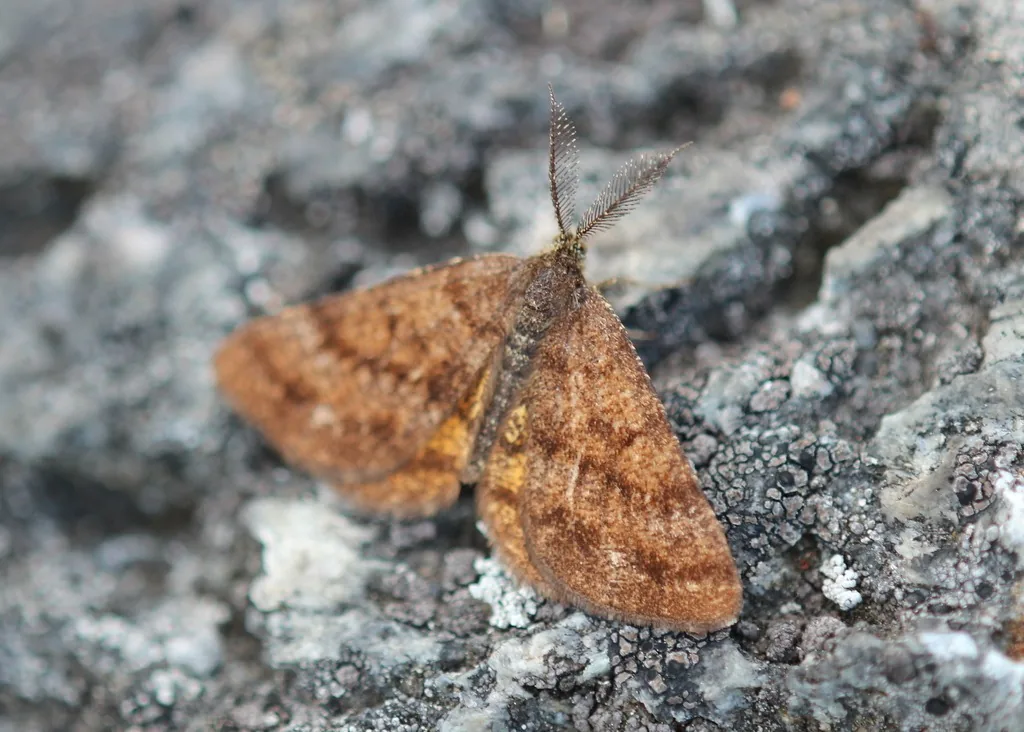
- The adult is a small moth with a wingspan of about an inch (23 to 28 mm), described by UMass as light gray dully variegated with rusty brown and, on its newer sheet, simply as brown next to the larger, sulphur-yellow green spanworm moth; Wisconsin describes males with a grayish-brown body and white to yellow forewings with brown markings, and slightly paler females. BAMONA calls it a day-flier, and the moths flutter up out of the vines when a bog is swept in June.[1][4][3][2]
- Eggs are laid singly in the leaf litter: light green to yellowish-orange, 0.7 to 0.8 mm long, elliptical, with rows of hexagonal pits. The pupa is 9 to 10 mm and light to dark brown.[3]
Look-alikes
| Look-alike | How to tell them apart |
|---|---|
| Green cranberry spanworm (Macaria sulphurea) | The other main cranberry spanworm. Its larvae are green with white lines and a narrow yellow side stripe and hatch in April and May, weeks before brown spanworm; its female moth is sulphur-yellow and larger than the brown spanworm moth.[1][4] |
| Curved-toothed geometer (great cranberry spanworm) | A much bigger brown looper, to 2.5 inches, with a dark bumpy ridge across the back behind the head and a 2-inch gray moth; brown spanworm larvae stay a little over an inch and the moth spans about an inch.[1] |
| False armyworm and cranberry blossomworm | Cutworm-type caterpillars of the same bogs with five pairs of hind legs and a stout body; very young ones loop like spanworms, so UMass recommends a 10x lens to count the legs.[1] |
Where it lives
BAMONA gives Nova Scotia to Pennsylvania and west to Manitoba and Minnesota, in bogs and wet meadows. UMass describes it as a pest of Massachusetts cranberry bogs, and the University of Wisconsin covers it as a cranberry pest.[2][1][3]
Biology and life cycle
Pupae overwinter in the leaf litter on the bog floor and can withstand the winter flood. Some moths emerge in late May and most in the first weeks of June (end of May through mid-June in Wisconsin).[1][3]
Female moths lay eggs in June, in clusters of up to 20 according to UMass. The eggs begin to hatch in mid-June, much later than cutworms or green spanworms and around bloom; young larvae are light brown with whitish stripes, and full-grown larvae appear in late July. There is one generation a year.[1][3]
BAMONA lists arborvitae and other woody plants as hosts and says it is sometimes a pest on cranberry.[2]
As the larvae grow they are less likely to turn up in a sweep net, because some of them cling halfway down the stem of the upright at mid-day instead of sitting up on the leaves.[1]
Damage and signs
- Larvae feed openly on new leaves and flowers and do not web the foliage. Infestations can be patchy; where populations go unchecked, UMass has seen areas where all the bloom was destroyed.[1][3]
- Larvae also chew on small berries, penetrating the surface layer, and the damaged spots form brown patches on the berry as it enlarges. Severe infestations can turn large areas of a bed brown, and extensive leaf feeding can reduce the following year's crop.[1][3]
Health risk
UMass, the University of Wisconsin and BAMONA treat it only as a pest of cranberry and other plants; none mentions bites, stings or any effect on people or pets.[1][3][2]
Control
Traps and physical control
Sweep-netting is the detection method; no synthetic pheromone lure is available for trapping. UMass's long-standing threshold for green and brown spanworm is an average of 18 larvae per 25 sweeps. Fluttering brown spanworm moths in June are a signal to keep sweeping into bloom, although a larval population does not always follow a moth flight, and larger larvae hiding on the stems are undercounted.[1][3]
Biological control
Bacillus thuringiensis (B.t.) products are effective against spanworms while they are small and are a good spray option for brown spanworm, but they require good coverage and may need two or more treatments; Wisconsin suggests a second application after 5 to 10 days if larvae keep hatching, and notes Bt may be the material of choice when bees are already working the beds.[1][3]
Pesticides
Brown spanworm is particularly tricky to treat because its mid-June hatch coincides with the placement of bee hives on the bogs, and UMass reports it is resistant to some insecticides. Wisconsin lists most broad-spectrum insecticides as effective, with the selective materials tebufenozide and spinosad also registered, applied while larvae are young; larger caterpillars are much harder to control with any spray.[1][3]
Where the sources disagree
Eggs: UMass says they are laid in clusters of up to 20; Wisconsin says they are deposited singly in the leaf litter.[1][3]
The moth: UMass describes it as light gray dully variegated with rusty brown; Wisconsin gives males white to yellow forewings with brown markings and a 23 to 28 mm wingspread; BAMONA describes powdery orange wings, the forewing rusty brown in the male and more whitish and brown in the female, spanning 2.5 to 3 cm in males.[1][3][2]
Genus: BAMONA lists it as Hypomecis amitaria, formerly Ematurga; GBIF uses Ematurga amitaria.[2][5]
Flight season: Wisconsin gives the end of May through mid-June; BAMONA gives late May to August.[3][2]
Common questions
- When should I expect brown spanworm on a cranberry bog?
- Moths fly from late May into June and eggs hatch from mid-June, later than cutworms and green spanworms; full-grown larvae appear in late July.[1]
- How is brown spanworm different from green spanworm?
- Brown spanworm larvae are light to grayish brown with whitish stripes and hatch in mid-June; green spanworm larvae are green with a yellow side stripe and hatch in April and May. The brown spanworm moth is brown or gray with rusty markings and smaller than the yellow green spanworm moth.[1][4]
- Does flooding the bog kill the overwintering stage?
- No: Wisconsin says the pupa can withstand the winter flood and, because the larvae hatch late, reflooding is not practical. UMass's spring caterpillar sheet recommends late water for false armyworm and blossomworm and sanding for green spanworm, and for brown spanworm relies on sweeping and well-timed sprays.[3][1]
Sources
- UMass Amherst Cranberry Station, Center for Agriculture, Food, and the Environment, “Confusing Spring Caterpillars in Cranberry (1999) (UMass Cranberry Station fact sheet).” www.umass.edu/agriculture-food-environment/cranberry/fact-sheets/confusing-spring-caterpilars-in-cranberry-1999 (accessed 2026-11-13)
- Butterflies and Moths of North America (BAMONA), “Cranberry Spanworm Moth, Hypomecis amitaria (species account).” www.butterfliesandmoths.org/species/Ematurga-amitaria (accessed 2026-11-13)
- University of Wisconsin-Madison, “Brown Cranberry Spanworm (D. L. Mahr, November 2005; revised from the University of Wisconsin Cranberry Crop Management software).” wpcdn.web.wsu.edu/wp-wsucahnrs/uploads/sites/2166/2025/05/Brown-Cranberry-Spanworm.pdf (accessed 2026-11-13). PDF copy hosted by Washington State University CAHNRS
- UMass Amherst Cranberry Station, Center for Agriculture, Food, and the Environment, “Green Cranberry Spanworm in MA Cranberry (M. M. Sylvia and A. L. Averill, March 2023) (UMass Cranberry Station fact sheet).” www.umass.edu/agriculture-food-environment/cranberry/fact-sheets/green-cranberry-spanworm-in-ma-cranberry-march-2023 (accessed 2026-11-13)
- Global Biodiversity Information Facility (GBIF), “Ematurga amitaria (Guenée) (GBIF Backbone Taxonomy).” api.gbif.org/v1/species/1956462 (accessed 2026-11-13)
- iNaturalist, “Ematurga amitaria taxon page (order and family).” www.inaturalist.org/taxa/219051 (accessed 2026-11-10)