On this page
How to identify it
- Early signs are hard to spot: look for small, shrunken berries that have turned blue too soon, with a pin-sized entry hole near the stem, then open the berries next to them to find the larva.[1]
- Eggs may be visible too; they change from white-green to yellow.[1]
- Masses of brown frass and silk that web berry clusters together show up only later, once the larva starts moving from berry to berry.[1]
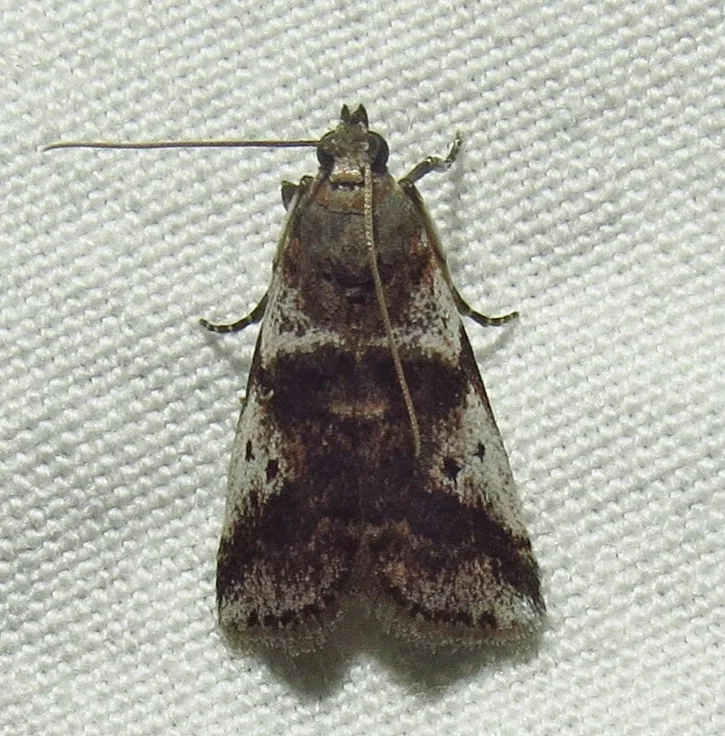
- Adults are small brown moths.[1]
- UF/IFAS describes the eggs as flat, white and scale-like with a yellow or reddish tinge near the center; after hatching, the empty shells look brighter and whiter.[11]
- Full-grown larvae have a pale yellow head with brownish-yellow spots. The back of the thorax is reddish yellow shading to green on the sides, and the back of the abdomen runs from red at the front to reddish yellow at the rear.[11]
- Male moths have a black line along the middle of the forewing, a nearly triangular black spot in the middle of the front edge, white scaling along that edge and diffuse red shading. Acrobasis moths are notoriously hard to tell apart, so finding the moth on its host plant helps.[11]
Look-alikes
| Look-alike | How to tell them apart |
|---|---|
| Cherry fruitworm | Another blueberry fruit borer that also destroys berry clusters; its larvae have pink-red bodies with brown or black heads, and it overwinters in dead wood or pruning stubs on the bush rather than in litter under it.[3][1] |
Where it lives
Found throughout the eastern United States wherever wild blueberries grow, and a pest of cultivated blueberries and cranberries: it is the top insect pest of cranberry in Wisconsin, has been studied in southeastern New Brunswick, and is covered as a cranberry pest in the Pacific Northwest handbook. UF/IFAS gives its range as eastern North America from Florida to Nova Scotia and west to Wisconsin and Texas, with small populations in the Pacific Northwest that persist.[1][4][7][2][11]
Biology and life cycle
It overwinters as a full-grown larva, in litter near the soil surface under blueberry bushes (Penn State) or encased in a hibernaculum (Pacific Northwest cranberry handbook).[1][2]
In blueberries the moths come out around bloom; females lay eggs in the calyx cup as berries are just forming, and larvae enter the berry soon after hatching. There is one generation a year.[1]
In cranberries, moths emerge in late June and can be monitored with pheromone traps. Eggs are laid singly on the fruit, and females may hold off until berries reach about BB to pea size; larvae enter the fruit right after hatching.[2]
Larvae in southeastern New Brunswick went through five instars, based on head-capsule widths; a study 50 years earlier and 200 km away had reported six.[7]
The female sex pheromone has been identified, and traps baited with a synthetic blend caught large numbers of males in field tests.[8]
Eggs hatch in about five days at 25°C (77°F) and nine days at 20°C (68°F). First-stage larvae crawl to the stem end, chew in, cover the hole with silk and eat the pulp and seeds, then move on to the next berry. A female lays only one egg per fruit but up to 50 in all.[11]
At the northern edge of its range there is one generation: larvae leave the fruit at season's end and spin a silk hibernaculum in the leaf litter at the base of the plant, then pupate in spring; the pupal stage generally lasts 29 days. Larvae that don't reach the sixth stage generally don't survive winter. Farther south, larvae found both early and in mid-season suggest more than one generation in warmer regions like Florida.[11]
Hosts are limited to huckleberries (Gaylussacia, including black huckleberry) and Vaccinium, which includes cranberry and highbush blueberry. Adults don't feed on or damage the fruit.[11]
Damage and signs
- Infested berries shrivel and are webbed together with frass and silk.[1]
- It is a key pest of highbush blueberry and the top insect pest of cranberry in Wisconsin, where the larvae feed entirely inside the fruit.[5][4]
- In Wisconsin cranberry marshes more than 99% of larvae collected from damaged berries were cranberry fruitworm, and the cultivars 'Mullica Queen' and 'Ben Lear' had more damaged berries than 'Stevens' or 'GH1'.[6]
- A single larva can destroy a whole berry cluster. At market, finding more than one larva in four pints of blueberries sampled from a pallet is enough to reject the entire pallet, which is why commercial growers rely on routine sprays timed to pheromone trap catches.[11]
Health risk
It feeds inside fruit; none of the sources mentions any risk to people.[1][2]
Control
Prevention
Researchers are testing pheromone mating disruption; in early Wisconsin cranberry trials the results for cranberry fruitworm were promising but inconsistent.[9]
Sanitation
Pick and destroy berry clusters that show webbing; this also helps against cherry fruitworm.[1]
Repeated disking to remove weeds and trash also helps control it. UF/IFAS adds that removing leaf litter in blueberry plantings and flooding cranberry beds in spring significantly reduce fruitworm pressure.[1][11]
Biological control
The egg parasitoid Trichogramma minutum develops inside cranberry fruitworm eggs. In lab tests, spinosad, pyriproxyfen, novaluron and emamectin benzoate did not harm it, while indoxacarb and acetamiprid did. UF/IFAS cites a complex of 17 parasitoid species: Trichogramma wasps were the most common egg parasitoids, the ichneumonid wasp Campoletis patsuiketorum the most common in larvae, and the bee fly Villa lateralis parasitized pupae in Michigan.[5][11]
Pesticides
Because larvae are protected inside the fruit, commercial sprays target adults and eggs, and the Pacific Northwest handbook times some cranberry sprays to when fruit are BB to pea size. Spinosad was toxic to all life stages in lab tests but its effect on larvae was short-lived. If you treat a home planting, use a product labeled for your crop and follow the label.[4][2][5]
Where sources disagree
Where eggs go: Penn State (blueberries) says eggs are laid in the calyx cup as berries begin to form; the Pacific Northwest cranberry handbook says they are laid singly on the fruit, often once berries are BB to pea size.[1][2]
When moths fly: Penn State says around blueberry bloom; the Pacific Northwest cranberry handbook says late June.[1][2]
Number of larval instars: five in a 2002 New Brunswick study, which notes an earlier study reported six.[7]
Berries per larva: this page's Penn State and Pacific Northwest figures run up to five or six; UF/IFAS says each larva eats three to eight.[1][2][11]
Instars: UF/IFAS describes six larval stages, with the sixth entering diapause, matching the older study the New Brunswick authors cite rather than their five.[11][7]
Generations: Penn State gives one a year; UF/IFAS agrees for the northern range but says warmer regions like Florida may have more than one.[1][11]
Egg color: Penn State says eggs change from white-green to yellow; UF/IFAS describes them as flat and white with a yellow or reddish tinge near the center.[1][11]
Common questions
- Why are some of my blueberries shriveled and webbed together?
- Cranberry fruitworm larvae web berry clusters together with silk and brown frass as they move from berry to berry.[1]
- How do I control cranberry fruitworm in a home planting?
- Pick off and destroy webbed clusters, and keep weeds and trash down under the bushes.[1]
- Does it really attack cranberries?
- Yes. It is the top insect pest of cranberry in Wisconsin, and the larvae feed entirely inside the berries.[4][6]
- Can cranberry fruitworm attack huckleberries?
- Yes. UF/IFAS lists huckleberries (Gaylussacia, including black huckleberry) along with cranberry and blueberry as its hosts.[11]
Sources
- Penn State Extension, “Cranberry Fruitworm on Blueberries.” extension.psu.edu/cranberry-fruitworm-on-blueberries (accessed 2026-11-11)
- Pacific Northwest Pest Management Handbooks (Oregon State, Washington State and University of Idaho Extension), “Cranberry: Cranberry fruitworm (Pacific Northwest Insect Management Handbook).” pnwhandbooks.org/insect/small-fruit/cranberry/cranberry-cranberry-fruitworm (accessed 2026-11-11)
- Pacific Northwest Pest Management Handbooks (Oregon State, Washington State and University of Idaho Extension), “Blueberry: Cherry fruitworm (Pacific Northwest Insect Management Handbook).” pnwhandbooks.org/insect/small-fruit/blueberry/blueberry-cherry-fruitworm (accessed 2026-11-11)
- Environmental Entomology, via PubMed, “Temperature-mediated growth thresholds of Acrobasis vaccinii (Chasen & Steffan 2016, USDA-ARS and University of Wisconsin).” pubmed.ncbi.nlm.nih.gov/27174127/ (accessed 2026-11-11)
- Journal of Economic Entomology, via PubMed, “Activity of broad-spectrum and reduced-risk insecticides on life stages of cranberry fruitworm in highbush blueberry (Wise et al. 2010).” pubmed.ncbi.nlm.nih.gov/21061972/ (accessed 2026-11-11)
- Journal of Economic Entomology, via PubMed, “Population densities of lepidopteran pests in selected cranberry cultivars in Wisconsin (McMahan et al. 2017).” pubmed.ncbi.nlm.nih.gov/31930406/ (accessed 2026-11-11)
- Journal of Economic Entomology, via PubMed, “Head capsule width as an instar indicator for larvae of the cranberry fruitworm (Godin et al. 2002).” pubmed.ncbi.nlm.nih.gov/12539847/ (accessed 2026-11-11)
- Journal of Chemical Ecology, via PubMed, “Sex pheromone of cranberry fruitworm, Acrobasis vaccinii (McDonough et al. 1994).” pubmed.ncbi.nlm.nih.gov/24241991/ (accessed 2026-11-11)
- Journal of Insect Science, via PubMed, “Multi-species mating disruption in cranberries: early evidence using a flowable emulsion (Steffan et al. 2017).” pubmed.ncbi.nlm.nih.gov/28423417/ (accessed 2026-11-11)
- iNaturalist, “Acrobasis vaccinii taxon page (order and family).” www.inaturalist.org/taxa/1295940 (accessed 2026-11-11)
- University of Florida IFAS Extension, EDIS (Featured Creatures), “Cranberry Fruitworm, Acrobasis vaccinii Riley, EENY-759/IN1306 (Featured Creatures).” ask.ifas.ufl.edu/publication/IN1306 (accessed 2026-11-14)