On this page
How to identify it
- It is a large inchworm, up to 45 mm long. The body is brown to grey, variously marked, with a repeating hourglass pattern down the middle of the back, and is slim but wider from segments 6 to 9.[2]
- The second thoracic segment, just behind the head, has a pair of large angular swellings on the sides and small tubercles on top. Abdominal segments 4 and 5 each carry a pair of tubercles.[2]
- The head is small and flattened, dull yellowish white with dark markings.[2]
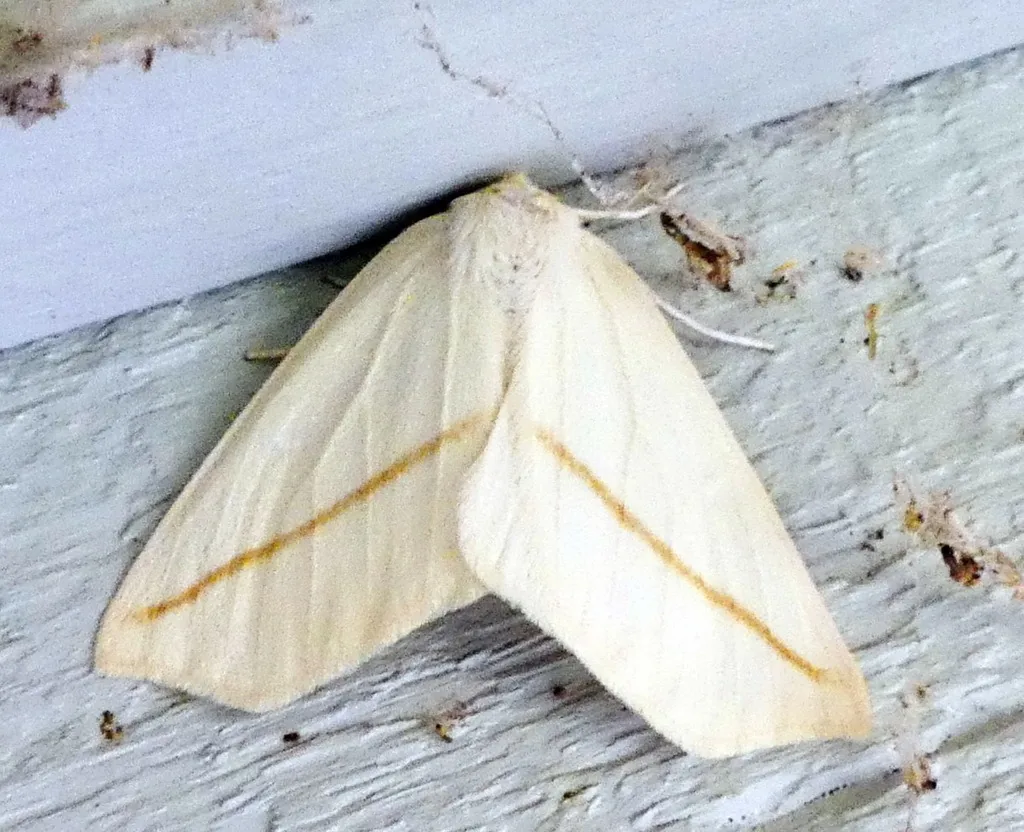
- The moth has creamy white wings with an oblique pale orange line and a wingspan of 1.5 to 2.0 inches; it often rests on dogwood bracts and May-apple blossoms.[1]
- The USDA Forest Service guides describe a black-brown to gray caterpillar with a flattened head held forward, long antennae and a conspicuously thickened second thoracic segment that can look quite angular at rest. Abdominal segments 4 and 5 each carry a pair of knobs on the back that may be joined by a ridge.[4][5]
- One especially reliable feature is the head coloring: the triangle on the face and the line down the middle are pale and abruptly bordered by a diffuse field of black that darkens over the top of the head.[4]
- A conspicuous black line runs down the middle of the back from the rear end forward to at least the eighth abdominal segment, and there is often a wavy black line above the first pair of prolegs.[4]
Look-alikes
| Look-alike | How to tell them apart |
|---|---|
| Yellow slant-line (Tetracis crocallata) | Its moth looks similar, but BAMONA says the white slant-line's forewing is paler, yellowish to cream, with an orangish line, and the hindwing is white; Ohio says only the white slant-line combines creamy white wings with an oblique pale orange line. The yellow slant-line caterpillar has a black crescent or U-shaped mark running up around the top of the head, smaller warts on abdominal segments 4 and 5 and a less conspicuous black stripe on the last segments.[3][1][4][5] |
| Large maple spanworm (Prochoerodes lineola) | Some color forms resemble slant-line caterpillars, but the second thoracic segment tends to be less swollen and the last abdominal segments are rarely marked with the black stripe down the middle.[4] |
| Variable antepione (Antepione thisoaria) | The USDA Forest Service geometroid guide notes its caterpillar can be similar to the white slant-line's; like it, its color is highly variable and the second thoracic segment is swollen.[4] |
Where it lives
Natural Resources Canada says it is generally distributed through the southern interior of British Columbia and occurs east to Nova Scotia and south to Florida; BAMONA gives Nova Scotia to Florida, west to Manitoba and Arkansas, and the USDA Forest Service geometroid guide gives it as transcontinental in Canada and south in the East to northern Florida and Arkansas, in forests and woodlands. GBIF holds about 3,300 U.S. records since 1990 from 36 state-level areas, the most from Massachusetts (482), New York (249), Pennsylvania (224) and Ohio (223).[2][3][4][6]
Biology and life cycle
Natural Resources Canada says its coniferous hosts are mainly Douglas-fir, tamarack and white spruce, with white birch, trembling aspen and many willows also main hosts; BAMONA lists ash, birches, cherry, elms, maples, oaks, pines, sheep laurel, sweetfern, willows and other trees and shrubs.[2][3]
In Canada the caterpillars are present from early June to late September, pupation runs from July to mid-August, and adults emerge in September or May.[2]
BAMONA gives the flight period as April to June. Ohio notes the moths often rest on dogwood bracts and May-apple blossoms.[3][1]
Ohio's field guide calls the caterpillar an extraordinary twig mimic.[1]
The USDA Forest Service geometroid guide lists alder, ash, basswood, birch, bittersweet, black gum, cherry, elm, fir, gale, hemlock, ironwood, larch, laurel, maple, ninebark, oak, pine, poplar, spruce, sweetfern, viburnum and willow as common hosts; the eastern forests guide adds that it feeds on many deciduous trees as well as pines and hemlocks.[4][5]
In Connecticut and Maryland there is essentially one generation, with mature caterpillars from late July to October. A small percentage of the pupae hatch in late summer and give a second brood, whose fate in Connecticut is unknown. It overwinters mainly as a pupa.[4]
At rest it holds all three pairs of legs tightly against the underside of the thorax. The guide's authors commonly find the caterpillars by beating foliage in August and September.[4]
Damage and signs
- Each caterpillar feeds alone and moves about freely on the leaves or needles. Natural Resources Canada rates it a relatively uncommon and innocuous defoliator.[2]
Health risk
It is a leaf and needle feeder. Natural Resources Canada, Ohio, BAMONA and the USDA Forest Service caterpillar guides don't mention any risk to people or pets.[2][1][3][4][5]
Control
Prevention
None of the sources gives a control step; the USDA Forest Service guides offer no control advice, and Natural Resources Canada calls it an innocuous defoliator.[2][1][3][4][5]
Where the sources disagree
Abundance: Ohio calls it one of the most abundant forest inchworm moths in the state, and the USDA Forest Service geometroid guide calls it very common in Connecticut and Maryland; Natural Resources Canada calls it relatively uncommon.[1][4][2]
Adult timing: Natural Resources Canada says adults emerge in September or May; BAMONA gives a flight period of April to June.[2][3]
Range: BAMONA's range reaches west only to Manitoba and Arkansas; Natural Resources Canada says it is generally distributed in the southern interior of British Columbia.[3][2]
Generations and caterpillar season: the geometroid guide gives essentially one generation in Connecticut and Maryland, with mature caterpillars from late July to October and a small second brood; the eastern forests guide gives caterpillars from June to November with 2 generations in the North; Natural Resources Canada gives early June to late September in Canada.[4][5][2]
Common questions
- What is the big brown inchworm that looks like a twig?
- The white slant-line is one candidate: a brown-to-grey inchworm up to 45 mm long with angular swellings behind the head, which Ohio's field guide calls an extraordinary twig mimic.[2][1]
- When will I see white slant-line caterpillars?
- In Canada the caterpillars are present from early June to late September; in Connecticut and Maryland mature caterpillars are found from late July to October.[2][4]
Sources
- Ohio Department of Natural Resources, Division of Wildlife, “Moths of Ohio Field Guide (Publication 5467).” dam.assets.ohio.gov/image/upload/ohiodnr.gov/documents/wildlife/backyard-wildlife/Moths%20of%20Ohio%20Field%20Guide%20pub5467.pdf (accessed 2026-11-13)
- Natural Resources Canada, Canadian Forest Service, “White slant-line, Trees, insects and diseases of Canada's forests.” tidcf.nrcan.gc.ca/en/insects/factsheet/9118 (accessed 2026-11-13)
- Butterflies and Moths of North America (BAMONA), “White Slant-line, Tetracis cachexiata.” www.butterfliesandmoths.org/species/Tetracis-cachexiata (accessed 2026-11-13)
- USDA Forest Service, Forest Health Technology Enterprise Team, “Geometroid Caterpillars of Northeastern and Appalachian Forests, FHTET-2001-10 (D. L. Wagner, D. C. Ferguson, T. L. McCabe and R. C. Reardon, September 2001; scanned copy).” archive.org/details/geometroidcaterp00wagn (accessed 2026-11-14)
- USDA Forest Service, Forest Health Technology Enterprise Team, “Caterpillars of Eastern Forests, FHTET-96-34 (D. L. Wagner, V. Giles, R. C. Reardon and M. L. McManus, November 1997; scanned copy).” archive.org/details/caterpillarsofea001997 (accessed 2026-11-14)
- Global Biodiversity Information Facility (GBIF), “Tetracis cachexiata: U.S. occurrence records since 1990 by state (GBIF occurrence API).” api.gbif.org/v1/occurrence/search?taxonKey=5144575&country=US&hasGeospatialIssue=false&occurrenceStatus=PRESENT&year=1990%2C2026&facet=stateProvince&facetLimit=400&limit=0 (accessed 2026-11-13). 3,280 records from 36 state-level areas; fetched 2026-11-13.
- Global Biodiversity Information Facility (GBIF), “Tetracis cachexiata Guenée (GBIF Backbone Taxonomy).” api.gbif.org/v1/species/5144575 (accessed 2026-11-13). ACCEPTED; order Lepidoptera, family Geometridae; vernacular name White Slant-line