On this page
How to identify it
- The caterpillar is elongate, up to about 32 mm (Natural Resources Canada) or 35 mm (USDA Forest Service). It is tan to rusty brown or yellowish and brownish, with variable body color, a dark brown stripe down the middle of the back and scattered dark warts.[1][2]
- The head is angular with a cleft top. The USDA guide describes it as dark brown with a light brown streak across the front and lighter brown lobes swollen and almost pointed; Natural Resources Canada describes it as gray with rust markings and a black frontal triangle.[2][1]
- The USDA guide notes a prominent swelling around the breathing hole (spiracle) on the third abdominal segment with a large dark bump below it; Natural Resources Canada notes parallel dark streaks on the back of the third and fourth abdominal segments.[2][1]
Where it lives
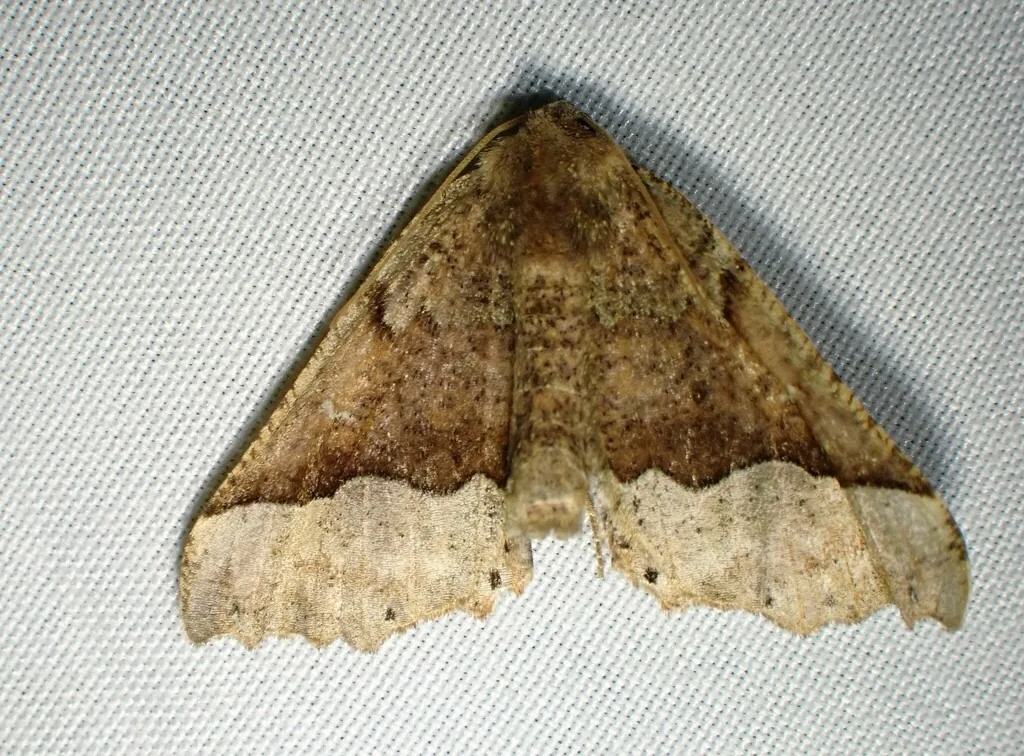
Natural Resources Canada says it is generally distributed throughout British Columbia south of the Skeena and Fraser drainages and occurs east to Newfoundland. A USDA Forest Service guide covers it among caterpillars on conifers in the northeastern United States. GBIF holds about 2,800 records, about 1,400 each from the US and Canada; its roughly 850 US records since 1990 come mostly from Massachusetts, Montana, Washington and Oregon.[1][2][4][5]
Biology and life cycle
Hosts are mainly conifers. The USDA guide lists balsam fir, eastern hemlock, eastern larch, pines and spruces and calls records from broadleaf trees and shrubs probably erroneous; Natural Resources Canada names Douglas-fir and western hemlock as principal hosts in British Columbia, with several spruces and firs, and also lists willow and alder.[2][1]
The pupa spends the winter in the soil or debris, according to the USDA guide.[2]
Both sources describe one generation a year. The USDA guide says mature caterpillars are present mainly in July and August; in British Columbia the moths emerge in July, caterpillars feed from July to September and pupate in September.[2][1]
Damage and signs
- The caterpillars feed alone on the foliage. Natural Resources Canada calls Morrison's pero an innocuous defoliator.[1]
Health risk
Natural Resources Canada and the USDA Forest Service guide describe it only as a conifer foliage feeder; no cited source describes any risk to people or pets.[1][2]
Control
Prevention
No control is suggested. Natural Resources Canada considers the species innocuous, and the USDA Forest Service guide covers only its identification and life cycle.[1][2]
Where the sources disagree
Hosts: Natural Resources Canada lists willow and alder among the hosts; the USDA Forest Service guide calls records of broadleaf trees and shrubs probably erroneous.[1][2]
Size and head: Natural Resources Canada gives mature larvae up to 32 mm with a gray head marked with rust; the USDA guide gives up to 35 mm and a dark brown head with a light brown streak across the front.[1][2]
Common questions
- What is the brown inchworm that looks exactly like a twig on my spruce?
- It could be Morrison's pero; a USDA Forest Service guide calls its caterpillar an excellent twig mimic and lists spruces, firs, eastern hemlock, eastern larch and pines as its foods.[2]
- Does Morrison's pero damage trees?
- Natural Resources Canada calls it a relatively uncommon, innocuous defoliator; each caterpillar feeds alone.[1]
Sources
- Natural Resources Canada, Canadian Forest Service, “Pero moth, Trees, insects and diseases of Canada's forests.” tidcf.nrcan.gc.ca/en/insects/factsheet/8972 (accessed 2026-11-13)
- USDA Forest Service, Forest Health Technology Enterprise Team, “Caterpillars on the Foliage of Conifers in the Northeastern United States, FHTET-2011-07.” www.fs.usda.gov/foresthealth/technology/pdfs/Caterpillars_FHTET-2011-07.pdf (accessed 2026-11-13)
- Global Biodiversity Information Facility (GBIF), “Pero morrisonaria (H.Edwards, 1881) (GBIF Backbone Taxonomy).” api.gbif.org/v1/species/5148719 (accessed 2026-11-13)
- Global Biodiversity Information Facility (GBIF), “Pero morrisonaria: occurrence records by country (GBIF occurrence search).” api.gbif.org/v1/occurrence/search?taxonKey=5148719&facet=country&facetLimit=20&limit=0 (accessed 2026-11-13)
- Global Biodiversity Information Facility (GBIF), “Pero morrisonaria: U.S. occurrence records since 1990 by state (GBIF occurrence search).” api.gbif.org/v1/occurrence/search?taxonKey=5148719&country=US&hasGeospatialIssue=false&occurrenceStatus=PRESENT&year=1990%2C2026&facet=stateProvince&facetLimit=400&limit=0 (accessed 2026-11-13)