On this page
How to identify it
- The caterpillar is an inchworm up to 35 millimeters (1.4 inches) long. Its body is yellow to light brown, with wavy rusty brown to gray lines on the back and a broken yellow line down the middle.[1]
- Along each side runs a broad yellow stripe, broken by brown patches around each breathing hole. The USDA Forest Service caterpillar guide says the pale areas may be gray, yellow or yellow-green; many forms have light patches running forward from the breathing holes on the front abdominal segments, sometimes edged above with a short slanted black line, and rarely these join into a broad, irregular band.[1][6]
- The head is pale brown with a dark herringbone pattern on each side, and each abdominal segment has a pair of dark bumps near its rear edge.[1]
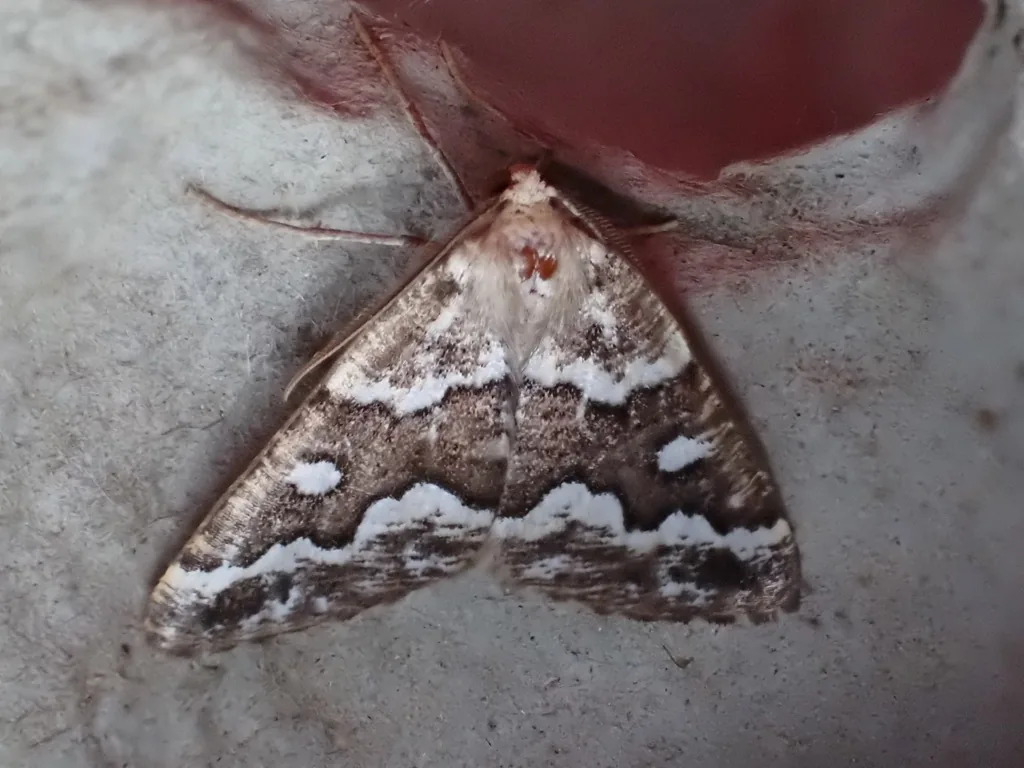
- The moth's forewing is dull grayish brown with brown shading along the front edge, black toothed lines accented with white, and a large white spot outlined in black. The wingspan is 2.7 to 3.8 cm.[2]
- Well-marked caterpillars have pale diamonds on the back of the front abdominal segments. The Forest Service guide says the warts and other texturing are more subdued than in the other two eastern Caripeta, and the grown caterpillar reaches 3.5 cm.[6]
- Caripeta caterpillars are variable and hard to tell apart. The Forest Service guide recommends rearing them to the moth stage whenever a positive identification is needed.[6]
Look-alikes
| Look-alike | How to tell them apart |
|---|---|
| Greenstriped forest looper | Also a solitary looper on western hemlock, Sitka spruce and other western conifers, but its grown caterpillar is green with broad whitish-green stripes along the back, an unmarked green head and prominent yellow spots at the breathing holes. The gray spruce looper is yellow to light brown with a herringbone-patterned head.[3][1] |
| Brown pine looper (Caripeta angustiorata) and northern pine looper (Caripeta piniata) | These relatives are found more often on pine. The Forest Service guide says a Caripeta inchworm on hemlock, spruce, fir or larch is very likely the gray spruce looper, and that the brown pine looper's pale patches on the back are less diamond-shaped, with the front half open and poorly defined.[6] |
Where it lives
Natural Resources Canada lists it in Canada, on eastern hosts such as balsam fir and black spruce and western ones such as Sitka spruce, shore pine, western hemlock and western redcedar. GBIF holds about 2,300 U.S. records since 1990 from 28 state-level areas, the most from Vermont (432), Maine (265), Oregon (178) and Alaska (159). The USDA Forest Service caterpillar guide gives coniferous forests across Canada and, in the East, south to Georgia in the mountains; the Forest Service's western manual calls it transcontinental in the northern United States and Canada.[1][4][6][7]
Biology and life cycle
Natural Resources Canada's main hosts are amabilis, balsam, grand and subalpine fir; black, Engelmann, Norway, Sitka and white spruce; jack and shore pine; tamarack; western hemlock; western redcedar; and Rocky Mountain Douglas-fir, with eastern white pine as a secondary host. BAMONA lists balsam fir, hemlock, spruces and white pine. The Forest Service caterpillar guide lists a wide range of conifers including fir, hemlock, larch, northern white cedar, pine and spruce; the western manual lists western hemlock, Douglas-fir, true firs, spruce, larch, western redcedar and pine.[1][2][6][7]
The pupa spends the winter. In Canada the moths fly in June and July, and each female lays up to 75 eggs on the host's needles. Caterpillars are present from July to mid-September and pupate in August.[1]
In Connecticut and Maryland there is one generation a year, with grown caterpillars from August to November, and the species is moderately common there. In British Columbia the western manual also gives one generation: eggs are laid in June, caterpillars are present until mid-October, and the pupae overwinter.[6][7]
Damage and signs
- The caterpillars feed alone and move about freely on the foliage, eating the needles. Natural Resources Canada describes it as common and occasionally destructive.[1]
Health risk
It is a conifer-feeding caterpillar. Natural Resources Canada and BAMONA don't mention any risk to people or pets. Nor do the USDA Forest Service caterpillar guide and western manual.[1][2][6][7]
Control
Prevention
Natural Resources Canada does not recommend any control for the gray spruce looper. Neither do the USDA Forest Service caterpillar guide and western manual.[1][6][7]
Where the sources disagree
White pine: BAMONA lists white pine among its hosts; Natural Resources Canada lists eastern white pine only as a secondary host.[2][1]
Name: Natural Resources Canada's page is titled gray spruce looper but its text calls it the grey forest looper. The USDA Forest Service western manual also calls it the gray forest looper.[1][7]
Caterpillar color: Natural Resources Canada says yellow to light brown; the USDA Forest Service caterpillar guide says the ground color varies from gray to brown and burnt red-brown; the western manual says yellowish and gray or brown with off-white or yellowish stripes.[1][6][7]
Caterpillar season: Natural Resources Canada gives July to mid-September in Canada; the western manual says caterpillars are present until mid-October in British Columbia; the caterpillar guide gives grown caterpillars from August to November in Connecticut and Maryland.[1][7][6]
Size: Natural Resources Canada and the caterpillar guide give grown caterpillars up to 35 mm (3.5 cm); the western manual says about 37 mm.[1][6][7]
Common questions
- What is the brown inchworm on my spruce in the fall?
- One candidate is the gray spruce looper. In Canada its caterpillars are present from July to mid-September; grown ones are yellow to light brown with wavy lines on the back and a pale brown head with a dark herringbone pattern. In the East, the USDA Forest Service guide says Caripeta inchworms on hemlock, spruce, fir or larch are very likely this species, with grown caterpillars from August to November in Connecticut and Maryland.[1][6]
- Is the gray spruce looper a serious pest?
- Only occasionally. Natural Resources Canada calls it a common and occasionally destructive defoliator that feeds alone rather than in groups.[1]
Sources
- Natural Resources Canada, Canadian Forest Service, “Gray spruce looper, Trees, insects and diseases of Canada's forests.” tidcf.nrcan.gc.ca/en/insects/factsheet/8496 (accessed 2026-11-14)
- Butterflies and Moths of North America (BAMONA), “Gray Spruce Looper, Caripeta divisata Walker.” www.butterfliesandmoths.org/species/Caripeta-divisata (accessed 2026-11-13)
- Natural Resources Canada, Canadian Forest Service, “Greenstriped forest looper, Trees, insects and diseases of Canada's forests.” tidcf.nrcan.gc.ca/en/insects/factsheet/1000022 (accessed 2026-11-13)
- Global Biodiversity Information Facility (GBIF), “Caripeta divisata: U.S. occurrence records since 1990 by state (GBIF occurrence API).” api.gbif.org/v1/occurrence/search?taxonKey=5144593&country=US&hasGeospatialIssue=false&occurrenceStatus=PRESENT&year=1990%2C2026&facet=stateProvince&facetLimit=400&limit=0 (accessed 2026-11-13). 2,341 records from 28 state-level areas; Vermont 432, Maine 265, Oregon 178, Alaska 159; fetched 2026-11-13.
- Global Biodiversity Information Facility (GBIF), “Caripeta divisata Walker, 1862 (GBIF Backbone Taxonomy).” api.gbif.org/v1/species/5144593 (accessed 2026-11-13). ACCEPTED; order Lepidoptera, family Geometridae
- USDA Forest Service, Forest Health Technology Enterprise Team (scan at Internet Archive), “Geometroid Caterpillars of Northeastern and Appalachian Forests, FHTET-2001-10 (D. L. Wagner, D. C. Ferguson, T. L. McCabe and R. C. Reardon, September 2001).” archive.org/details/geometroidcaterp00wagn (accessed 2026-11-14)
- USDA Forest Service (scan at Internet Archive), “Western Forest Insects (R. L. Furniss and V. M. Carolin, issued November 1977).” archive.org/details/CAT78702369 (accessed 2026-11-14)