On this page
How to identify it
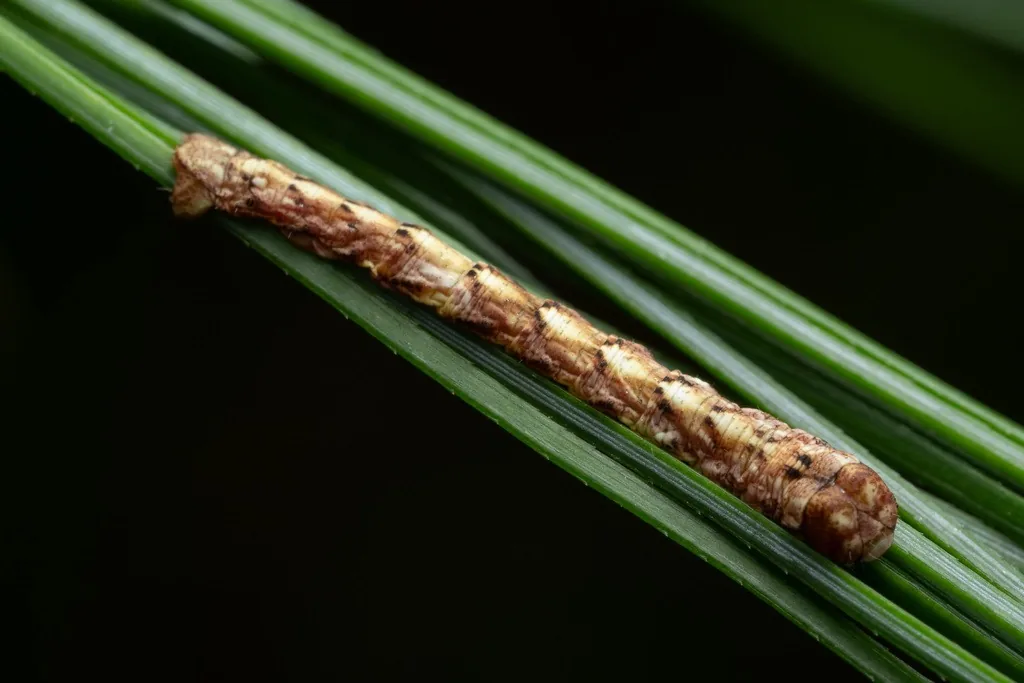
- The full-grown caterpillar is up to 27 mm long, with a light brown, dark-mottled head and a light reddish brown body marked with a pale yellow diamond pattern down the back and a black chevron on the back of each abdominal segment.[1]
- The caterpillars are free-living defoliators that feed on and move about freely on the foliage.[1]
- The USDA Forest Service guide describes the ground color as a mottle of green, yellow, tan, white, brown and black; some caterpillars carry a series of greenish or pale brown arrowhead marks down the back of the abdomen.[4]
- On the sides the black mottling is often heaviest around the breathing holes (spiracles), which are commonly white or pale brown with a black outer ring, and a pale patch often separates these dark areas. The eighth abdominal segment is slightly humped and often stamped with a small white spot.[4]
- Each side of the head is heavily mottled. The USDA guide gives mature caterpillars up to 3.5 cm long.[4]
Look-alikes
| Look-alike | How to tell them apart |
|---|---|
| Esther variant (Hypagyrtis esther) | Hypagyrtis is a taxonomically difficult genus. The USDA Forest Service authors treat the pine measuringworm as a northern species and the Esther variant as its replacement in barrens and coastal plain communities, south to Georgia and Texas; rearing records suggest pines are its preferred host, though both accept a broad range of conifers.[4] |
| One-spotted variant (Hypagyrtis unipunctata) | Possibly the most widely encountered inchworm in the East. Its ground color varies from green to gray, brick red or brown, it lacks the bumps of other bark-mimicking inchworms, and most individuals have a diffuse pale patch on the fifth abdominal segment.[4] |
Where it lives
Natural Resources Canada says it is generally distributed through the central and southern interior of British Columbia, from the upper Fraser and Peace drainages south, and occurs east to Newfoundland. GBIF holds about 260 U.S. records since 1990 from 22 state-level areas, the most from Massachusetts (53), Vermont (50), New York (33) and Minnesota (29). The USDA Forest Service guide describes its habitat as coniferous woodlands and forests and carries it south in the eastern United States to Maryland, the Great Lakes region and Georgia (in the mountains).[1][2][4]
Biology and life cycle
The principal hosts are Douglas-fir, western hemlock, Engelmann spruce and white spruce; other hosts include western larch, tamarack, lodgepole pine, western white pine, ponderosa pine, western redcedar and subalpine fir. The factsheet's host table also lists balsam fir, black spruce, eastern hemlock, eastern white pine, jack pine and red spruce.[1]
The caterpillar is the overwintering stage.[1]
In Canada the caterpillars resume feeding in spring and continue until June or July. They pupate in July and August, the moths emerge and lay eggs in the same months, and the eggs hatch soon after; the new caterpillars feed until early fall.[1]
The USDA Forest Service guide lists its common hosts as fir, hemlock, larch, pine and spruce.[4]
In all Hypagyrtis variants the caterpillar overwinters exposed on bark or foliage.[4]
In Connecticut and Maryland there are two generations, with mature caterpillars in May and June and again in July and August, and the species is locally common there.[4]
Damage and signs
- The caterpillars feed alone, moving freely over the foliage and eating needles. Natural Resources Canada calls it a common but innocuous defoliator.[1]
Health risk
It is a conifer needle feeder. Natural Resources Canada and the USDA Forest Service guide cover only its looks, hosts and seasons and don't mention any risk to people or pets.[1][4]
Control
Prevention
Natural Resources Canada regards it as an innocuous solitary defoliator and gives no control measures, and the USDA Forest Service identification guide suggests none either.[1][4]
Where the sources disagree
Size: Natural Resources Canada gives full-grown caterpillars up to 27 mm, while the USDA Forest Service guide gives mature larvae up to 3.5 cm.[1][4]
Season: Natural Resources Canada describes caterpillars feeding from spring to June or July and new caterpillars from late summer to early fall in Canada, while the USDA guide reports two generations in Connecticut and Maryland, with mature caterpillars in May and June and again in July and August.[1][4]
Common questions
- Does the pine measuringworm only eat pine?
- No. Natural Resources Canada's principal hosts are Douglas-fir, western hemlock, Engelmann spruce and white spruce, and it lists many other conifers, including larch, tamarack, redcedar and fir as well as pines.[1]
- Why do I see inchworms on my conifers in spring?
- One possibility is the pine measuringworm. It overwinters as a caterpillar exposed on the bark or foliage, and the caterpillars resume feeding in spring and continue until June or July.[1][4]
Sources
- Natural Resources Canada, Canadian Forest Service, “Pine measuringworm moth, Trees, insects and diseases of Canada's forests.” tidcf.nrcan.gc.ca/en/insects/factsheet/8808 (accessed 2026-11-14)
- Global Biodiversity Information Facility (GBIF), “Hypagyrtis piniata: U.S. occurrence records since 1990 by state (GBIF occurrence API).” api.gbif.org/v1/occurrence/search?taxonKey=1963874&country=US&hasGeospatialIssue=false&occurrenceStatus=PRESENT&year=1990%2C2026&facet=stateProvince&facetLimit=400&limit=0 (accessed 2026-11-13). 263 records from 22 state-level areas; Massachusetts 53, Vermont 50, New York 33, Minnesota 29; fetched 2026-11-13.
- Global Biodiversity Information Facility (GBIF), “Hypagyrtis piniata (Packard, 1870) (GBIF Backbone Taxonomy).” api.gbif.org/v1/species/1963874 (accessed 2026-11-13). ACCEPTED; order Lepidoptera, family Geometridae; vernacular name Pine Measuringworm
- USDA Forest Service, Forest Health Technology Enterprise Team (scan at Internet Archive), “Geometroid Caterpillars of Northeastern and Appalachian Forests, FHTET-2001-10 (D. L. Wagner, D. C. Ferguson, T. L. McCabe and R. C. Reardon, September 2001).” archive.org/details/geometroidcaterp00wagn (accessed 2026-11-14)