On this page
How to identify it
- Caterpillars are slender, smooth inchworms, mottled brown and gray with mottled stripes. The big head has brown and black spots, the three front pairs of legs are yellowish, and there are only two pairs of abdominal legs. Full grown, they reach about 1.2 inches (UMass) to 1 1/4 inches (NC State).[2][1]
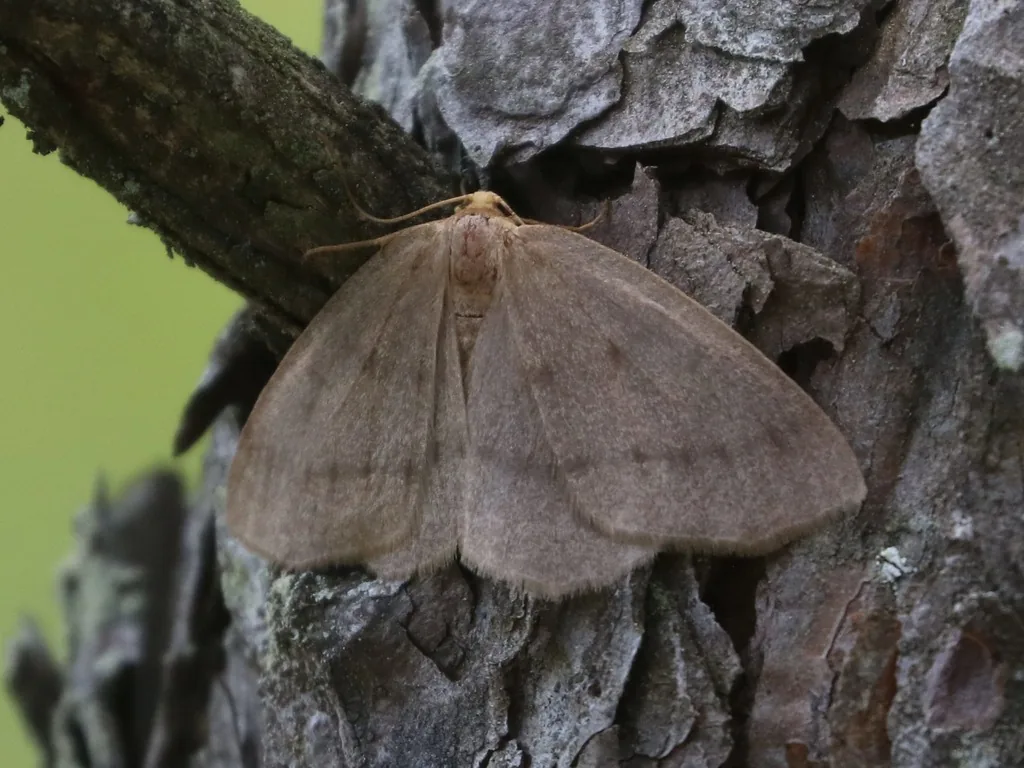
- Moths are mottled brown to gray with a darker line across the wing and a wingspan up to 1 1/2 inches. At rest they hold their wings in a broad triangle.[2][1]
- Eggs are oval and pale green, turning yellowish tan, and are laid in batches along the needles.[1][2]
Where it lives
A native insect. NC State says it occurs throughout North Carolina, and UMass reports outbreaks on Cape Cod and in eastern Massachusetts. It is also known as the yellow-headed looper.[2][1]
Biology and life cycle
Pupae spend the winter in leaf litter or soil under the host pines. Moths emerge in May and lay eggs into late June, and in outbreak years large flights show up in June.[1][2]
Caterpillars feed from late summer into fall: NC State says August to November, and UMass says feeding picks up in September and October, when heavy defoliation can occur. There's one generation a year.[2][1]
Hosts are pitch, red, shortleaf and other hard pines. NC State mentions a report of feeding on oak but doubts it.[1][2]
Damage and signs
- Young caterpillars chew notches in the needles, which then turn straw brown; older ones eat whole needles.[1][2]
- Usually too scarce to notice, but outbreaks have come about every 10 years on Cape Cod, with a big one in eastern Massachusetts in 1994. If heavy defoliation goes on for 2 or 3 years, the pines can die.[2][1]
Health risk
It eats pine needles. UMass and NC State describe it only as a pine defoliator and don't mention any risk to people or pets.[1][2]
Control
Prevention
Watch preferred hosts for browning needles after eggs hatch in May and June, especially where an outbreak is due. Heavier feeding may not show until late in the season.[1]
Biological control
Parasitoids, predators and diseases probably keep numbers down most years, but UMass says little is known about which ones matter in New England. It also knows of no cultural controls that work.[1]
Pesticides
On a small tree you can spray, NC State says one application of an insecticide labeled for caterpillars in home landscapes should clear the loopers. Pyrethroids are very toxic to fish, so keep them away from pools, ponds and streams.[2]
Is it a separate species?
UMass notes that some scientists question whether it differs from the spring hemlock looper, Lambdina athasaria, though for now it is treated as its own species.[1]
In a pheromone study, males of both loopers came only to the same lure blend, were trapped in the same hours after midnight and flew through June. The authors said this supports treating them as one species, pending more work.[3]
A mitochondrial DNA study found the two had essentially the same mtDNA and may be the same species. GBIF's backbone taxonomy still lists Lambdina pellucidaria as accepted.[4][5]
Where the sources disagree
When to look: UMass says to watch for browning needles after the eggs hatch in May and June, with feeding picking up in September and October; NC State says the loopers occur from August to November.[1][2]
How serious: UMass says it can at times be a serious defoliator; NC State says it is rarely abundant enough even to be noticed, though it has caused local defoliation.[1][2]
The pheromone evidence: UMass says females of both loopers respond to the same sex attractant; in the pheromone study it was males of both that came to the same lure blend.[1][3]
Common questions
- What inchworms are browning my pitch pine?
- Possibly eastern pine loopers. The young ones notch needles, which then turn straw brown.[1][2]
- Will eastern pine loopers kill my pine?
- Rarely. Most years there are too few to notice, but NC State says heavy feeding that goes on for 2 or 3 years can kill pines.[2][1]
Sources
- UMass Extension Landscape, Nursery and Urban Forestry Program (Landscape Insect & Mite Guide), “Lambdina pellucidaria (Pine Looper).” www.umass.edu/agriculture-food-environment/landscape/publications-resources/insect-mite-guide/lambdina-pellucidaria (accessed 2026-11-13)
- NC State Extension, “Eastern Pine Looper (PDIC Factsheet).” content.ces.ncsu.edu/eastern-pine-looper (accessed 2026-11-13)
- J Chem Ecol 2001;27(3):431-42, via PubMed, “Does pheromone biology of Lambdina athasaria and L. pellucidaria contribute to their reproductive isolation? (Duff et al., 2001).” pubmed.ncbi.nlm.nih.gov/11441437/ (accessed 2026-11-13)
- Insect Mol Biol 1999;8(1):97-106, via PubMed, “Mitochondrial DNA sequence variation among populations and host races of Lambdina fiscellaria (Sperling et al., 1999).” pubmed.ncbi.nlm.nih.gov/9927178/ (accessed 2026-11-13)
- Global Biodiversity Information Facility (GBIF), “Lambdina pellucidaria (Grote & Robinson, 1867) (GBIF Backbone Taxonomy).” api.gbif.org/v1/species/1962925 (accessed 2026-11-13)
- iNaturalist, “Lambdina pellucidaria taxon page (order and family).” www.inaturalist.org/taxa/222620 (accessed 2026-10-06)