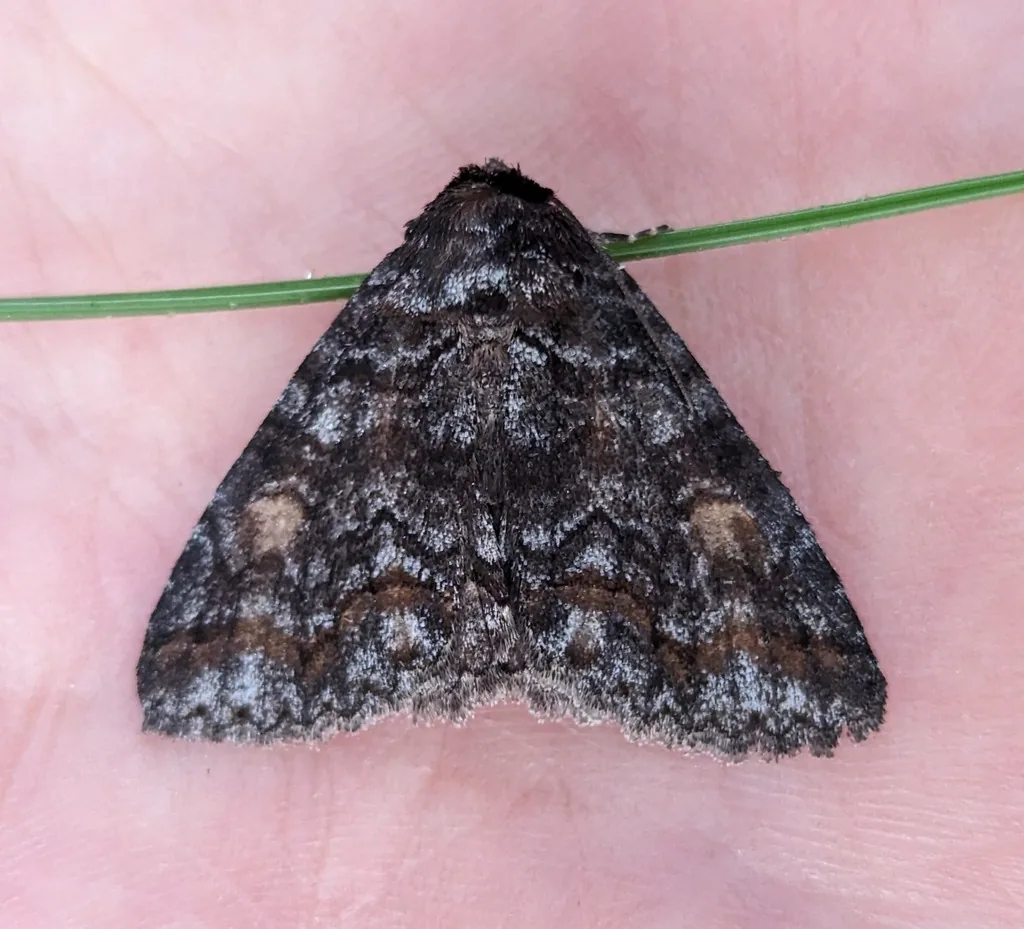
On this page
How to identify it
- The mature caterpillar reaches 35 millimeters. Its body is elongate and rusty brown (the most common color) to dark gray.[1]
- The head is mottled brown or gray, with a prominent white marking at the vertices.[1]
- A prominent pair of tubercles sits on top of the eighth abdominal segment, and a white to grayish-white Y mark lies along the midline at the rear edge of each abdominal segment.[1]
- The first two pairs of mid-abdominal prolegs are reduced in size.[1]
Where it lives
Natural Resources Canada records it from New Brunswick, Quebec, Ontario and western Canada. The Montana Field Guide reports 27 observations in the Montana Natural Heritage Program database. GBIF holds 578 U.S. records since 1990, led by Montana (72), Colorado (57) and Michigan (57).[1][2][3]
Biology and life cycle
Natural Resources Canada lists eastern white pine, jack pine, red pine and shore pine as main hosts.[1]
It overwinters as a pupa, and adults emerge in May.[1]
Larvae are present from June to August, feeding on and moving about freely on the foliage, and pupate in August.[1]
Damage and signs
- The caterpillars eat pine needles but are solitary feeders. Natural Resources Canada describes the species as a common, innocuous defoliator.[1]
Health risk
Natural Resources Canada describes it only as a pine defoliator and mentions no harm to people.[1]
Control
Prevention
Natural Resources Canada calls this caterpillar innocuous and gives no control recommendations.[1]
Where the sources disagree
Family: Natural Resources Canada places it in the Noctuidae, while BAMONA, the Montana Field Guide and the GBIF taxonomy place it in the Erebidae.[1][4][2][5]
Range: Natural Resources Canada lists only Canadian provinces, while GBIF's U.S. records since 1990 are led by Montana (72), where the Montana Field Guide reports 27 observations in the state's Natural Heritage Program database.[1][3][2]
Common questions
- What is the rusty brown caterpillar feeding on my pine needles in summer?
- One candidate is the pine false looper. Natural Resources Canada describes the mature caterpillar as up to 35 millimeters, rusty brown to dark gray, with a pair of tubercles on top of the eighth abdominal segment, present from June to August.[1]
- Does the pine false looper hurt pine trees?
- Natural Resources Canada describes it as a common, innocuous solitary defoliator.[1]
Sources
- Natural Resources Canada, Canadian Forest Service, “Pine zale, Trees, insects and diseases of Canada's forests.” tidcf.nrcan.gc.ca/en/insects/factsheet/10577 (accessed 2026-11-14)
- Montana Natural Heritage Program, “Pine False Looper Moth, Zale duplicata (Montana Field Guide).” fieldguide.mt.gov/speciesDetail.aspx?elcode=IILEY7P200 (accessed 2026-11-14)
- Global Biodiversity Information Facility (GBIF), “Zale duplicata: U.S. occurrence records since 1990 by state (GBIF occurrence search).” api.gbif.org/v1/occurrence/search?taxonKey=5112968&country=US&hasGeospatialIssue=false&occurrenceStatus=PRESENT&year=1990%2C2026&facet=stateProvince&facetLimit=400&limit=0 (accessed 2026-11-14)
- Butterflies and Moths of North America (BAMONA), “Zale duplicata (species account).” www.butterfliesandmoths.org/species/Zale-duplicata (accessed 2026-11-14)
- Global Biodiversity Information Facility (GBIF), “Zale duplicata Bethune, 1865 (GBIF Backbone Taxonomy).” api.gbif.org/v1/species/5112968 (accessed 2026-11-14)
- iNaturalist, “Zale duplicata taxon page (order and family).” www.inaturalist.org/taxa/233930 (accessed 2026-11-09)