On this page
How to identify it
- Feeding starts on buds and new needles in spring, about May. Partly eaten needles are webbed to branch tips and turn reddish brown, giving trees a scorched look that shows first in the upper crown.[1][2][3]
- Despite the name, balsam fir is the main host. Minnesota calls spruces moderately susceptible, while UMass lists white spruce with balsam fir as preferred hosts. The Forest Service says white, red and black spruce are suitable hosts and that spruce mixed with fir is more likely to be damaged than spruce in pure stands.[2][1][3]
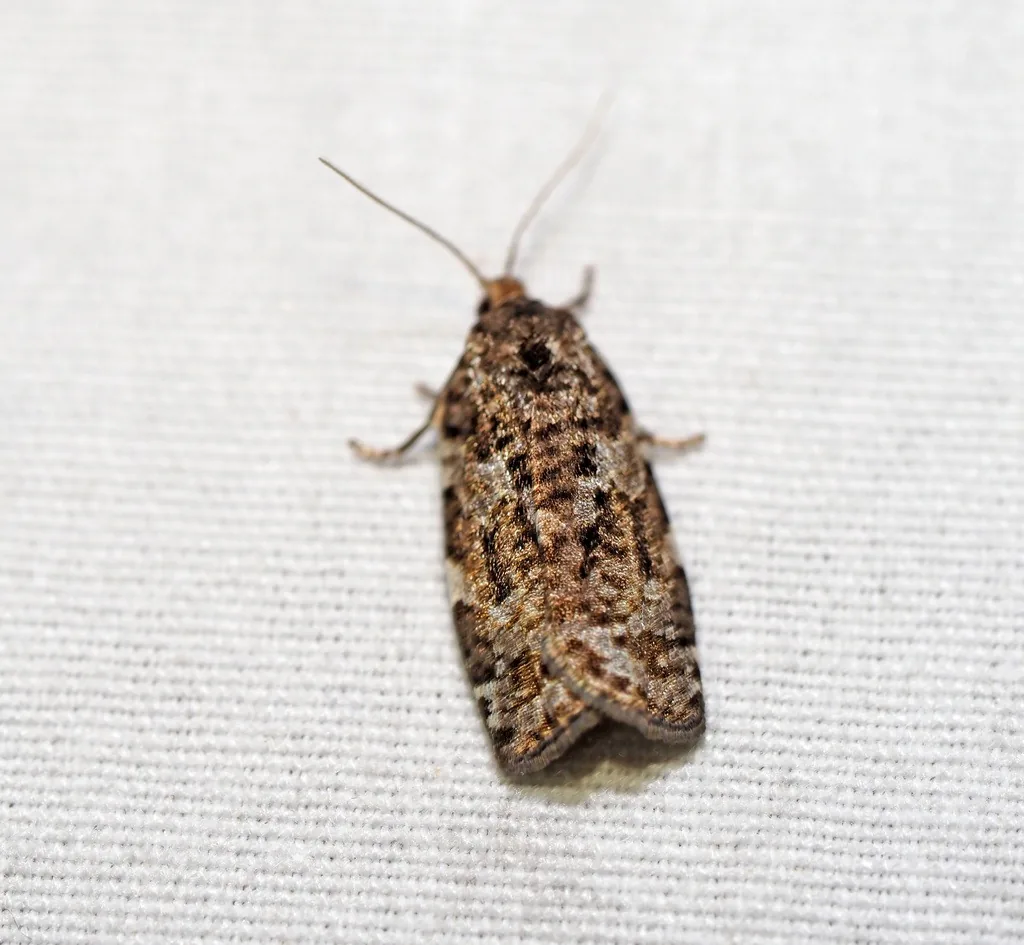
- Moths have a wingspan of about 2 cm and are usually grayish with dark brown markings. Grown caterpillars are about an inch (2.5 cm) long, dark brown with light spots along the back and a dark brown or black head.[3][1]
Look-alikes
| Look-alike | How to tell them apart |
|---|---|
| Western spruce budworm | Western spruce budworm is a related budworm of western conifers; the Forest Service gives the eastern species' range as the Northern States east of Montana, wherever its hosts grow.[1][3] |
Where it lives
Native across northern spruce-fir forests of the eastern US and Canada. The Forest Service names Maine, New Hampshire, New York, Michigan, Minnesota and Wisconsin as the states most often affected; UMass says in New England it is usually a concern only in the north, and Minnesota has seen budworm activity every year since at least 1954.[3][1][2]
Biology and life cycle
There is one generation a year. Sources describe egg laying differently: UMass says clusters of 10 to 150 eggs on needles from about July through August; the Forest Service says overlapping masses of 2 to 60, averaging about 20, on needle undersides near the buds; Minnesota says each moth lays up to 10 egg masses in July. Eggs hatch in 1 to 2 weeks (UMass) or about 2 weeks (Forest Service).[1][3][2]
Newly hatched larvae feed little, spin a silk shelter (hibernaculum) and overwinter in it as second instars. In spring, just before balsam fir buds break, they resume feeding on flower buds or old needles, then expanding buds and new shoots, tying shoot tips together with silk as they grow. They pupate in the webbing, and moths emerge from late June through mid-July.[1][3][2]
Sources give different travel distances: UMass says moths riding wind currents can disperse 50 miles, while the Forest Service says up to 10 miles or more, and hundreds of miles on storm fronts. Young larvae also drift on silk threads.[1][3][2]
Damage and signs
- It is one of the most important conifer defoliators in North America, and outbreaks recur: UMass says every 30 to 40 or 60 years, and Minnesota says every 30 to 40 years in eastern Canada and northern New England and every 25 to 40 years in the same Minnesota areas, where an outbreak typically lasts 8 to 10 years. UMass says the last major New England outbreak was in the 1970s and 1980s.[1][2]
- Minnesota says dead and dying trees near homes and buildings are a fire hazard and should be removed.[2]
- Sources differ on how fast trees die. The Forest Service says individual trees die after 1 or more years of heavy defoliation, depending on vigor; UMass says mortality is common after 4 or 5 consecutive years of severe defoliation; Minnesota says balsam fir usually dies after 3 to 4 years and white spruce after 5 to 7, and that whole stands rarely die.[3][1][2]
Health risk
The caterpillars feed on conifer buds and needles, and no cited source describes any risk to people or pets.[1][2][3]
Control
Prevention
In forests, avoid large areas of mature and overmature balsam fir and reduce reliance on fir; the Forest Service also suggests favoring less susceptible species. Minnesota says thinning healthy white spruce stands helps, but stands already in an outbreak won't respond.[1][3][2]
Otherwise, Minnesota says to keep yard trees healthy: protect the roots from damage, water during dry periods and mulch to hold soil moisture.[2]
Biological control
Parasitic wasps and flies, birds, spiders, disease and bad weather help regulate populations, but the Forest Service says several years of warm, dry springs can let an outbreak outrun these natural controls.[1][3]
Pesticides
Minnesota says yard trees can be sprayed to protect foliage: treat early, before needle feeding begins in June, and every year of an outbreak. Because the spray has to reach the tops of tall trees, homeowners usually struggle to get coverage, so it points to licensed applicators. Bacillus thuringiensis (Bt) has worked against moderate forest infestations (Minnesota, Forest Service), but the Forest Service says it did not protect foliage in extreme populations. Follow the label.[2][3]
Common questions
- Is spruce budworm a problem for my yard spruce?
- Usually not. UMass says it is rarely a concern on landscape trees unless a large regional outbreak is under way; during one, Minnesota says yard trees can be protected with early-season sprays, though reaching the tops of tall trees is hard.[1][2]
- How long do spruce budworm outbreaks last?
- Several years. Minnesota says an outbreak typically stays in an area for 8 to 10 years, and UMass says outbreaks can last several years; both say they recur every few decades.[2][1]
Sources
- UMass Extension Landscape, Nursery and Urban Forestry Program (Landscape Insect & Mite Guide), “Choristoneura fumiferana (Spruce Budworm).” www.umass.edu/agriculture-food-environment/landscape/publications-resources/insect-mite-guide/choristoneura-fumiferana (accessed 2026-11-13)
- University of Minnesota Extension (Forestry), “Eastern spruce budworm.” extension.umn.edu/natural-resources/forestry-and-wildlife/forestry/forest-pests-and-diseases/eastern-spruce-budworm (accessed 2026-11-13)
- USDA Forest Service (Forest Insect & Disease Leaflets), “Spruce Budworm in the Eastern United States (FIDL 160, January 1981).” www.fs.usda.gov/foresthealth/docs/fidls/FIDL-160-SpruceBudworm.pdf (accessed 2026-11-13)
- Global Biodiversity Information Facility (GBIF), “Choristoneura fumiferana (Clemens, 1865) (GBIF Backbone Taxonomy).” api.gbif.org/v1/species/5102666 (accessed 2026-11-13)