On this page
How to identify it
- The mature caterpillar is about 10 millimeters long. Its head is dark yellow with darker pigmentation on the sides; the shield behind the head, the tail plate and the legs are dark yellow, the body paler yellow, and there is no anal fork.[2]
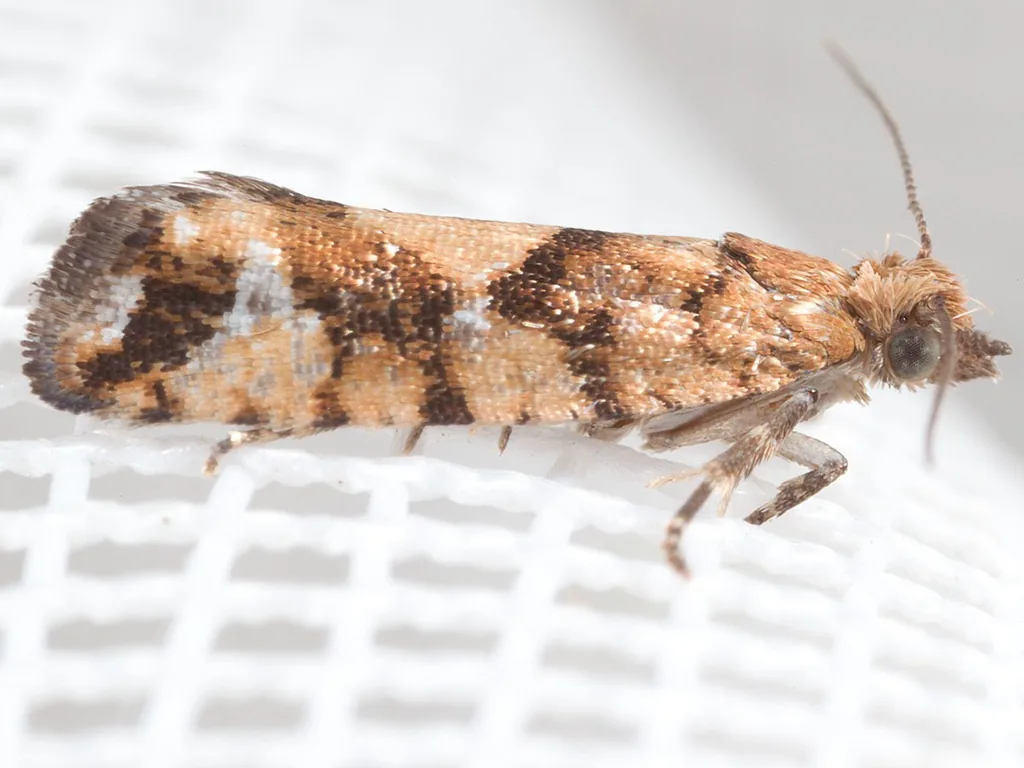
- The adult's head and thorax are orange-brown, and the forewing is orange-brown with irregular black and silver bands and, in most specimens, a distinct pale orange triangular mark at the middle of the inner margin. The hindwings are dark gray or brown.[2]
- The most obvious sign is the bud cap held on the tip of a new shoot with silk threads long after it would normally fall. Needles chewed along their edges or cut off at the base gradually turn reddish.[1]
- A second sign used to scout for it is multiple leaders and branches with many small branchlets in the upper crown.[1]
Look-alikes
| Look-alike | How to tell them apart |
|---|---|
| Eastern spruce budworm | Spruce bud moth damage is often confused with spruce budworm damage. The bud moth prefers open-growing spruce rather than spruce in forests.[1] |
| Zeiraphera ratzeburgiana | Before 1966 the spruce bud moth was thought to be this Palearctic species, which it very closely resembles. Adults can be told apart only by dissection, but larvae differ: Z. ratzeburgiana has an anal fork and Z. canadensis does not.[2] |
Where it lives
It is native to North America and was first reported in eastern Canada in 1938. The USDA APHIS identification tool says it is broadly distributed in the northern United States and Canada, from Nova Scotia and Maine west to Washington and Alaska, and that records from California and Colorado require verification. GBIF holds 23 U.S. records since 1990, 13 of them from Colorado.[1][2][3]
Biology and life cycle
White spruce is the preferred host, and it also feeds on black spruce, balsam fir and other Pinaceae; it has not been recorded on pine. Natural Resources Canada lists black and white spruce as main hosts.[2][1]
There is one generation a year. In New Brunswick, eggs are laid singly or, rarely, in groups of up to 20 in late July and early August between the scales at the base of the current year's growth. The eggs overwinter and hatch in May as white spruce buds begin to burst.[2]
First- and second-stage larvae mine the needles of newly burst buds; third- and fourth-stage larvae feed on the base of the needles and on the growing tissue, leaving a characteristic scar. There are four larval stages.[2]
After finishing development in June, larvae drop to the ground to pupate. Adults emerge about two to three weeks later and are active for a similar length of time.[2]
Baker's 1972 USDA Forest Service manual Eastern Forest Insects, written when the North American spruce bud moth was still called Zeiraphera ratzeburgiana, says young larvae feed singly in opening buds in spring or on tender terminal needles they web together. Some pupae are found on the foliage, but most lie just below the ground surface; winter is passed in the egg stage, and there is one generation a year.[7]
Damage and signs
- Young caterpillars feeding on shoot tips do little lasting harm. Older caterpillars do more, because they like the tender bark of twigs, and the weakened shoots can snap off in rain or strong wind.[1]
- The USDA APHIS identification tool calls it a major pest of spruce in North America, especially of young trees in plantations, and says feeding by older larvae can severely weaken and destroy stems.[2]
- It became very noticeable alongside the spruce budworm during the eastern Canadian outbreak of 1939 to 1958.[1]
Health risk
Natural Resources Canada and the USDA APHIS identification tool describe it only as a spruce-feeding caterpillar and mention no harm to people.[1][2]
Control
Prevention
Scout new spruce shoots in spring for bud caps still held on by silk at the tip, the main sign Natural Resources Canada uses to detect this insect. Neither Natural Resources Canada nor the USDA APHIS identification tool gives specific treatments.[1][2]
Where the sources disagree
Colorado: the USDA APHIS identification tool says records from Colorado require verification, yet 13 of GBIF's 23 U.S. records since 1990 come from Colorado.[2][3]
Hosts: Natural Resources Canada lists black and white spruce, BAMONA says species of spruce are reported as hosts, and the USDA APHIS identification tool adds balsam fir and other Pinaceae.[1][4][2]
Name: Natural Resources Canada lists Zeiraphera ratzeburgiana as a synonym, while the USDA APHIS identification tool treats it as a separate Palearctic species that the spruce bud moth was once mistaken for.[1][2]
Origin: Baker's 1972 Eastern Forest Insects, under the name Zeiraphera ratzeburgiana, called it an apparent introduction from Europe late in the 19th century; Natural Resources Canada calls the spruce bud moth native to North America, and the USDA APHIS identification tool says it was thought to be the Palearctic Z. ratzeburgiana until Mutuura and Freeman's 1966 revision.[7][1][2]
Caterpillar: Baker (1972) describes full-grown larvae as yellowish or grayish green and about 18 mm long; the USDA APHIS identification tool gives the mature caterpillar as approximately 10 mm, with a paler yellow body.[7][2]
Common questions
- Why are the little brown caps still stuck to the tips of my spruce's new growth?
- A bud cap that stays on the tip of a new shoot, held by silk threads, is the main sign of the spruce bud moth. Its small caterpillar feeds on the new needles of the shoot.[1][2]
- Why does my open-grown white spruce have several leaders?
- Natural Resources Canada lists multiple leaders and branches with many branchlets in the upper crown as one of two signs used to scout for the spruce bud moth, which prefers open-growing spruce. Check new shoots for bud caps held on with silk to confirm it.[1]
Sources
- Natural Resources Canada, Canadian Forest Service, “Spruce bud moth, Trees, insects and diseases of Canada's forests.” tidcf.nrcan.gc.ca/en/insects/factsheet/11208 (accessed 2026-11-14)
- USDA APHIS PPQ Identification Technology Program, “Zeiraphera canadensis (Tortricids of Agricultural Importance).” idtools.org/tortricid/index.cfm?packageID=1169&entityID=7018 (accessed 2026-11-14)
- Global Biodiversity Information Facility (GBIF), “Zeiraphera canadensis: U.S. occurrence records since 1990 by state (GBIF occurrence search).” api.gbif.org/v1/occurrence/search?taxonKey=1743694&country=US&hasGeospatialIssue=false&occurrenceStatus=PRESENT&year=1990%2C2026&facet=stateProvince&facetLimit=400&limit=0 (accessed 2026-11-14)
- Butterflies and Moths of North America (BAMONA), “Zeiraphera canadensis (species account).” www.butterfliesandmoths.org/species/Zeiraphera-canadensis (accessed 2026-11-14)
- Global Biodiversity Information Facility (GBIF), “Zeiraphera canadensis Mutuura & Freeman, 1967 (GBIF Backbone Taxonomy).” api.gbif.org/v1/species/1743694 (accessed 2026-11-14)
- iNaturalist, “Zeiraphera canadensis taxon page (order and family).” www.inaturalist.org/taxa/178547 (accessed 2026-11-09)
- USDA Forest Service (scan at Internet Archive), “Eastern Forest Insects, Miscellaneous Publication No. 1175 (W. L. Baker, 1972).” archive.org/details/easternforestins1175bake (accessed 2026-11-14)