On this page
How to identify it
- The full-grown caterpillar is reddish to cinnamon brown and about 8 mm long, with a light brown head and shield behind the head.[2]
- The moth is very small: Natural Resources Canada gives a wingspan of 10 to 13 millimeters, BAMONA 0.95 to 1.2 cm and Eastern Forest Insects 10 to 18 mm.[1][4][2]
- Look for clusters of several adjacent hollowed needles from the previous year's growth, loosely webbed together with silk. Natural Resources Canada also classes the caterpillar as a webworm that spins a silk shelter in which to hide or feed.[3][1]
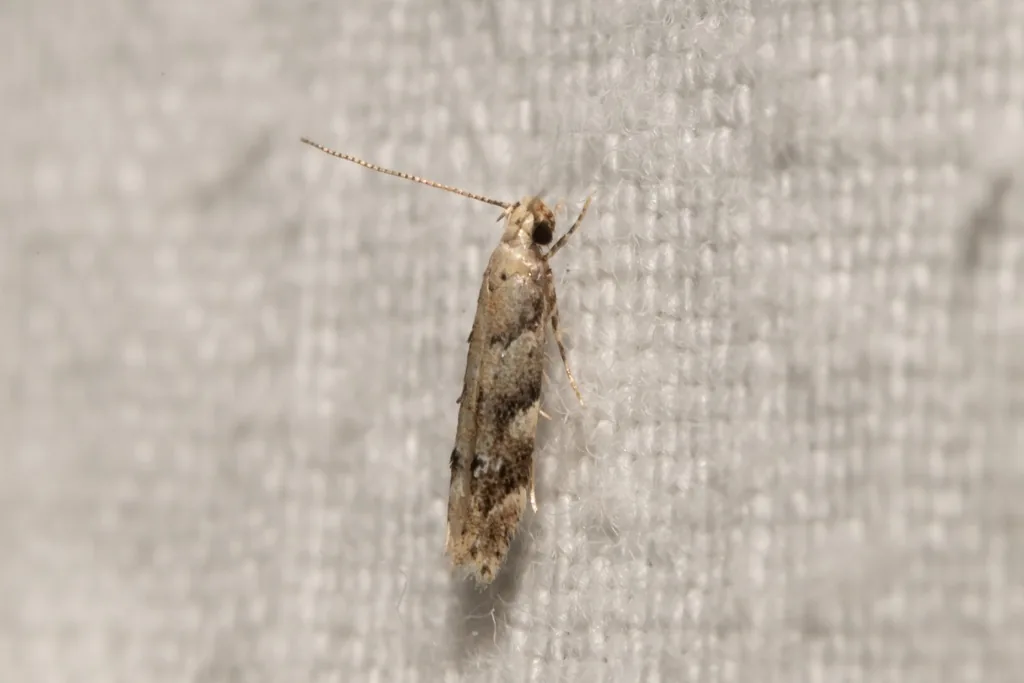
- The moth is light gray with a pale yellow to whitish head and thorax. Its forewings are buff or ochre near the base, shading to dusky at the tip, with dark gray diagonal crossbands and a few conspicuous black spots; the broad hindwings are gray with a silvery sheen.[2]
Look-alikes
| Look-alike | How to tell them apart |
|---|---|
| Spruce needleminer (Taniva albolineana) | Eastern Forest Insects separates it by the caterpillar: a flattened yellowish-brown head, pale greenish shields and a light greenish brown, semitransparent body sparsely clothed with hairs, rather than a reddish to cinnamon-brown body.[2] |
| European spruce needleminer (Epinotia nanana) | Another needle miner of Norway, white and Colorado blue spruce. Its caterpillar, also about 8 mm, has a blackish head, neck shield, legs and tail plate on a dirty white to reddish body.[2] |
Where it lives
Eastern Forest Insects says it occurs commonly from Maine to Colorado and from the Maritime Provinces to Alberta; Western Forest Insects gives Eastern Canada and New England to Alberta and Colorado. Natural Resources Canada records it in eastern Canada, and BAMONA gives southern Canada and from Colorado east through much of the northeastern United States. GBIF holds 54 U.S. records since 1990, led by Washington (9), Michigan (8) and Montana (7).[2][3][1][4][5]
Biology and life cycle
Eastern Forest Insects lists white, Colorado blue, Engelmann, Norway, red and black spruces as hosts, and BAMONA gives all spruce species. Natural Resources Canada lists balsam fir with black and white spruce as main hosts and shows larvae feeding on white spruce pollen.[2][4][1]
There is one generation a year. Moths are active from June to late July. Eggs are laid singly, or rarely two or three together, between the bases of the current year's needles, in needles or cones damaged by insects or other injury, or in spent pollen flowers.[2]
The caterpillars mine healthy needles, needles and cones damaged by other insects, spent pollen flowers and needles killed by late spring frost; Western Forest Insects also calls it a scavenger in cones and galls. They overwinter as caterpillars in mined needles.[2][3]
Damage and signs
Health risk
Natural Resources Canada, BAMONA and the USDA Forest Service manuals describe it only as a conifer-feeding caterpillar and mention no harm to people.[1][4][2][3]
Control
Prevention
None of the cited sources recommends a control for the orange spruce needleminer; the USDA Forest Service manuals say its damage is usually not very injurious and matters mainly on ornamentals.[1][4][2][3]
Where the sources disagree
Hosts: Natural Resources Canada lists balsam fir with black and white spruce as main hosts; Eastern Forest Insects and BAMONA list only spruces (BAMONA all spruce species, including blue spruce).[1][2][4]
Range: Natural Resources Canada records it in eastern Canada and BAMONA from Colorado east, but GBIF's U.S. records since 1990 are led by Washington (9) and Montana (7) along with Michigan (8).[1][4][5]
Wingspan: Natural Resources Canada gives 10 to 13 millimeters; BAMONA gives 0.95 to 1.2 cm; Eastern Forest Insects gives 10 to 18 mm.[1][4][2]
Common questions
- What makes spruce needles hollow and webbed with silk?
- Needle-mining caterpillars such as the orange spruce needleminer. Each caterpillar hollows out several neighboring needles from the previous year's growth and webs them loosely together, and it spends the winter inside a mined needle.[3][2][1]
- When are orange spruce needleminers active?
- The moths fly from June to late July. The caterpillars mine needles and pass the winter inside a mined needle, and there is one generation a year.[2][3]
Sources
- Natural Resources Canada, Canadian Forest Service, “Orange spruce needleminer, Trees, insects and diseases of Canada's forests.” tidcf.nrcan.gc.ca/en/insects/factsheet/8322 (accessed 2026-11-14)
- USDA Forest Service, “Eastern Forest Insects, Miscellaneous Publication 1175 (W. L. Baker, 1972; scanned copy).” archive.org/details/easternforestins1175bake (accessed 2026-11-14)
- USDA Forest Service, “Western Forest Insects, Miscellaneous Publication 1339 (R. L. Furniss and V. M. Carolin, November 1977; scanned copy).” archive.org/details/CAT78702369 (accessed 2026-11-14)
- Butterflies and Moths of North America (BAMONA), “Orange Spruce Needleminer, Coleotechnites piceaella (species account).” www.butterfliesandmoths.org/species/Coleotechnites-piceaella (accessed 2026-11-14)
- Global Biodiversity Information Facility (GBIF), “Coleotechnites piceaella: U.S. occurrence records since 1990 by state (GBIF occurrence search).” api.gbif.org/v1/occurrence/search?taxonKey=1851409&country=US&hasGeospatialIssue=false&occurrenceStatus=PRESENT&year=1990%2C2026&facet=stateProvince&facetLimit=400&limit=0 (accessed 2026-11-14)
- Global Biodiversity Information Facility (GBIF), “Coleotechnites piceaella (Kearfott, 1903) (GBIF Backbone Taxonomy).” api.gbif.org/v1/species/1851409 (accessed 2026-11-14)
- iNaturalist, “Coleotechnites piceaella taxon page (order and family).” www.inaturalist.org/taxa/217384 (accessed 2026-11-09)