On this page
How to identify it
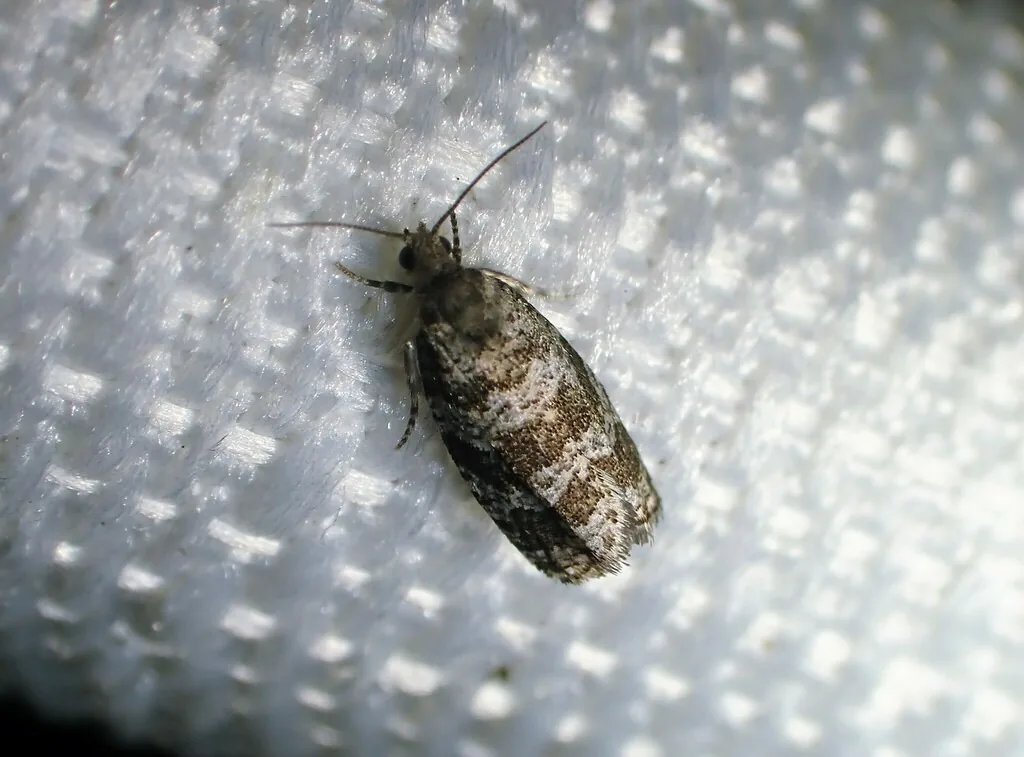
- Adult moths are small and brown, about 1/2 inch with wings spread, with three irregular gray-white bands on the forewings.[1]
- Clumps of brown, hollow needles webbed together with silk and frass are the key sign; with magnification, tiny exit holes show at the needle bases. South Dakota's forest health specialist notes the clumps often sit along interior whorls of branches and are easily missed until the outer branches are pulled aside.[1][2][3]
- Caterpillars are green to greenish brown, sometimes reddish brown, with a yellow or brown head, and reach about 1/4 inch.[1]
Where it lives
UMass says it occurs across much of the United States and Canada, while South Dakota's forest health specialist says the northern United States and southern Canada. UMass lists blue, Norway and white spruce as hosts in the Northeast and says Engelmann, blue and Sitka spruces may be more common hosts in the West; South Dakota calls it a particular problem on Colorado (blue) spruce.[1][4]
Biology and life cycle
Moths emerge in May and June and lay pale green eggs at the base of needles, usually 6 or 7 to a needle; Illinois says they're laid like shingles. Larvae chew into the needle base, hollow it out, cut it loose and move on until frost, each killing up to about 10 needles.[1][2]
Larvae spend the winter in hollowed needles or their webbed nests, feed again in spring and pupate in silk cocoons in the nests, by about mid-April according to UMass. Moths are most noticeable in the second half of June, and nests can be found from about July through the next spring.[1][2][4]
Damage and signs
- It prefers older needles. The damage is usually aesthetic and doesn't affect the tree's overall health, and large trees are very seldom killed. UMass says the whole crown of small trees is occasionally killed, and nursery-grown Black Hills spruce in New York has been seriously damaged.[1]
- On infested trees the lower branches can look more open than normal, because many needles are detached and webbed together.[3][1]
Health risk
It feeds inside spruce needles. UMass Extension, Illinois Extension and South Dakota's forest health program describe tree damage only and don't mention any risk to people or pets.[1][2][4][3]
Control
Traps and physical control
Prune out and destroy infested branches where practical, or wash the webbed needles out of the tree with a strong stream of water and then rake up and dispose of the fallen needles. South Dakota suggests the water treatment in early spring.[1][4][3]
Biological control
Little is known about its natural enemies. UMass says they probably keep numbers low, but the only record it cites is a single parasitic wasp in the genus Chelonus.[1]
Pesticides
Sources differ on spraying. UMass says chemical control may not be necessary because the damage is usually cosmetic. Illinois suggests an insecticide in early spring, and South Dakota's forest health specialist names a carbaryl foliage spray in April, just before the larvae become active, using a product labeled for this use.[1][2][3]
Common questions
Sources
- UMass Extension Landscape, Nursery and Urban Forestry Program (Landscape Insect & Mite Guide), “Taniva albolineana (Spruce Needleminer).” www.umass.edu/agriculture-food-environment/landscape/publications-resources/insect-mite-guide/taniva-albolineana-formerly-endothenia-albolineana (accessed 2026-11-13)
- University of Illinois Extension, “Spruce Needle Miners.” extension.illinois.edu/insects/spruce-needle-miners (accessed 2026-11-13)
- South Dakota Department of Agriculture and Natural Resources and SDSU Extension, “Tree Pest Alert, December 1-8, 2021 (Vol. 19, no. 39; John Ball).” danr.sd.gov/Conservation/Forestry/ForestHealth/Docs/TreePestAlerts-2021/December%201-8%202021.pdf (accessed 2026-11-13)
- South Dakota Department of Agriculture and SDSU Extension, “Pest Update, May 4, 2016 (Vol. 14, no. 13; John Ball, Forest Health Specialist).” danr.sd.gov/Conservation/Forestry/ForestHealth/Docs/TreePestAlerts-2016/05-04-2016.pdf (accessed 2026-11-13)
- Global Biodiversity Information Facility (GBIF), “Taniva albolineana (Kearfott, 1907) (GBIF Backbone Taxonomy).” api.gbif.org/v1/species/10002059 (accessed 2026-11-13)
- iNaturalist, “Taniva albolineana taxon page (order and family).” www.inaturalist.org/taxa/322119 (accessed 2026-10-06)