On this page
How to identify it
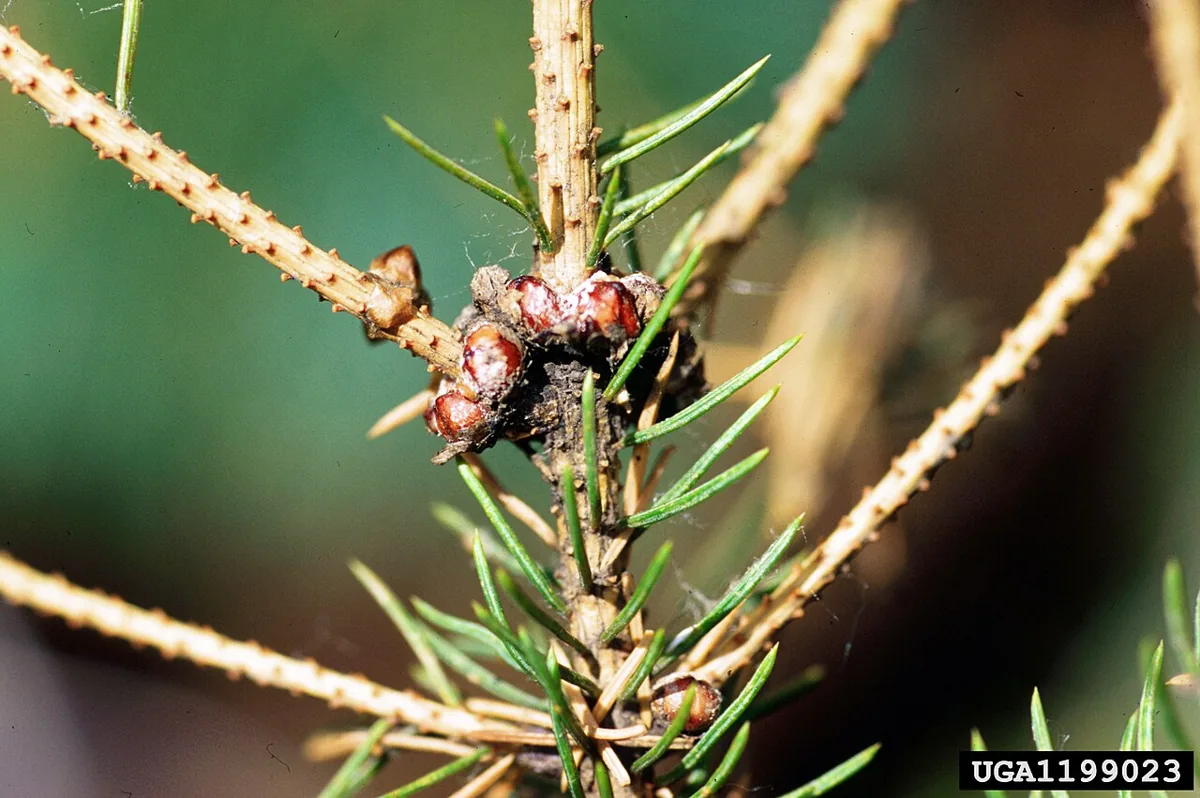
- Females are globular, about 1/8 inch, yellowish to reddish or dark brown with a light white dusting, often in groups of three to eight at the base of new growth.[1][2][3]
- Crawlers are tiny, about 3/64 inch, yellow-orange and wingless.[1]
- Signs include sticky honeydew and black sooty mold on the lower branches.[1][2][3]
Where it lives
Utah State lists spruce and occasionally pine as hosts; Illinois says it attacks mainly Norway spruce but also other spruces. Extension services in Utah, Illinois and Montana cover it.[1][2][3]
Biology and life cycle
Immatures overwinter on needles or bud scales and move to twigs in spring to finish developing. Utah State says they mature around May, and Montana State says mating happens in late spring.[1][2][3]
There is one generation a year. Crawlers hatch in June (Illinois), June to July (Montana State) or mid-June to late July (Utah State), settle on needles and later move to twigs.[2][3][1]
Utah State says females can reproduce without mating and lay their eggs beneath their bodies.[1]
Damage and signs
Health risk
It feeds on spruce, and no cited source describes any risk to people or pets.[1][2][3]
Control
Prevention
Keep trees healthy, including watering them, and monitor the lower branches for scales.[1][3]
Pesticides
Time contact sprays to crawler activity. Illinois suggests spraying when hills-of-snow hydrangea blooms and Montana State says late June; Utah State lists carbamate, horticultural oil, insecticidal soap, organophosphate and pyrethroid options. Follow the label.[2][3][1]
Sources differ on oil: Montana State suggests a dormant oil in early spring, while Illinois warns that summer oil turns blue spruce green and Montana State says oils can discolor needles.[3][2]
For a systemic option, Utah State suggests a neonicotinoid in spring after new needles expand, and Montana State names imidacloprid or dinotefuran in spring.[1][3]
Common questions
- Why are there little round 'buds' at the base of my spruce shoots?
- They may be spruce bud scales, which look very much like buds.[1][2][3]
- When should I treat spruce bud scale?
- Contact sprays target crawlers in early summer, from June into July depending on the source. Utah State and Montana State also describe systemic treatments in spring.[2][3][1]
Sources
- Utah State University Extension (Integrated Pest Management), “Spruce Bud Scale (Ornamental Pest Guide).” extension.usu.edu/planthealth/ipm/ornamental-pest-guide/arthopods/scales/spruce-bud-scale.php (accessed 2026-11-13)
- University of Illinois Extension, “Spruce Bud Scale.” extension.illinois.edu/insects/spruce-bud-scale (accessed 2026-11-13)
- Montana State University Extension (Urban IPM), “Spruce Bud Scale (Physokermes spp.) (insect fact sheet, Laurie Kerzicnik).” urbanipm.montana.edu/documents/entomology/fact_sheets/insect_fact_sheet_spruce_bud_scale.pdf (accessed 2026-11-13)
- Global Biodiversity Information Facility (GBIF), “Physokermes piceae (Schrank, 1801) (GBIF Backbone Taxonomy).” api.gbif.org/v1/species/7953772 (accessed 2026-11-13)