On this page
How to identify it
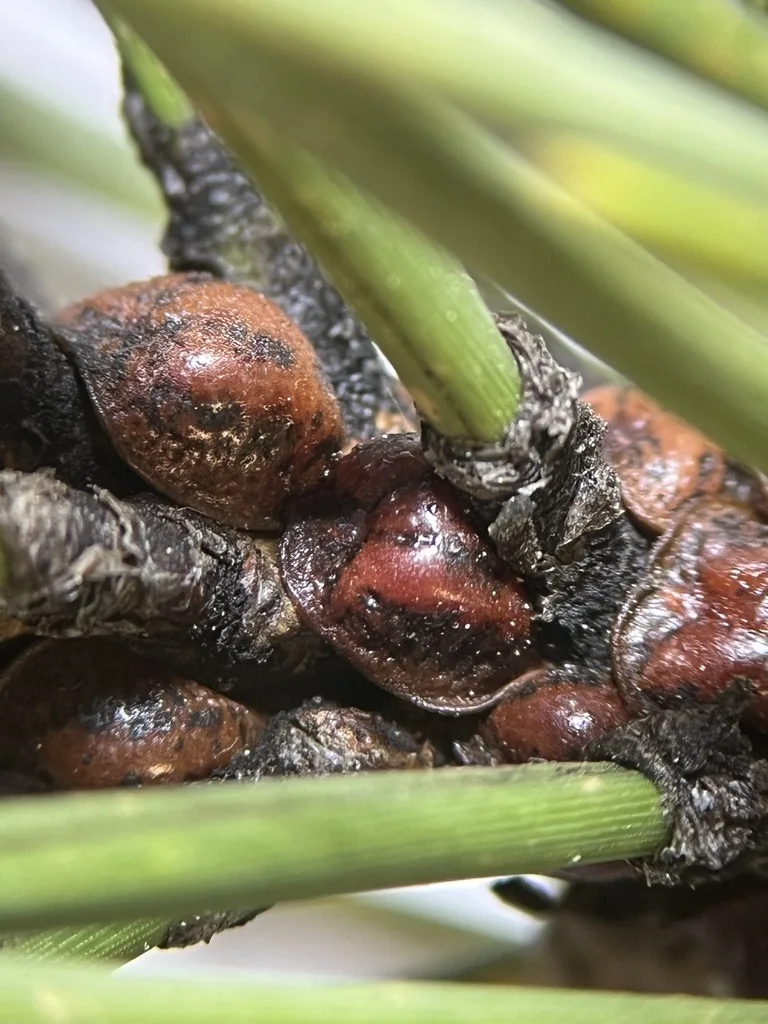
- Adult females are helmet-shaped, about 1/4 inch (6.3 mm) across and reddish brown with dark brown to black markings. Those on twigs are round and convex, which gives them their tortoise-shell look.[2][4][1]
- Females that settle on needles are a different shape: elongate, and only as wide as the needle.[4]
- Crawlers are red. Once they settle on a twig they start forming a white crystalline coating on their bodies.[2][1]
- Males develop inside white pupal cases on the branch tips. The small winged males have no working mouthparts, can't feed and die soon after mating.[2][1][5]
- Check the newest growth first. Kansas State finds the females on the terminal growth of branches, and in Italy more scales turned up on twigs than on needles.[2][3][6]
Look-alikes
| Look-alike | How to tell them apart |
|---|---|
| Striped pine scale | A close relative that is commonly confused with it, with similar life history, hosts and controls. Striped pine scale females carry one or more cream stripes down the middle of the back.[7] |
| Pine needle scale | A white to grayish-white scale about 1/8 inch long that always sits on the needles. It is an armored (hard) scale and produces no honeydew.[7][8] |
Where it lives
Native to North America. NC State gives its natural range as the Dakotas east to the Atlantic and south to Florida; the California Department of Food and Agriculture says it is native to the eastern United States, from most states east of the Mississippi west to North Dakota, Colorado and Texas, and to Canada and Mexico. It has become a pest along much of Colorado's Front Range. It has been introduced to the Caribbean and Europe, where EFSA reports it in Italy since 2014 and France since 2021, and California found it on stone pines in San Diego County in September 2021. Kansas State reports one generation a year in Kansas, and NC State says it can be particularly severe on Virginia pine in North Carolina.[1][4][7][3][2]
Biology and life cycle
It spends the winter as immature, fertilized females on the branches. In spring the females mature and lay eggs under their bodies, and crawlers emerge from beneath them: April to May in North Carolina, early to midsummer in Kansas, and late June and July in Illinois.[1][2][5]
The number of generations depends on climate: one a year in Kansas, Illinois and the north, two to three in North Carolina, three in southern Italy and five or more in tropical areas. Overlapping generations mean several stages can be on a tree at once.[1][5][2][4][3]
Kansas and Illinois Extension put it at up to 500 eggs or crawlers per female. In Italy EFSA reports up to 1,014 eggs per female, averaging 199 for the summer generation and 730 for the overwintering one.[2][5][3]
Crawlers spread by walking, on wind currents and on the feet of birds, and the scale travels much farther on pine nursery stock.[2][3]
Damage and signs
- Hosts are mainly Scots, jack, Austrian and red pines, Virginia pine and several southern pines; eastern white pine is generally not attacked. In Europe stone pine has been hit hardest.[1][5][3]
- Feeding yellows the needles and stunts their growth. The copious honeydew grows black sooty mold that can make a tree look covered in soot, and wasps, bees, flies and ants come to feed on it.[2][1][4]
- Young trees are more susceptible than older ones, and foliage close to the ground tends to carry the most scales. On Christmas tree farms the sooty mold can leave trees unmarketable.[2][5][1]
- Outside its native range it has been far more destructive. It killed most of the Caicos pines in the Turks and Caicos Islands in just over a decade, causing 95% tree mortality across large areas of the Caribbean, and it is contributing to the decline and death of stone pines in Europe.[9][4][3]
Health risk
These extension and agency sources treat it only as a pest of pines; none mentions any risk to people or pets.[1][5][2]
Control
Prevention
Scout from May through June for the red crawlers: hold a white sheet of paper on a clipboard under a branch, shake the branch, and watch for moving specks with a 10- or 16-power hand lens. Don't wait for honeydew to appear before acting.[2][1]
Traps and physical control
Remove heavily infested branches so crawlers don't spread to nearby trees, and a high-pressure water spray once a week dislodges crawlers and mature females.[2]
Biological control
Parasitoids and predators attack it but generally don't hold it below damaging levels. Controlling ants helps, because ants tending the honeydew kill the scale's natural enemies, and repeated use of one insecticide or of broad-spectrum products can make scale problems worse.[2][1]
Pesticides
Mature females resist sprays because of their hard covering, so target the crawlers with a thorough, high-pressure application that reaches the inner canopy. The first spring generation is the best target, because crawlers emerge most evenly then; Illinois times the first spray to Vanhoutte spirea bloom, with follow-ups.[1][5][2]
Horticultural oil or insecticidal soap in late fall or early spring, before bud break, targets overwintering females and usually spares beneficial insects. Illinois warns that a summer oil may discolor needles.[1][2][5]
Where sources disagree
Native range: NC State limits it to the Dakotas east to the Atlantic and south to Florida, while the California Department of Food and Agriculture extends it west to Colorado and Texas and into Canada and Mexico.[1][4]
Whether it kills trees: NC State says it usually doesn't, although it can. Kansas State says extensive infestations can kill branches and even mature Christmas trees, and EFSA lists tree mortality among the effects of large populations.[1][2][3]
Where it overwinters: NC State and Kansas State describe immature females on the branches, EFSA says adult females overwinter on the needles in Italy, and the California sheet says females overwinter under the bark in temperate areas.[1][2][3][4]
Research from Italy
In a trial at the Ostia Antica archaeological park near Rome, abamectin injected into the trunks of infested stone pines significantly cut adult female numbers and stayed active in the trees for about 60 days. The authors present trunk injection as an option for public areas because it avoids spray drift.[6]
Common questions
- Why are my pine needles turning black?
- Black sooty mold growing on honeydew is a common cause, and pine tortoise scale produces a lot of it on Scots, Austrian and other pines. Look for brown, helmet-shaped scales on the newest twigs.[1][2][5]
- When should I spray for pine tortoise scale?
- When crawlers are out: April to May in North Carolina, early to midsummer in Kansas, late June to July in Illinois. Confirm with the white-paper shake test before spraying.[1][2][5]
- Will pine tortoise scale kill my pine?
- Usually not in its native range, but heavy infestations can kill branches and sometimes whole trees, and young trees are hit hardest.[1][2]
Sources
- NC State Extension, “Pine Tortoise Scale (PDIC Factsheet).” content.ces.ncsu.edu/pine-tortoise-scale (accessed 2026-11-12)
- Kansas State University Research and Extension, “Pine Tortoise Scale: Insect Pest of Christmas Trees (MF3554, December 2020).” bookstore.ksre.ksu.edu/pubs/MF3554.pdf (accessed 2026-11-12)
- EFSA Journal, via PubMed, “EFSA Panel on Plant Health (2022), Pest categorisation of Toumeyella parvicornis.” pubmed.ncbi.nlm.nih.gov/35281635/ (accessed 2026-11-11)
- California Department of Food and Agriculture, Plant Pest Diagnostic Laboratory, “Pine tortoise scale (Toumeyella parvicornis) Pest Fact Sheet (April 2025).” www.cdfa.ca.gov/plant/ppd/PDF/pinetortoisescale.pdf (accessed 2026-11-12)
- University of Illinois Extension, “Pine Tortoise Scale.” extension.illinois.edu/insects/pine-tortoise-scale (accessed 2026-11-11)
- Pest Management Science, via PubMed, “Di Sora, Rossini, Contarini, Chiarot and Speranza (2022), Endotherapic treatment to control Toumeyella parvicornis infestations on Pinus pinea.” pubmed.ncbi.nlm.nih.gov/35306750/ (accessed 2026-11-11)
- Colorado State University Extension, “Scale Insects Affecting Conifers (Fact Sheet 5.514).” extension.colostate.edu/resource/scale-insects-affecting-conifers/ (accessed 2026-11-12)
- Kansas State University Research and Extension, “Scale Insect Pests (MF3457, July 2019).” bookstore.ksre.ksu.edu/pubs/MF3457.pdf (accessed 2026-11-11)
- Plant Diversity, via PubMed, “Sanchez, Manco, Blaise, Corcoran and Hamilton (2019), Conserving and restoring the Caicos pine forests: the first decade.” pubmed.ncbi.nlm.nih.gov/31193154/ (accessed 2026-11-11)
- iNaturalist, “Toumeyella parvicornis taxon page (order and family).” www.inaturalist.org/taxa/454676 (accessed 2026-10-06)