PestControlLibrary
Menu

Black Pineleaf Scale

Dynaspidiotus californicus (formerly Nuculaspis californica)[3]

Black pineleaf scale is a small native armored scale insect that feeds on the needles of pines and Douglas-fir.[1][2]

Group
Insect
Order
Hemiptera
Family
Diaspididae
US range
2 states in sources
Sources
3 cited
Updated
2026-11-12
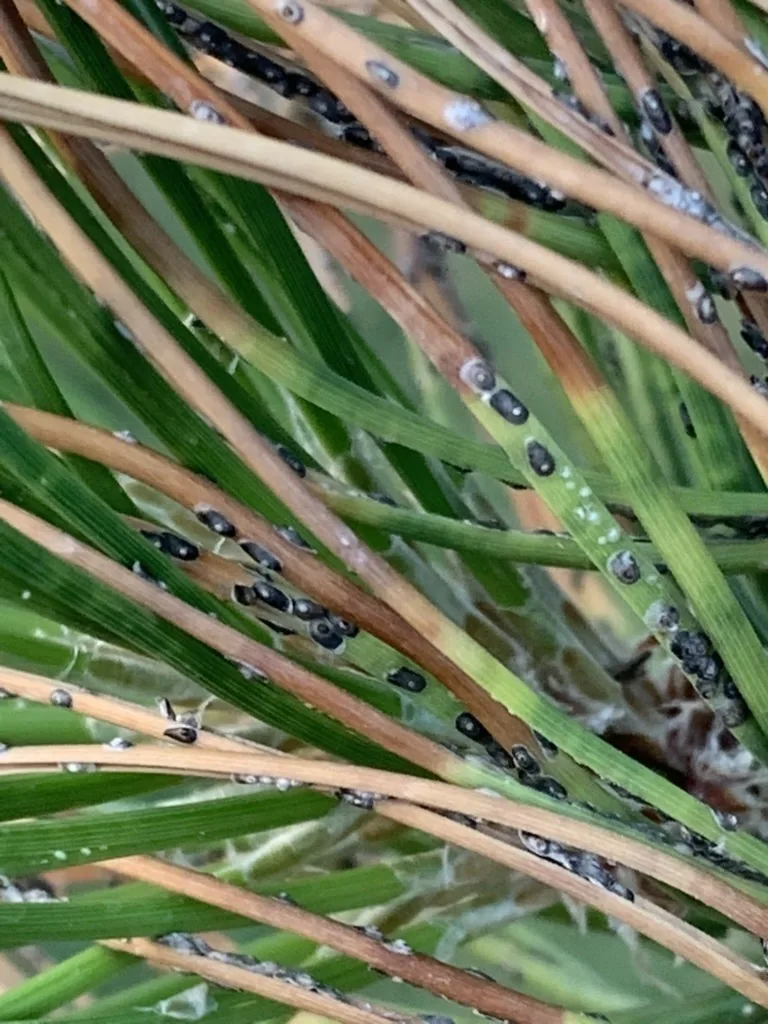
Black pineleaf scales, small black ovals, on pine needles
Black pineleaf scales, small black ovals, on pine needles. (c) Hunter Hickok, some rights reserved (CC BY) — via iNaturalist, CC BY 4.0
On this page
  1. Identification
  2. Where it lives
  3. Biology
  4. Damage and signs
  5. Health risk
  6. Control
  7. Related profiles
  8. Common questions
  9. Sources

How to identify it

  • Adult covers are about 5/64 inch, gray to black and oval; crawlers are yellow-orange and about 3/64 inch.[2]
  • Scales sit on the face of needles and between paired needles, so they are hard to see.[1]

Where it lives

Native to the United States, Mexico and Canada; severe infestations are mostly a problem in western North America. Extension guides from Massachusetts (UMass) and Utah (Utah State) cover it.[1][2]

US map: states named in the cited sources or covered by their state extension guides.

Biology and life cycle

UMass reports one generation in the Northeast and two or three in warmer climates; Utah State has mating in June and eggs in late June and early July.[1][2]

Females produce about 40 eggs or live crawlers over a long period, and immature scales overwinter.[1][2]

Damage and signs

  • Feeding leaves yellow blotches on needles and thins crowns; heavy infestations cause needle drop and can kill trees.[1][2]
  • Common on Austrian, Scotch and mugo pines and Douglas-fir; stressed trees, such as those along dusty roads or with compacted, dry soil, are hit hardest.[1][2]

Health risk

None to people or pets.[1][2]

Control

Prevention

Correct tree stresses such as drought, soil compaction and root damage, which make infestations worse.[1]

Biological control

Parasitic wasps such as Coccobius and Encarsia attack it.[1]

Common questions

Why are my pine needles yellow-blotched with tiny black specks?
Black pineleaf scale is a likely cause.[1][2]

Sources

  1. UMass Extension Landscape, Nursery and Urban Forestry Program (Landscape Insect & Mite Guide), “Dynaspidiotus californicus (Black Pineleaf Scale).” www.umass.edu/agriculture-food-environment/landscape/publications-resources/insect-mite-guide/dynaspidiotus-californicus-formerly-nuculaspis-californica (accessed 2026-10-16)
  2. Utah State University Extension (Integrated Pest Management), “Black Pineleaf Scale (Ornamental Pest Guide).” extension.usu.edu/planthealth/ipm/ornamental-pest-guide/arthopods/scales/black-pineleaf-scale.php (accessed 2026-10-16)
  3. iNaturalist, “Dynaspidiotus californicus taxon page (order and family).” www.inaturalist.org/taxa/1037819 (accessed 2026-10-06)

Updated 2026-11-12. Built from sourced records. Spot an error? Tell us.