On this page
How to identify it
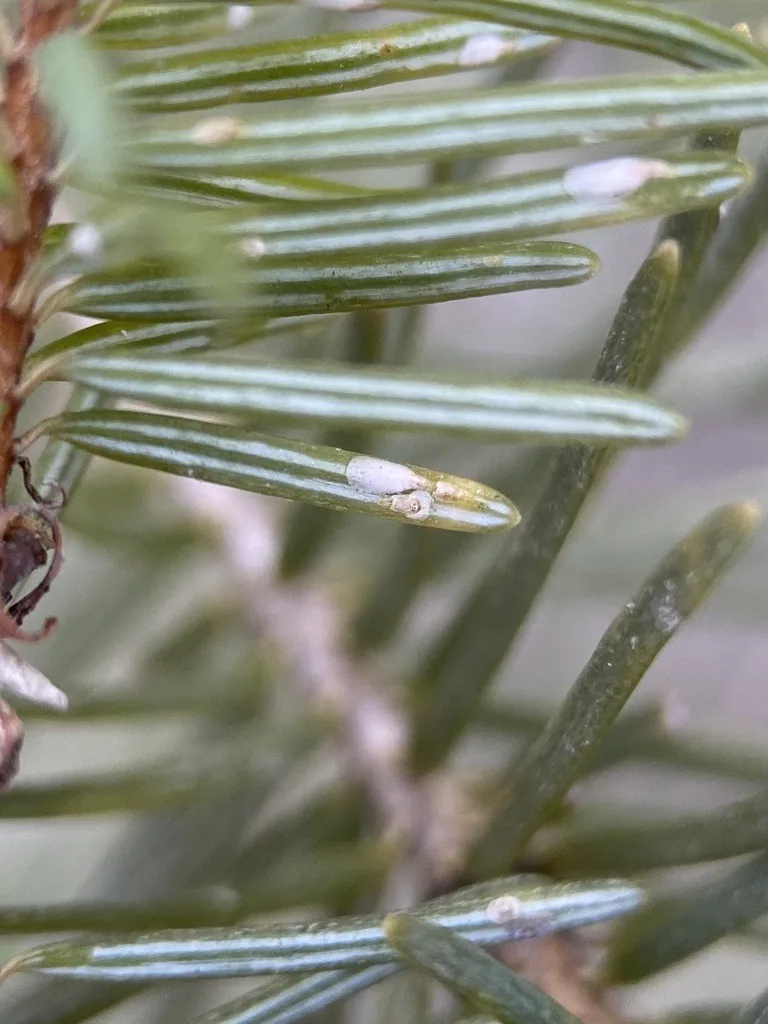
- Female covers are white, oval to oyster-shell shaped and about 1/8 inch (3 mm) long; Penn State notes a yellow tip at the narrow end. Male covers are smaller, about 2 mm.[1][3][4]
- Unlike most armored scales, they're easy to see, white against green needles. Penn State says severe infestations make a tree look whitewashed.[1][3]
- Eggs under the female cover are reddish, and so are the crawlers. Adult males are tiny and winged; Penn State says they look like small parasitic wasps.[3][2][4]
Look-alikes
| Look-alike | How to tell them apart |
|---|---|
| Other scale insects | Scale species differ in timing, so identify the species to know when crawlers are active.[1] |
| Black pineleaf scale | Black pineleaf scale is black with gray edges and smaller, 1/12 to 1/10 inch, instead of white.[1] |
| Pine scale (Chionaspis heterophyllae) | UMass says this close relative can't be told apart from pine needle scale in the field.[4] |
Where it lives
It is native to North America, and UMass notes it has become invasive in parts of Europe. Hosts include mugo, Austrian, red, Scots and eastern white pine, most spruces, Douglas-fir, firs, hemlock and cedars. NC State says mugo and Scots pine suffer most.[4][3][1][2]
Biology and life cycle
Eggs spend the winter under the dead mother's cover. Penn State and NC State say a female lays up to 40, UMass up to 100. They hatch in mid to late May in Minnesota and Pennsylvania.[1][3][2][4]
Crawlers settle on needles and form their covers, and they can blow on the wind to new trees. Sources differ on generations: Minnesota Extension says one a year there, while Penn State and UMass describe a second, with crawlers from late July into September in Massachusetts. UMass says areas farther north may have only one.[1][3][4][2]
UMass says some populations reproduce without males.[4]
Damage and signs
- Light to moderate feeding yellows needles and makes them drop. Minnesota says heavy, lasting infestations that cut vigor are uncommon. NC State says heavily infested pines turn sickly yellow, drop needles early and die back, and UMass says lower branches die first.[1][2][4]
- It does the most harm in ornamental plantings, nurseries and Christmas tree farms, and UMass says trees near dusty roads are more likely to be attacked.[2][3][4]
Health risk
It feeds on conifer sap. Minnesota, Penn State, NC State and UMass Extension describe tree damage only and don't mention any risk to people or pets.[1][3][2][4]
Control
Prevention
Shake branches over white paper or a plate, or wrap double-sided tape around twigs, and check weekly for the reddish crawlers. Penn State suggests checking in April and July, and UMass says to inspect at least twice a season, starting with the lower branches.[1][3][4]
NC State says light infestations aren't worth treating. When planting Scots pine, UMass reports 'Riga' and 'Pike Lake Improved' are attacked more than 'Belgium' and 'Land O'Pine'.[2][4]
Traps and physical control
Prune out heavily infested branches.[4]
Biological control
Natural enemies usually keep numbers low. Lady beetles and tiny parasitic wasps are the main ones; UMass lists wasps such as Aphytis, Encarsia and Coccophagus, Chilocorus and Harmonia lady beetles and predatory Leucopis flies.[1][3][4]
Pesticides
If a spray is needed, aim insecticidal soap or horticultural oil at the crawlers; Minnesota says these have little effect on natural enemies. Sources disagree on dormant oil: Minnesota says it doesn't work on scales that overwinter as eggs, while NC State cites Cornell work showing oil sprays work in winter as well as summer.[1][2]
Imidacloprid doesn't work on armored scales; Minnesota says dinotefuran does, applied to soil or bark in spring along with a crawler spray. Apply systemics after flowering to protect bees. Massachusetts made neonicotinoids state restricted-use on trees and shrubs from July 1, 2022.[1][4]
Generations and timing
In Pennsylvania, crawlers hatch in mid to late May and mature by early July. Second-generation eggs are laid in mid-July, and those scales mature in September.[3]
UMass times crawlers by growing degree days (base 50°F from March 1): about 298 to 448 for the first generation and 1290 to 1917 for the second.[4]
Common questions
- What are the white specks on my spruce needles?
- Likely pine needle scale, a white, elongate armored scale that attacks most spruces as well as pines.[1][3]
- When do crawlers hatch?
- Mid to late May in Minnesota and Pennsylvania. Where there's a second generation, crawlers come again from late July into September.[1][3][4]
Sources
- University of Minnesota Extension, “Scale insects (Yard and garden insects).” extension.umn.edu/garden-and-home/yard-and-garden/yard-and-garden-insects/scale-insects (accessed 2026-11-13)
- NC State Extension, “Pine Needle Scale (Frank & Baker).” content.ces.ncsu.edu/pine-needle-scale (accessed 2026-11-13)
- Penn State Extension, “Pine Needle Scale.” extension.psu.edu/pine-needle-scale (accessed 2026-11-13)
- UMass Amherst Center for Agriculture, Food, and the Environment, “Chionaspis pinifoliae (Pine Needle Scale), Landscape Insect & Mite Guide.” www.umass.edu/agriculture-food-environment/landscape/publications-resources/insect-mite-guide/chionaspis-pinifoliae (accessed 2026-11-13)
- Global Biodiversity Information Facility (GBIF), “Chionaspis pinifoliae (Fitch, 1856) (GBIF Backbone Taxonomy).” api.gbif.org/v1/species/2086762 (accessed 2026-11-13)
- iNaturalist, “Chionaspis pinifoliae taxon page (order and family).” www.inaturalist.org/taxa/1584493 (accessed 2026-10-06)