On this page
How to identify it
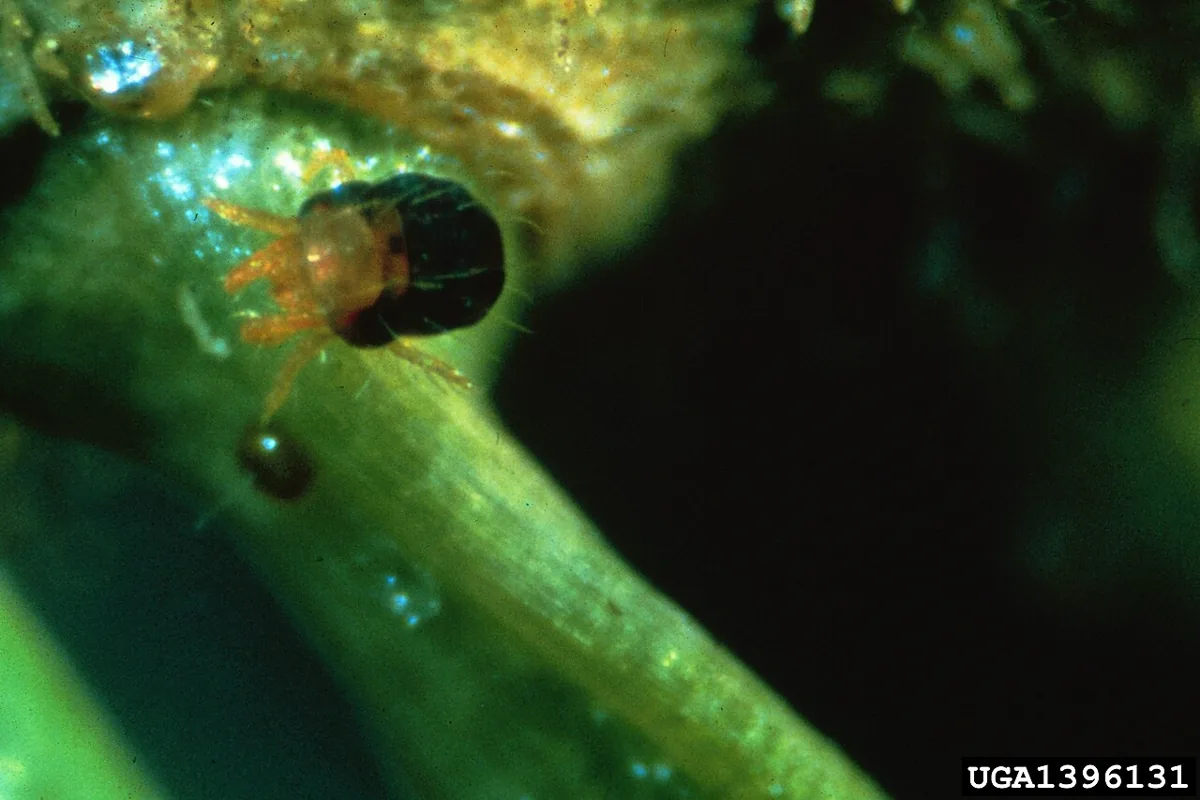
- Adults and nymphs are dark green to nearly black with salmon-pink spines and salmon-pink legs, about 0.5 mm long.[1][3]
- Utah State describes adults as very tiny, about 1/64 inch, and dark brown or reddish to dark green; when squashed they leave a greenish stain.[5][4]
- Each egg is round, flattened on top, with a thin thread sticking up from its center, which identifies the species; overwintering eggs are brown.[2][3][1]
- Infested trees look speckled and yellowish at first, and the mites spin fine silk webs on the needles; damage can be patchy within the canopy.[1][3][5]
Look-alikes
| Look-alike | How to tell them apart |
|---|---|
| Predatory mites | Predatory mites often show up with spruce spider mites and eat them. They move faster, tend to be reddish and leave a red stain when squashed; spruce spider mites are dark green to dark brown and leave a green stain.[4] |
Where it lives
Penn State Extension covers it on landscape conifers in Pennsylvania; dwarf Alberta spruce is a preferred host.[1]
Biology and life cycle
It overwinters as brown eggs around bud scales and needle bases, which hatch in spring before new growth starts; Utah State says hatch begins around mid-March to mid-April.[1][5][2]
It's a cool-season mite, active mainly in spring and fall. In hot weather it stops feeding and survives as dormant eggs until fall; Utah State puts the cutoff at about 80 to 90 °F.[1][2][5][4][6]
A generation takes about 2 to 3 weeks, and generations overlap so all stages may be present in late spring and early summer.[1][3][5]
Mites spread mainly on the wind.[3]
Damage and signs
- Feeding on older, inner and lower needles turns them yellow-stippled, then rusty or reddish brown, and they may drop early. Damage mostly happens in spring and fall but may not show until June or July.[1][3][2]
- These mites usually don't cause branch dieback; NC State says dieback usually points to scale insects or another problem.[2]
- Hosts include spruce, arborvitae, juniper, hemlock, pine, Douglas-fir, Fraser fir and yew; dwarf Alberta spruce and blue spruce are favorites.[1][2][6][5]
Health risk
It feeds on plants; none of these extension sources mentions any risk to people.[1][3][5]
Control
Prevention
Hold white paper under a branch and strike it; ten or more dark mites at each of three or four spots means treatment may be warranted.[1][3]
Before spraying, check for predatory mites. If many are present, Illinois advises against miticides, which kill the predators more easily than the pests; a few spruce spider mites alone may need no treatment.[4]
Water drought-stressed trees and don't over-fertilize mite-infested ones.[3][6]
Traps and physical control
A strong jet of water knocks mites off; done regularly, about weekly, it can work like a heavy rain on specimen trees.[3][6]
Pesticides
Horticultural oil, insecticidal soap or neem oil are easier on natural enemies; Utah State suggests a dormant oil or soap in spring or fall when mites are present, and NC State notes oils also control aphids and scales on conifers. Spray thoroughly, since the mites feed on older, inner growth.[6][5][2]
Treat in early to mid-May and again in early September if needed, and rotate miticide classes after every third application to slow resistance. Avoid broad-spectrum insecticides, which kill beneficial mites.[1][6]
Research on sampling and predator releases
University of Maryland researchers found that beating juniper branches over a surface underestimates the total number of spruce spider mites dramatically, though beat counts still tracked feeding injury.[8]
In a juniper nursery trial, releases of the predatory mites Neoseiulus fallacis and Galendromus occidentalis cost 2.5 to 7 times more than miticides and gave weaker control when spruce spider mite numbers were already high.[7][3]
Where sources disagree
Generations a year: Penn State says 7 to 10; UMass says 3 to 4, with 7 to 10 reported in some areas; Utah State says up to six; Montana State says typically two.[1][3][5][6]
Resistance: Penn State advises switching miticide class after every third application because mites develop resistance, and Montana State says spider mites resist many insecticides; NC State says this mite is not particularly resistant to miticides.[1][6][2]
When to act: Penn State and UMass use 10 mites per tap at each of three or four spots; Illinois says a few mites may need nothing and that sprays should be skipped when predatory mites are numerous.[1][3][4]
Common questions
- Why is my dwarf Alberta spruce turning rusty brown inside?
- Spruce spider mites often attack its older, inner needles, which turn rusty and drop.[1][3]
- How do I check a conifer for spider mites?
- Tap a branch over white paper and look for tiny dark specks moving on it. Fast-moving reddish mites are likely predators.[1][5][4]
- Why do the mites disappear in summer?
- They are cool-season mites; in hot weather only the eggs survive, and the mites return in fall.[2][5][4]
Sources
- Penn State Extension, “Spruce Spider Mite.” extension.psu.edu/spruce-spider-mite (accessed 2026-11-11)
- NC State Extension, “Spruce Spider Mite.” content.ces.ncsu.edu/spruce-spider-mite (accessed 2026-11-11)
- UMass Amherst Center for Agriculture, Food, and the Environment, “Oligonychus ununguis (Insect & Mite Guide).” www.umass.edu/agriculture-food-environment/landscape/publications-resources/insect-mite-guide/oligonychus-ununguis (accessed 2026-11-11)
- University of Illinois Extension, “Spruce Spider Mite.” extension.illinois.edu/insects/spruce-spider-mite (accessed 2026-11-11)
- Utah State University Extension, “Spruce Spider Mite (Ornamental Pest Guide).” extension.usu.edu/planthealth/ipm/ornamental-pest-guide/arthopods/mites/spruce-spider-mite.php (accessed 2026-11-11)
- Montana State University Extension, “Spruce Spider Mite (A Guide to Pests, Problems and Identification of Ornamental Shrubs and Trees in Montana).” www.montana.edu/extension/Full_HTML_Pubs/a-guide-to-pests-problems-and-identification-of-ornamental-shrubs-and-trees-in-montana/insects/spruce-spider-mite.html (accessed 2026-11-11)
- Journal of Economic Entomology, via PubMed, “Evaluation of predatory mite releases to suppress spruce spider mites on juniper (Shrewsbury and Hardin 2003).” pubmed.ncbi.nlm.nih.gov/14977103/ (accessed 2026-11-11)
- Journal of Economic Entomology, via PubMed, “Beat sampling accuracy in estimating spruce spider mite populations and injury on juniper (2004).” pubmed.ncbi.nlm.nih.gov/15384359/ (accessed 2026-11-11)
- iNaturalist, “Oligonychus ununguis taxon page (order and family).” www.inaturalist.org/taxa/263173 (accessed 2026-11-11)