On this page
How to identify it
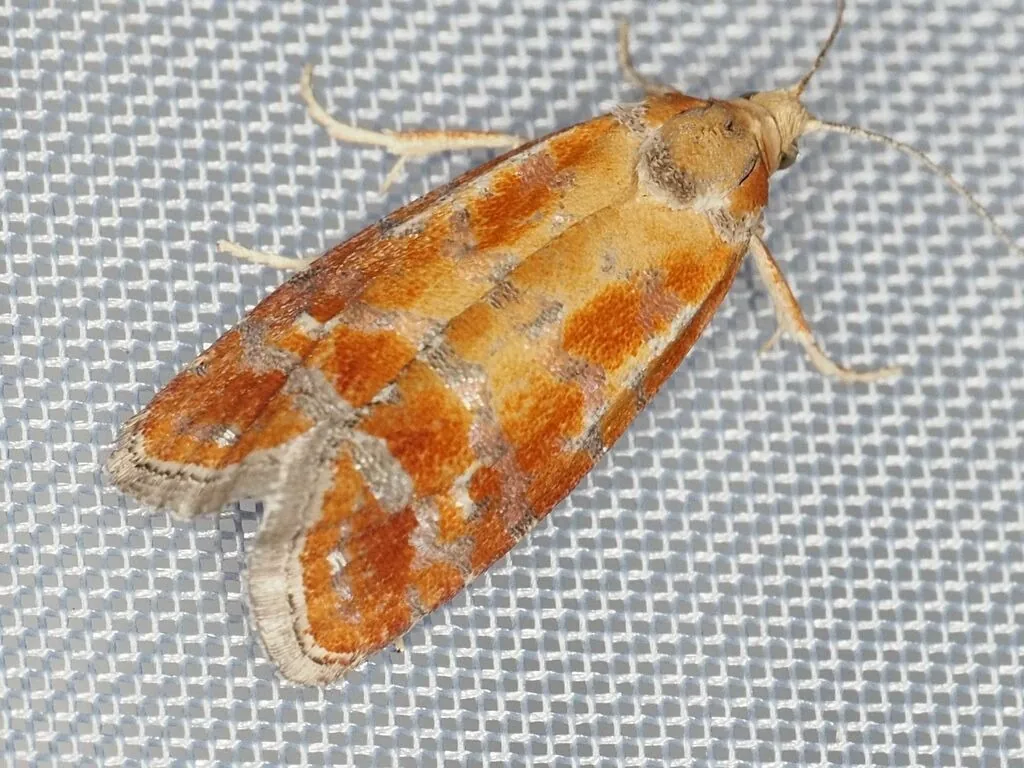
- The moths are orange-red with irregular silver bars on the forewings, dark gray hind wings and white legs. Penn State gives a wingspan of about 20 mm, Montana's agriculture department about 3/4 inch.[1][5][6]
- Larvae are brown with black heads. Sizes vary by source: Penn State says 12 to 15 mm when mature, Montana about 1/2 inch, WSU about 5/8 inch and UMass about 3/4 inch.[1][6][5][3]
- Look for resin-coated webbing over entry holes, pitch between bud clusters, and needles that yellow at the tips and then turn brown.[1][3][5]
Look-alikes
| Look-alike | How to tell them apart |
|---|---|
| Nantucket pine tip moth | Penn State says this cousin has two generations a year in Pennsylvania; European pine shoot moth has one. UMass adds that the pitch pine tip moth does similar damage in the Northeast.[1][3] |
Where it lives
It came from Europe and occurs across the northeastern U.S. and southern Canada, with infestations in the Pacific Northwest. Penn State and UMass date the first U.S. record to 1914 in New York; Natural Resources Canada says 1913. Canada first reported it in 1925, and it now ranges from Newfoundland to Ontario and into southern British Columbia.[1][3][4]
Biology and life cycle
Larvae overwinter in silk-lined tunnels inside buds and start boring into buds and new shoots again in April.[1]
They pupate in the shoots in late May. Moths emerge two to three weeks later and lay flat eggs singly near needle bases or on buds; the eggs hatch in 7 to 10 days.[1][3][4][6]
Young larvae feed under resin-coated webs at the needle bases, then move into buds in midsummer and stay there through winter.[1]
Hosts include mugo, Scots, red, Austrian, ponderosa, Japanese black and Japanese red pines. Natural Resources Canada calls red pine its preferred host in North America. Sources differ on five-needle pines: Penn State and UMass list eastern white pine, but WSU says two- and three-needle species are most at risk.[1][2][3][4][5]
Overwintering larvae can't survive below about -20 F. Warm, dry summers and mild winters help them, and drought and poor soil raise the risk of an infestation.[1][3][2]
Damage and signs
- Wilted shoots that soon turn brown are the first sign.[1]
- Weakened shoots bend but keep growing, leaving 'post horn' or shepherd's-crook bends. Losing the leader leaves a dead spike or a crooked trunk, and repeated attacks give a bushy tree dotted with witches' brooms.[1][5][4][6]
- Trees rarely die, though Illinois Extension says severe infestations can kill small trees. Young trees in open plantations are hit hardest: under 15 years old per Natural Resources Canada, under 10 feet tall per UMass.[4][2][3]
Health risk
It feeds on pines; none of the extension or agency sources mentions any risk to people.[1][3][4]
Control
Prevention
It moves mainly on nursery stock and Christmas trees. Montana's agriculture department regulates pine material from 20 states, and UMass suggests planting less-preferred pines where it's a known problem.[6][3]
Traps and physical control
Prune out and destroy dead buds and wilted shoots in spring, before adults emerge in June, and cut far enough down to remove the larvae.[1][3][5][4]
Biological control
Sources disagree on how much parasites help. Penn State says native and introduced parasitoids cut numbers by only about 10 percent, and Natural Resources Canada says introduced parasites haven't worked as well as hoped. UMass says natural enemies, notably the European wasp Orgilus obscurator, often keep it below damaging levels.[1][4][3]
Pesticides
Small larvae are the target if spraying is justified: early to mid-April as they leave winter sites, and early July right after egg hatch. Cover the buds thoroughly and follow the label.[1]
Monitoring
In summer, look for mined needles turning brown and resin-covered webbing at the bases of buds; bent 'post horn' leaders show up later. Pheromone traps can also help with monitoring.[3][1]
UMass places adult activity at about 480 to 710 growing degree days (base 50 F, starting March 1). Severely infested trees can take on a reddish cast.[3][2]
Common questions
- Why are the new shoots on my pine wilting and turning brown?
- European pine shoot moth larvae boring into buds and shoots are one cause.[1]
- When should European pine shoot moth be treated?
- Early to mid-April and again in early July, when small larvae are exposed. Pruning infested shoots before June is the first step.[1][3]
- Will European pine shoot moth kill my pine?
- Rarely. It mostly stunts and deforms shoots, though severe infestations can kill small trees.[4][3][2]
Sources
- Penn State Extension, “European Pine Shoot Moth.” extension.psu.edu/european-pine-shoot-moth (accessed 2026-11-13)
- University of Illinois Extension, “European Pine Shoot Moth.” extension.illinois.edu/insects/european-pine-shoot-moth-nantucket-pine-tip-moth (accessed 2026-11-13)
- UMass Amherst Center for Agriculture, Food, and the Environment, “Rhyacionia buoliana (Landscape, Nursery and Urban Forestry Insect and Mite Guide).” www.umass.edu/agriculture-food-environment/landscape/publications-resources/insect-mite-guide/rhyacionia-buoliana (accessed 2026-11-13)
- Natural Resources Canada, Canadian Forest Service, “European pine shoot moth (Trees, insects and diseases of Canada's forests).” tidcf.nrcan.gc.ca/en/insects/factsheet/11190 (accessed 2026-11-13)
- Washington State University Extension, “Pine: European pine shoot moth (HortSense).” hortsense.cahnrs.wsu.edu/fact-sheet/pine-european-pine-shoot-moth/ (accessed 2026-11-13)
- Montana Department of Agriculture, “European Pine Shoot Moth (EPSM) information sheet.” agr.mt.gov/_docs/nurseries-docs/European-Pine-Shoot-Moth-Info-Sheet.pdf (accessed 2026-11-13)
- Global Biodiversity Information Facility (GBIF), “Rhyacionia buoliana (Denis & Schiffermüller), 1775 (GBIF Backbone Taxonomy).” api.gbif.org/v1/species/1739381 (accessed 2026-11-13)