On this page
How to identify it
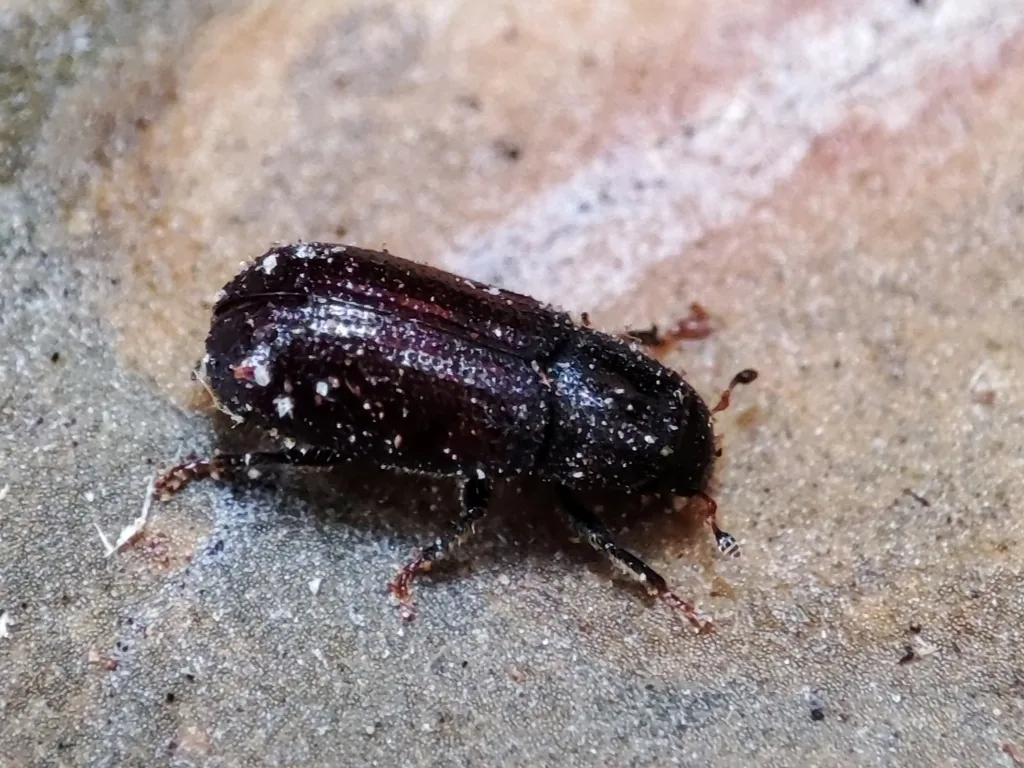
- Adults are cylindrical and 3 to 5 mm long, about the size of a match head, with a shiny black head and thorax and reddish-brown to black wing covers.[1]
- Adults somewhat resemble Dendroctonus bark beetles, such as the southern pine beetle and the black turpentine beetle, in general appearance, but the funicle of the antenna has six segments. A smooth second interval on the sloping rear of the wing covers separates this species from others in its genus.[2][4]
- Larvae are legless, slightly curved and white with a brown head, reaching about 1/4 inch (5 mm). Eggs are 1 mm long, oval and shiny white.[1]
- On the tree, look for new or one-year-old shoots that droop, turn yellow and fall off, a round entrance hole 2 to 3 mm across surrounded by pitch, and dead, bored-out shoots littering the ground underneath. UF/IFAS adds that the 2 to 3 mm holes are near the broken ends of the shoots, and that first- and second-year shoots droop and turn yellow or red in early summer.[2][3][4]
- Under the bark of infested logs and stumps are vertical egg galleries 4 to 10 inches long, with the larvae's horizontal galleries, 1.5 to 3.5 inches long, running off them.[1]
Look-alikes
| Look-alike | How to tell them apart |
|---|---|
| Dendroctonus bark beetles and Ips engravers | Florida's 1992 circular says the adults somewhat resemble Dendroctonus bark beetles in general appearance, but the pine shoot beetle's antennal funicle has six segments. It also says shoot damage may resemble that sometimes caused by Ips beetles, so any shoot damage should be carefully examined. UF/IFAS's current profile gives the same advice.[2][4] |
| Pine tip moths | Damage from pine tip moths (Rhyacionia species) can resemble pine shoot beetle injury, so any damaged shoot should be examined carefully. The beetle leaves a round entrance hole 2 to 3 mm across, surrounded by pitch. UF/IFAS gives the same warning and says to look for the 2 to 3 mm holes near the broken ends of the shoots.[2][3][4] |
Where it lives
Native to Europe and Asia; Florida's 1992 circular also lists Algeria and the Canary Islands in its distribution. It was first found in the United States in 1992 at a Christmas tree plantation in Ohio, and a 2020 Forest Service review says the number of infested states grew year by year, with about 20 states quarantined by 2016, mostly in the Midwest and Northeast. UF/IFAS's profile, last revised in 2010, lists it from Japan, Korea, Turkey and northeast China as well as Europe, and at that time counted 17 northeastern and north central states, with the beetle established in the Great Lakes regions of Ontario and Quebec in Canada.[1][2][5][4]
Biology and life cycle
There is one generation a year in its native range and in the United States; in Great Britain there is usually one, and in warmer countries there may be two. UF/IFAS cites Canadian Forest Service studies that confirm one generation a year in Canada and the northern United States.[1][2][5][4]
Overwintered adults take flight on the first warm days of spring, when highs reach about 50 to 54°F, which the Forest Service alert places in February or March in the Lake States. UF/IFAS gives March in the Great Lakes area, when daily highs reach 10°C to 12°C (50°F to 53.6°F) and the daily mean is 7°C to 8°C, and says the adults can fly several kilometers to find a suitable host.[1][4]
They colonize recently cut pine stumps, logs and slash, and sometimes the trunks of badly weakened trees, flying half a mile or more to find them. Pine is the main host, though in heavy populations they also breed in spruce, fir and larch logs in stands mixed with pine.[1]
Each female starts a gallery and is joined by one male. She cuts a vertical egg gallery in the inner bark and outer sapwood and lays eggs one at a time in niches along both sides.[1]
Most larvae finish feeding, pupate and become adults in May and June. The new adults chew out through round holes about 2 mm across and fly to the crowns of living, healthy pines of all ages, favoring the taller trees, where they enter the shoot within 15 cm of the tip and hollow it out for 2.5 to 10 cm.[1][3]
Each adult feeds in one to six shoots. The beetles spend the winter in the outer bark at the base of pine trees. UF/IFAS says the adults move into the soil or the base of pine trees in October; in warmer climates they can overwinter in shoots, and in cold areas snow pack adds insulation.[3][5][4]
Blue stain fungi are associated with this beetle. Adults find breeding material by host odors such as alpha-pinene and do not appear to produce an aggregation pheromone.[1]
Females cut egg galleries 10 to 25 cm long under the bark, more of them on the sides of logs and trees warmed by the sun. After laying eggs the adults leave and die, and the larvae feed in separate galleries 2.5 to 10 cm long from April through June, pupating at the ends of their galleries in May or June.[4]
In Great Britain, a 1940 study cited by UF/IFAS found adults overwintering in hollowed twigs or galleries at the base of the tree, emerging as early as February in warm places; development from egg to adult took about three months, with new adults emerging from June. The new adults are not yet sexually mature and feed on growing tips through the summer, and the overwintered adults also return to the crowns for this 'regeneration feeding' before laying a second batch of eggs in the trunks.[4]
Damage and signs
- Scotch pine is the preferred host, and red, jack, eastern white and Austrian pines are also attacked. UF/IFAS says that in the United States it has been found most commonly in Scotch pine, but also in Austrian and eastern white pine, and that in Europe it occasionally attacks spruce and larch.[3][4]
- The worst injury is the shoot feeding, which destroys growing points, deforms trees and, when severe, reduces tree growth. The Florida plant industry division expected this to be especially severe in Christmas tree plantations, where tree form matters most and the injury is permanent. A 1940 British study quoted by UF/IFAS called the tip feeding the worst damage, causing malformation and a great reduction in the value of the crop; trees may be destroyed by tip feeding, trunk feeding, or other insects that attack the stressed trees.[2][5][4]
- Sources differ on how dangerous it is. Florida's 1992 circular calls it the most serious bark beetle pest of pines in Europe, attacking weakened trees but also killing apparently healthy ones. In the United States, a Forest Service entomologist wrote in 2020 that it has never become a major pest in natural or planted pine forests and that no outbreaks have been reported, and USDA APHIS, in consultation with the National Plant Board, considers it a minor pest that can be controlled locally, given its slow spread and the minimal damage it causes. UF/IFAS also cites a 1991 report of it as a severe pest of Yunnan pine in the Kunming region of China, where it killed many apparently healthy trees.[2][5][6][4]
- In 1992 Florida's Division of Plant Industry listed four pines native to Florida that might be susceptible, based mainly on their resin flow and bark: sand, spruce, pond and loblolly pine. UF/IFAS's 2010 revision repeats this list and names Christmas trees, pine landscape and nursery products, and pine timber as the forest resources that may be threatened.[2][4]
Health risk
A tree pest. The Forest Service alert, Florida's circular, the UF/IFAS profile, the Massachusetts fact sheet and the APHIS bulletin describe damage to pines and don't mention any risk to people or pets.[1][2][4][3][6]
Control
Prevention
The federal quarantine covered pine logs and lumber with bark, nursery stock and Christmas trees, later adding stumps, bark and chips, and moving them out of the quarantine zone generally required some inspection and treatment. In 1992 several states also set their own quarantines on infested states.[5]
USDA APHIS published a final rule removing the federal domestic quarantine regulation for the pine shoot beetle, effective November 2, 2020. APHIS says removing the quarantine ended its domestic regulatory activities, such as issuing permits, certificates and compliance agreements, and that federal deregulation allows states to determine the best approach for managing the beetle within their boundaries. A Forest Service entomologist noted that the beetle never became a major pest in U.S. pine forests. The final rule says APHIS found the regulatory program ineffective in slowing the spread of the pest and reducing damage, which has also been found to be minimal, and it also ended restrictions on importing pine shoot beetle host material from Canada.[6][5][7]
Sanitation
Cultural practices used in Europe include precisely timed cutting operations and debarking cut timber. The adults breed in freshly cut pine stumps, logs and slash, and U.S. Christmas tree growers followed a Compliance Management Program of best management practices. UF/IFAS lists the same European practices.[1][2][5][4]
Biological control
A predatory checkered beetle, Thanasimus formicarius, can eat several pine shoot beetles a day. It disperses just before, during or just after the bark beetles' flight, often waits on fallen pines to catch them as they land, and, like them, is drawn to monoterpenes released from damaged areas of the fallen trees.[4]
Pesticides
In 1992 Florida's Division of Plant Industry reported that there appeared to be no practical chemical control. Christmas tree and nursery growers later followed a Compliance Management Program of best management practices, and beetle levels in those fields fell sharply. UF/IFAS's profile, last revised in 2010, still says there apparently is no practical chemical control.[2][5][4]
Where the sources disagree
Adult size and color: the Forest Service alert gives 3 to 5 mm, with a shiny black head and thorax and reddish-brown to black wing covers; Florida's circular gives 3.5 to 4.8 mm and calls the adults brown to black.[1][2]
Spring flight: the Forest Service alert says flight starts when highs reach about 50 to 54°F, in February or March in the Lake States; the Massachusetts fact sheet says 54°F in March or April; the 2020 Forest Service review says flight starts in late winter or early spring when temperatures exceed 10 to 12°C.[1][3][5]
New adults: the Forest Service alert says most larvae become adults in May and June; the Massachusetts fact sheet says mature larvae pupate and emerge as adults between July and October.[1][3]
How serious it is: Florida's 1992 circular calls it the most serious bark beetle pest of pines in Europe; the 2020 Forest Service review says no U.S. outbreaks have been reported, and APHIS calls it a minor pest that can be controlled locally.[2][5][6]
Spring flight, continued: UF/IFAS gives March in the Great Lakes area, when daily highs reach 10°C to 12°C (50°F to 53.6°F).[4]
Quarantine: UF/IFAS's profile, last revised in 2010 and still posted, describes a quarantine on moving host trees and advises checking state compliance programs; USDA APHIS removed the federal quarantine effective November 2, 2020.[4][7]
Common questions
- Why are dead pine shoot tips dropping under my Scotch pine?
- One cause is the pine shoot beetle: adults bore into the shoots to feed, and dead, bored-out shoots littering the ground under infested trees are a key symptom. Look for a round hole 2 to 3 mm across surrounded by pitch, and keep in mind that pine tip moth and Ips damage can look similar. UF/IFAS adds that first- and second-year shoots droop and turn yellow or red in early summer.[2][3][4]
- Can I spray for pine shoot beetle?
- Florida's Division of Plant Industry reported in 1992 that there appeared to be no practical chemical control. Christmas tree and nursery growers later followed a Compliance Management Program of best management practices, and beetle levels in those fields fell sharply. UF/IFAS's profile likewise says there apparently is no practical chemical control.[2][5][4]
- Is it safe to move pine logs or Christmas trees?
- There is no longer a federal quarantine. USDA APHIS removed the federal domestic quarantine regulation for the pine shoot beetle, effective November 2, 2020, and says deregulation allows states to determine the best approach for managing it within their boundaries. Before then, pine Christmas trees, nursery stock, logs and lumber with bark, stumps, bark and chips were regulated, and moving them out of the quarantine zone generally required some inspection and treatment. The final rule also removed the restrictions on importing host material from Canada.[6][5][7]
Sources
- USDA Forest Service, Northeastern Area, “New Introduction: Common Pine Shoot Beetle, Tomicus piniperda, pest alert NA-TP-05-93 (copy hosted by the New Jersey Department of Agriculture).” www.nj.gov/agriculture/divisions/pi/pdf/PSB_Pest%20Alert.pdf (accessed 2026-11-14)
- Florida Department of Agriculture and Consumer Services, Division of Plant Industry, “Pine shoot beetle, Tomicus piniperda (Linnaeus): A potential threat to Florida pines, Entomology Circular No. 354 (M. C. Thomas and W. N. Dixon, 1992).” ccmedia.fdacs.gov/content/download/4710/file/Pine%20Shoot%20Beetle.pdf (accessed 2026-11-14)
- Massachusetts Introduced Pests Outreach Project, Massachusetts Department of Agricultural Resources, “Pine Shoot Beetle, Tomicus piniperda, fact sheet (last reviewed December 2014).” massnrc.org/pests/pestFAQsheets/pineshootbeetle.html (accessed 2026-11-14)
- University of Florida/IFAS Extension (Featured Creatures), “Pine Shoot Beetle, Tomicus piniperda (Linnaeus), EENY-321/IN596 (M. C. Thomas, W. N. Dixon and T. R. Fasulo; revised September 2010).” ask.ifas.ufl.edu/publication/IN596 (accessed 2026-11-14)
- USDA Forest Service, “Where have all the pine shoot beetles gone, long time passing? The 1992 PSB federal quarantine is coming to an end (Robert A. Haack, USDA Forest Service Northern Research Station; Newsletter of the Michigan Entomological Society 64(2), September 2020).” www.fs.usda.gov/nrs/pubs/jrnl/2020/nrs_2020_haack_004.pdf (accessed 2026-11-14)
- USDA Animal and Plant Health Inspection Service (APHIS), “APHIS Removes Federal Domestic Quarantine for Pine Shoot Beetle (bulletin, September 30, 2020).” content.govdelivery.com/accounts/USDAAPHIS/bulletins/2a36c7b (accessed 2026-11-14). APHIS news bulletin sent through APHIS's own GovDelivery account; the APHIS website pages for pine shoot beetle returned 404 today.
- USDA Animal and Plant Health Inspection Service (Federal Register), “Deregulation of Pine Shoot Beetle, final rule (85 FR 61806, October 1, 2020; effective November 2, 2020).” www.govinfo.gov/content/pkg/FR-2020-10-01/pdf/2020-21800.pdf (accessed 2026-11-14)
- Global Biodiversity Information Facility (GBIF), “Tomicus piniperda (C.Linnaeus, 1758) (GBIF Backbone Taxonomy).” api.gbif.org/v1/species/1211257 (accessed 2026-11-14)
- iNaturalist, “Tomicus piniperda taxon page (order and family).” www.inaturalist.org/taxa/178812 (accessed 2026-11-14)