On this page
How to identify it
- The full-grown caterpillar is only about 9 mm long, pale yellow to reddish pink above the line of spiracles and creamy yellow below, with diffuse orange-brown to orange-red stripes down the middle and sides of the back that show best on pale specimens. The head is brown and unmarked.[1]
- Eggs are laid singly at the base of the needles; fresh eggs are pale green and turn yellowish orange after a few days.[1]
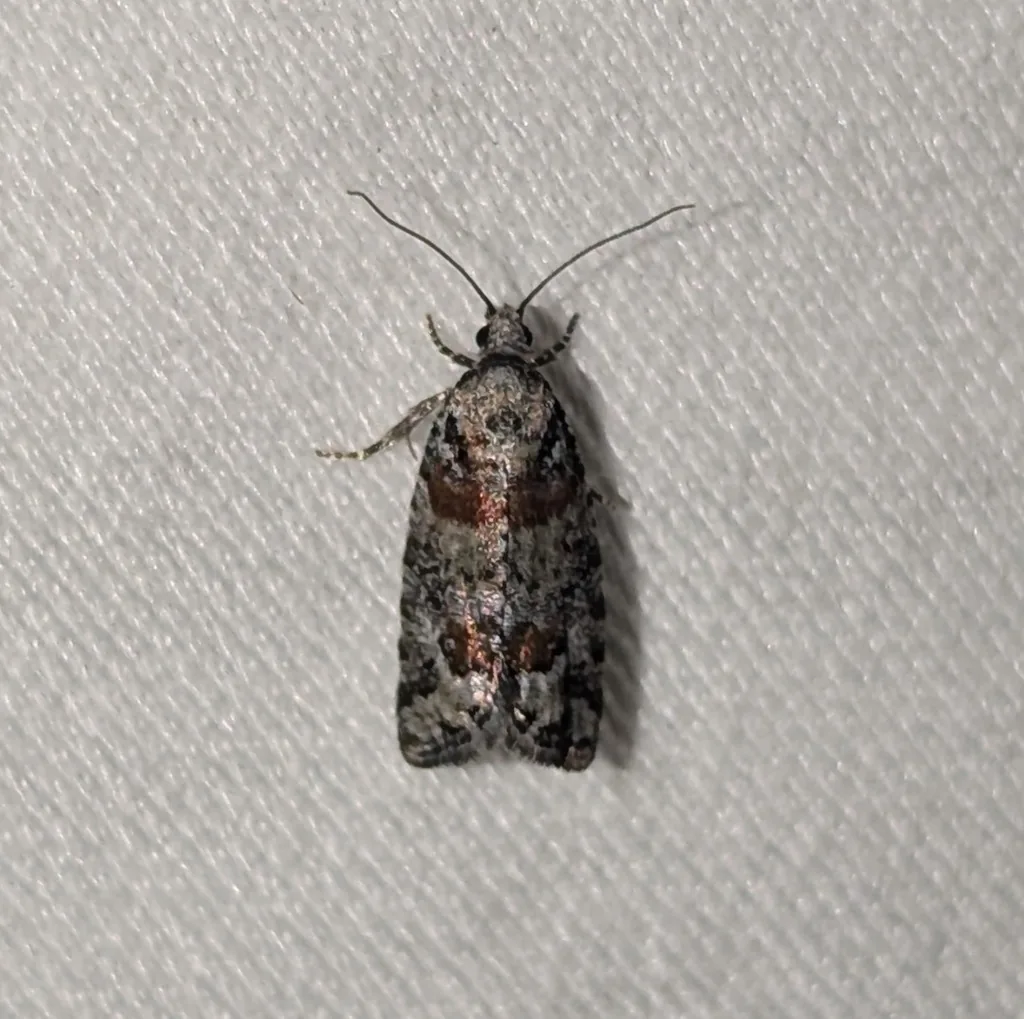
- The moth's forewings are ashy gray with rusty markings, and the wingspread is 13 to 15 mm. Adults emerge in August and September.[2][1]
- The first- and second-instar caterpillars resemble those of Zeiraphera bud moths; the pink-tinged, orange-striped coloring described by Natural Resources Canada is that of the mature larva.[2][1]
Look-alikes
| Look-alike | How to tell them apart |
|---|---|
| Western spruce budworm | The tip moth feeds in the opening buds much as the spruce budworm does and often occurs with it, but no economically important tip moth outbreak is recorded, while Western Forest Insects calls the western spruce budworm the most destructive forest defoliator in Western North America. The grown tip moth caterpillar is only about 9 mm long.[2][1] |
| Spruce bud moths (Zeiraphera) | Young spruce tip moth caterpillars in their first two instars resemble Zeiraphera. Eastern Forest Insects describes full-grown spruce bud moth (Z. ratzeburgiana) larvae as yellowish or grayish green and about 18 mm long, much larger than the 9 mm, pinkish tip moth caterpillar.[2][3][1] |
Where it lives
Natural Resources Canada says it occurs throughout British Columbia, east to Newfoundland and south to California, with records listed for British Columbia, Prince Edward Island and Yukon; Western Forest Insects calls it transcontinental, occurring in the West from California to British Columbia to Manitoba. A USDA Forest Service guide to Pacific Northwest caterpillars also reared it from western hemlock. GBIF holds about 1,100 records, about 920 of them from Canada and 170 from the US; its roughly 130 US records since 1990 come mostly from California, Washington, Michigan and Montana.[1][2][4][5][6]
Biology and life cycle
The principal hosts are Engelmann spruce, white spruce and Douglas-fir; other hosts include subalpine fir, grand fir, Sitka spruce and black spruce, and Natural Resources Canada also lists amabilis fir. Western Forest Insects says it is common on spruce, Douglas-fir and true firs and occasionally feeds on other conifers; in eastern forests it feeds principally on white spruce and balsam fir. The Pacific Northwest caterpillar guide records western hemlock as a host of field-reared caterpillars.[1][2][3][4]
The egg overwinters at the base of a needle. Caterpillars appear in late May and feed on the current year's foliage until early July, passing through five instars.[1]
Grown caterpillars either drop to the ground to spin cocoons and pupate or stay in the tree and pupate under the bud caps. The pupal stage lasts about three weeks; the moths emerge in August and September and lay eggs about seven days later.[1]
Damage and signs
Health risk
Natural Resources Canada and the USDA Forest Service manuals describe it only as a bud and needle feeder of conifers; no cited source describes any risk to people or pets.[1][2][3]
Control
Prevention
No control is recommended: Natural Resources Canada says it is not known to reach outbreak proportions, and Western Forest Insects records no economically important outbreak. If new spruce or fir growth is being lost in early summer, the spruce budworm it often accompanies is worth checking for.[1][2]
Where the sources disagree
Name: GBIF and Natural Resources Canada use Epinotia radicana; GBIF gives Griselda radicana Heinrich, 1923 as the original name, and the 2003 USDA Forest Service Pacific Northwest guide still lists it as Griselda radicana.[7][1][4]
Range: Natural Resources Canada describes a Canadian and far-western range (British Columbia to Newfoundland, south to California), while GBIF's US records since 1990 also include Michigan, Montana and Vermont.[1][6]
Hosts: Natural Resources Canada's host list has no hemlock, but the Pacific Northwest caterpillar guide records it from western hemlock.[1][4]
Eastern hosts: Eastern Forest Insects names white spruce and balsam fir as the principal hosts in eastern forests, but balsam fir is not on Natural Resources Canada's host list.[3][1]
Common questions
- What is the small pinkish striped caterpillar in my spruce buds?
- A caterpillar under 1 cm long, pale yellow to reddish pink with orange stripes, in opening spruce, fir or Douglas-fir buds in June is the spruce tip moth or red-striped needleworm.[1]
- Is it the same as the spruce budworm?
- No, though the two feed in the same opening buds and often occur together. The tip moth caterpillar is much smaller, about 9 mm when grown, and no economically important outbreak of it is recorded.[2][1]
- Does the spruce tip moth have outbreaks?
- It is not known to: Natural Resources Canada calls it a common, solitary defoliator that is not known to reach outbreak proportions.[1]
- Where does it pupate?
- Either in a cocoon on the ground or under the bud caps in the tree; the pupal stage takes about three weeks before the moths emerge in August and September.[1]
Sources
- Natural Resources Canada, Canadian Forest Service, “Spruce tip moth; redstriped needleworm, Trees, insects and diseases of Canada's forests.” tidcf.nrcan.gc.ca/en/insects/factsheet/11014 (accessed 2026-11-14)
- USDA Forest Service, “Western Forest Insects, Miscellaneous Publication 1339 (R. L. Furniss and V. M. Carolin, November 1977; scanned copy).” archive.org/details/CAT78702369 (accessed 2026-11-14)
- USDA Forest Service, “Eastern Forest Insects, Miscellaneous Publication 1175 (W. L. Baker, 1972; scanned copy).” archive.org/details/easternforestins1175bake (accessed 2026-11-14)
- USDA Forest Service, Forest Health Technology Enterprise Team, “Lepidoptera of the Pacific Northwest: Caterpillars and Adults, FHTET-03-11 (J. C. Miller and P. C. Hammond, 2003).” www.fs.usda.gov/foresthealth/technology/pdfs/FHTET_03_11.pdf (accessed 2026-11-13)
- Global Biodiversity Information Facility (GBIF), “Epinotia radicana: occurrence records by country (GBIF occurrence search).” api.gbif.org/v1/occurrence/search?taxonKey=1745606&facet=country&facetLimit=20&limit=0 (accessed 2026-11-13)
- Global Biodiversity Information Facility (GBIF), “Epinotia radicana: U.S. occurrence records since 1990 by state (GBIF occurrence search).” api.gbif.org/v1/occurrence/search?taxonKey=1745606&country=US&hasGeospatialIssue=false&occurrenceStatus=PRESENT&year=1990%2C2026&facet=stateProvince&facetLimit=400&limit=0 (accessed 2026-11-13)
- Global Biodiversity Information Facility (GBIF), “Epinotia radicana (Heinrich, 1923) (GBIF Backbone Taxonomy).” api.gbif.org/v1/species/1745606 (accessed 2026-11-13)