On this page
How to identify it
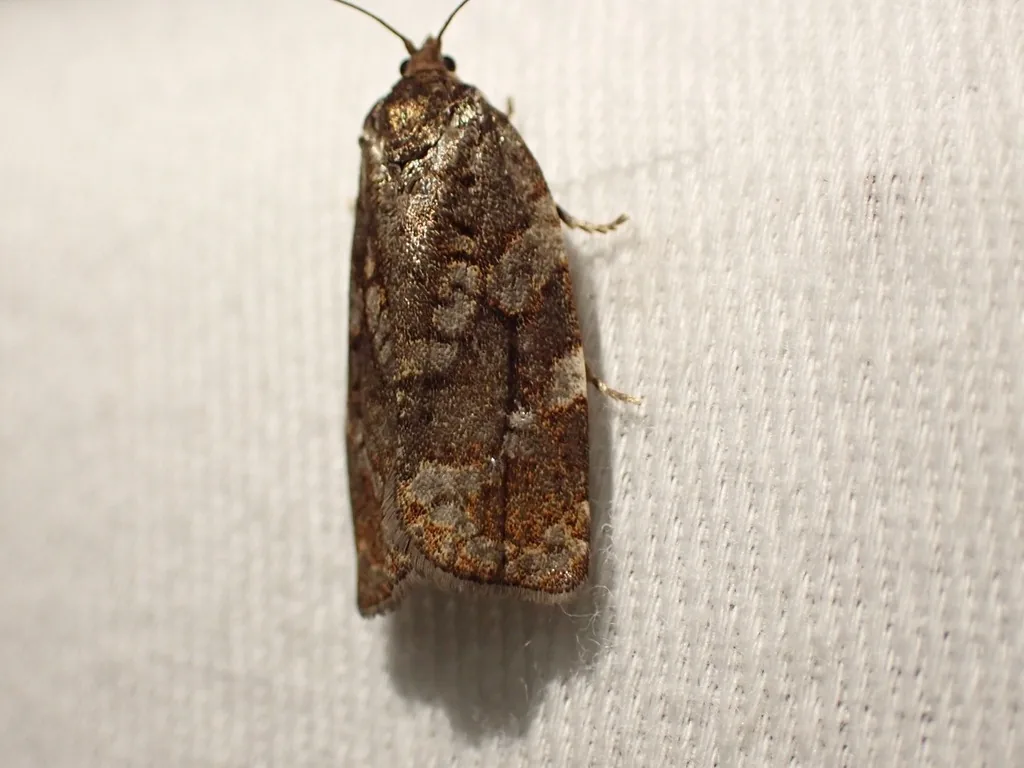
- Moths are mottled orange-brown (PNW) or gray to orange-brown, often with a white dot on each forewing (Forest Service). PNW gives a wingspan of up to 1 inch and the Forest Service 7/8 to 1 1/8 inches.[1][2]
- PNW describes larvae as green to brown with a darker head and, when older, white bumps. The Forest Service says grown larvae are olive to reddish brown with ivory markings and 1 to 1 1/4 inches long after six stages.[1][2]
- Eggs are oval and light green, laid in shingle-like masses under needles. PNW says they're laid in mid-July; the Forest Service says moths fly in late July and early August (early July in the southern Rockies) and each female lays about 150 eggs in masses averaging 25 to 40.[1][2]
Where it lives
The Forest Service gives its range as the Rocky Mountains from Arizona and New Mexico north through Colorado, Utah, Wyoming, Montana and Idaho, plus Oregon, Washington, British Columbia and Alberta. The Colorado State Forest Service calls it the most widely distributed forest defoliator in western North America.[2][3]
Biology and life cycle
Eggs hatch in about 10 days. The young larvae don't feed but spin small silk shelters, where they spend the winter.[2][1]
In spring the larvae disperse on silk threads. The Forest Service says they mine needles and buds from early May to late June, then web shoots together, and are full grown in early July after 30 to 40 days of feeding.[1][2]
Damage and signs
- Larvae feed on buds and new foliage and may web shoot tips into a nest. The Forest Service says webbed tips turn reddish brown, and the Colorado State Forest Service says larvae can eat all of a tree's new growth.[1][2][3]
- Repeated feeding causes top-kill and growth loss and damages cones and young trees. The Colorado State Forest Service says trees may die after three or more years in a row of defoliation; the Forest Service says weakened trees are more open to Douglas-fir beetle and fir engraver, and Colorado says to other insects and disease.[2][3]
- Sources differ on which trees matter most. PNW says it's mainly a pest of balsam and subalpine firs that also hits nearby spruce and Douglas-fir. The Forest Service lists Douglas-fir, grand, white, subalpine and corkbark firs, blue, Engelmann and white spruce and western larch as common hosts and says it damages ornamental Norway spruce and Scotch pine; Colorado reports severe infestations in Douglas-fir, white fir and spruce.[1][2][3]
Health risk
It feeds on conifers, and no cited source describes any risk to people or pets.[1][2][3]
Control
Prevention
In forests, the Forest Service suggests favoring nonhost trees such as lodgepole and ponderosa pine, thinning from below and keeping a single-layer canopy, and the Colorado State Forest Service says thinning and mixed-species stands reduce risk.[2][3]
Traps and physical control
On landscape trees, PNW suggests hand-picking and destroying larvae.[1]
Biological control
PNW says parasitoids, predators and weather help keep numbers in check, and Colorado credits predators, parasites, climate and food supply. The Forest Service lists more than 40 parasite species plus birds, chipmunks and squirrels, but says natural enemies seldom stop an epidemic; starvation and late spring frosts also kill many larvae.[1][3][2]
Pesticides
Both agencies say insecticides can be sprayed from the air over large forest areas or from the ground on individual trees for short-term protection. The Forest Service leaflet names the microbial insecticide Bacillus thuringiensis (Bt). Follow the label.[2][3]
Common questions
- What is webbing the new shoots of my fir together?
- Likely western spruce budworm larvae, which tie shoot tips together with webbing as they feed; the webbed tips later turn reddish brown.[1][2]
- Is western spruce budworm a threat to landscape trees?
- Sources differ. PNW calls it an infrequent landscape pest but a significant forest one, while the Forest Service says it damages ornamental Norway spruce and Scotch pine.[1][2]
- What is its scientific name?
- The Forest Service and PNW use Choristoneura occidentalis. GBIF's backbone taxonomy lists the western spruce budworm as Choristoneura freemani Razowski, 2008 and treats C. occidentalis Freeman, 1967 as a synonym.[2][1][4]
Sources
- Pacific Northwest Pest Management Handbooks (OSU, WSU, University of Idaho), “Fir (Abies): Spruce budworm (western) (Insect Management Handbook).” pnwhandbooks.org/insect/hort/landscape/hosts-pests-landscape-plants/fir-abies-spruce-budworm-western (accessed 2026-11-13)
- USDA Forest Service (Forest Insect & Disease Leaflets), “Western Spruce Budworm (FIDL 53).” www.fs.usda.gov/foresthealth/docs/fidls/FIDL-53-WesternSpruceBudworm.pdf (accessed 2026-11-13)
- Colorado State Forest Service, “Western Spruce Budworm (Common Forest Insects & Diseases).” csfs.colostate.edu/forest-management/common-forest-insects-diseases/western-spruce-budworm/ (accessed 2026-11-13)
- Global Biodiversity Information Facility (GBIF), “Choristoneura freemani Razowski, 2008 (GBIF Backbone Taxonomy).” api.gbif.org/v1/species/11510551 (accessed 2026-11-13)