On this page
How to identify it
- The caterpillar grows to about 25 mm. Its head is unmarked green and the body is green.[2]
- Two narrow dark green lines run down the middle of the back, with a light yellow stripe higher on each side and a creamy white stripe low on the side, below the breathing holes.[2]
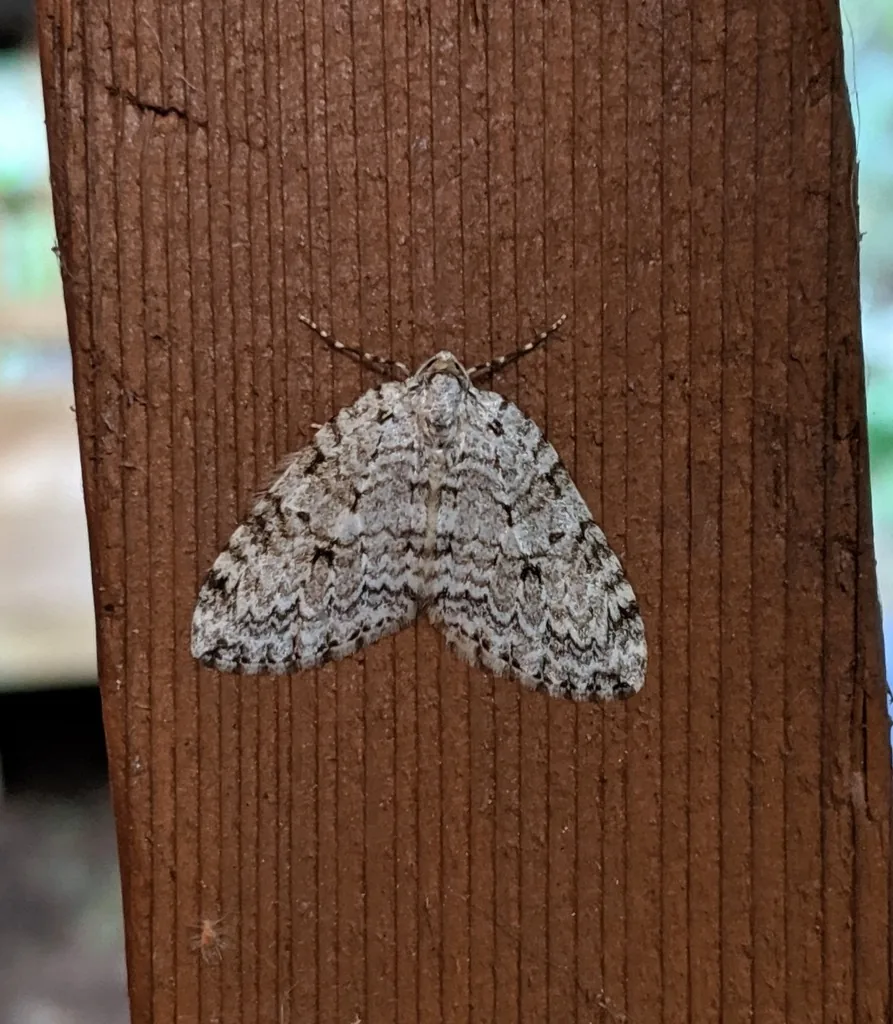
- The moth's forewing is pale gray or whitish with two darker bands of scalloped loops, and BAMONA calls the row of dark double dots along its outer edge distinctive. The wingspan is 2.5 to 3.6 cm.[1]
Where it lives
BAMONA gives coast to coast in southern Canada and the northern United States, south in the West to California, and also Eurasia, in coniferous and mixed woods and treed flood plains with alder and willow. Natural Resources Canada records it in Alberta and British Columbia on western conifers.[1][2]
Biology and life cycle
In western Canada the recorded hosts are conifers: amabilis, grand and subalpine fir, Engelmann, Sitka and white spruce, mountain and western hemlock, Rocky Mountain Douglas-fir and western redcedar. BAMONA adds alder, willow, birch and poplar.[2][1]
Natural Resources Canada says it overwinters as eggs.[2]
In western Canada caterpillars are present from May to July, pupate in June and July, and the moths fly from July to September.[2]
BAMONA gives a flight period of September and October.[1]
Damage and signs
- The caterpillars feed alone and move freely about the foliage. Natural Resources Canada describes the green velvet looper as common and on occasion locally abundant, but nondestructive.[2]
Health risk
Natural Resources Canada and BAMONA describe it only as a foliage-feeding caterpillar and its moth; neither mentions bites, stings or any effect on people or pets.[2][1]
Control
Prevention
Neither source recommends any control; Natural Resources Canada describes this looper as nondestructive.[2][1]
Where the sources disagree
Flight season: Natural Resources Canada gives July to September in western Canada; BAMONA gives September and October.[2][1]
Hosts: Natural Resources Canada lists only conifers in Alberta and British Columbia; BAMONA lists conifers plus alder, willow, birch and poplar.[2][1]
Common questions
- When do autumnal moths fly?
- BAMONA gives September and October; Natural Resources Canada records adults in western Canada from July to September. The egg is the stage that spends the winter.[1][2]
- Does the green velvet looper damage conifers?
- Natural Resources Canada calls it a common and on occasion locally abundant, but nondestructive, defoliator in Alberta and British Columbia.[2]
Sources
- Butterflies and Moths of North America (BAMONA), “Autumnal Moth, Epirrita autumnata (species account).” www.butterfliesandmoths.org/species/Epirrita-autumnata (accessed 2026-11-13)
- Natural Resources Canada, Canadian Forest Service, “Green velvet looper, Trees, insects and diseases of Canada's forests.” tidcf.nrcan.gc.ca/en/insects/factsheet/1000007 (accessed 2026-11-13)
- Global Biodiversity Information Facility (GBIF), “Epirrita autumnata (Borkhausen, 1794) (GBIF Backbone Taxonomy).” api.gbif.org/v1/species/4523560 (accessed 2026-11-13)
- iNaturalist, “Epirrita autumnata taxon page (order and family).” www.inaturalist.org/taxa/173571 (accessed 2026-11-09)