On this page
How to identify it
- Larvae are pale green inchworms with a faint white stripe down each side and two pairs of prolegs; newly hatched caterpillars are blackish. See where the sources disagree on full-grown size.[1][2]
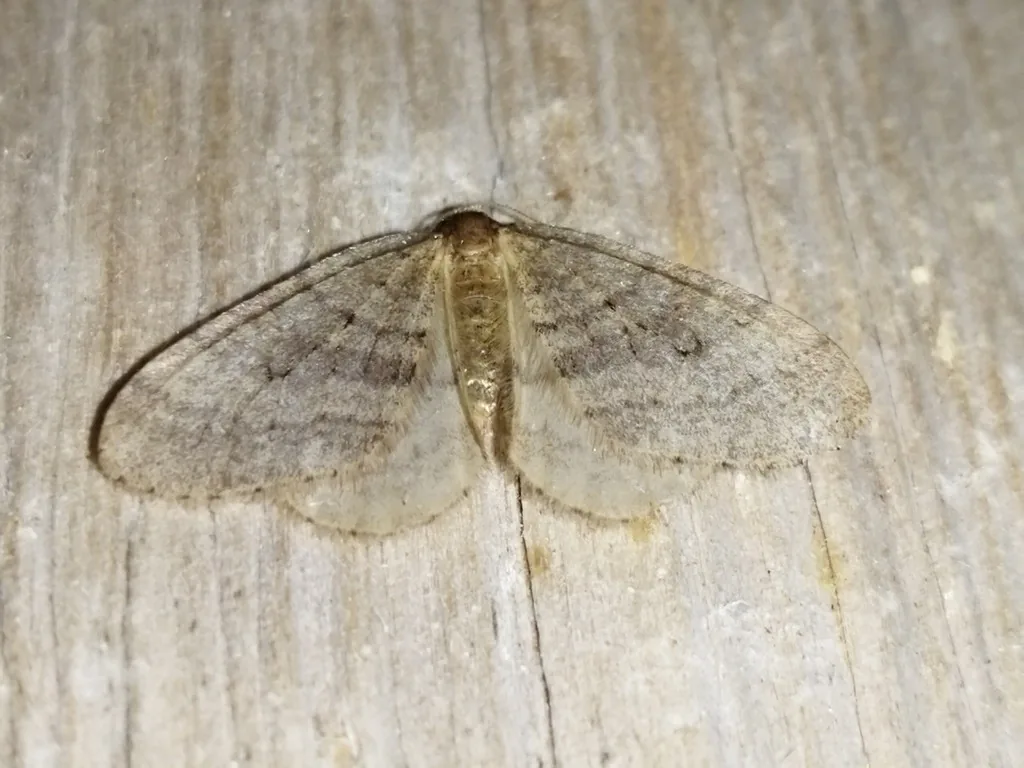
- Males are small light brown to tan moths with fringed, hairy-looking wing edges, about 0.8 to 1 inch across, and come to lights; the gray female is almost wingless and can't fly.[1][2]
- Larvae tie leaves together with silk but don't roll them the way leafrollers do.[1]
- Eggs are laid loose on bark and lichens; they turn from green to red-orange, then blue just before hatching.[2]
Look-alikes
| Look-alike | How to tell them apart |
|---|---|
| Leafrollers | Leafroller larvae roll leaves; winter moth larvae only tie them together with silk.[1] |
| Fall and spring cankerworms | UMass says cankerworms are similar inchworms often found with winter moth; the fall cankerworm has two and a half pairs of prolegs, the third pair much shorter, while winter moth has two.[2] |
| Bruce spanworm | A very similar native relative; UMass says it's rarely a problem, and its males also come to winter moth traps.[2] |
Where it lives
Introduced from Europe, it reached Nova Scotia in the 1930s and British Columbia around 1970, was found in Oregon and Washington in the 1950s (the PNW handbook says 1958), and was identified in Massachusetts in 2003.[2][1]
Biology and life cycle
It pupates in the soil from late spring into fall, and adults emerge in late fall and early winter after the first frost; UMass says from mid to late November, active into January when the weather is mild.[1][2]
The flightless female crawls up trees and shrubs and lays eggs in bark and bud crevices; UMass says each lays about 150 to 350. Eggs hatch around 55 degrees F, late March to mid-April in Massachusetts, near bud break, and larvae feed inside opening buds.[1][2]
After several weeks, larvae drop to the soil on silk threads to pupate; there's one generation a year.[1][2]
Young larvae spin fine silk threads to drift on the wind to new plants; UMass says they can land on roses and perennials this way.[1][2]
Damage and signs
- Larvae damage buds, blooms, leaves and fruit in spring. Oak, maple and apple are favored, along with cherry, basswood, ash, white elm, crabapple and blueberry; evergreens usually aren't hit.[1][2]
- UMass ties repeated defoliation, together with drought and other caterpillars, to serious decline and death of oaks in eastern Massachusetts.[2]
Health risk
It feeds on trees and shrubs. The PNW Insect Management Handbook and UMass Extension describe plant damage only and don't mention any risk to people or pets.[1][2]
Control
Prevention
Check buds and new leaves for small caterpillars in early spring, early to mid-April in Massachusetts, and act early if they're present.[1][2]
Traps and physical control
Home gardeners can pick larvae off when found and prune out infested growth.[1]
UMass says sticky tree bands aren't recommended for reducing heavy populations, but they're useful for watching eggs above and below the band to time hatch.[2]
Biological control
Lacewings, assassin bugs and spiders eat the larvae; see where the sources disagree on how much natural enemies matter. UMass notes that sprays can also kill the introduced parasitic fly Cyzenis albicans where it's spreading.[1][2]
Pesticides
The PNW handbook lists no products for home-garden use against it. UMass lists spinosad, Bacillus thuringiensis kurstaki (best on young caterpillars) and tebufenozide for landscape trees, says not to spray plants in bloom, and says there's no control for pupae in soil or for adults. Follow the label.[1][2]
Where the sources disagree
Larva size: the PNW handbook says up to 12 mm (about 1/2 inch); UMass says about 1 inch at maturity.[1][2]
Natural control: the PNW handbook says predators don't regulate populations well and cold winters may matter more; UMass says the parasitic fly Cyzenis albicans made winter moth mostly a non-pest in Nova Scotia after the 1950s.[1][2]
Arrival in the Northwest: the PNW handbook says 1958; UMass says the 1950s.[1][2]
Common questions
- What green inchworms are eating my blueberry buds in spring?
- Likely winter moth larvae, pale green inchworms that feed inside opening buds and on blooms, leaves and fruit; check for cankerworms, which look similar.[1][2]
- Why is it called the winter moth?
- The adults emerge in late fall and early winter, after the first frost, and can be active into January.[1][2]
Sources
- Pacific Northwest Pest Management Handbooks (OSU, WSU, University of Idaho), “Blueberry: Winter moth (Insect Management Handbook).” pnwhandbooks.org/insect/small-fruit/blueberry/blueberry-winter-moth (accessed 2026-11-13)
- UMass Extension Landscape, Nursery and Urban Forestry Program, “Winter Moth Identification & Management (R. Childs, J. Elkinton, T. Simisky, D. Swanson, H. Boettner; updated March 2017).” www.umass.edu/agriculture-food-environment/landscape/fact-sheets/winter-moth-identification-management (accessed 2026-11-13)
- Global Biodiversity Information Facility (GBIF), “Operophtera brumata (Linnaeus, 1758) (GBIF Backbone Taxonomy).” api.gbif.org/v1/species/1972449 (accessed 2026-11-13)
- iNaturalist, “Operophtera brumata taxon page (order and family).” www.inaturalist.org/taxa/60780 (accessed 2026-10-06)