On this page
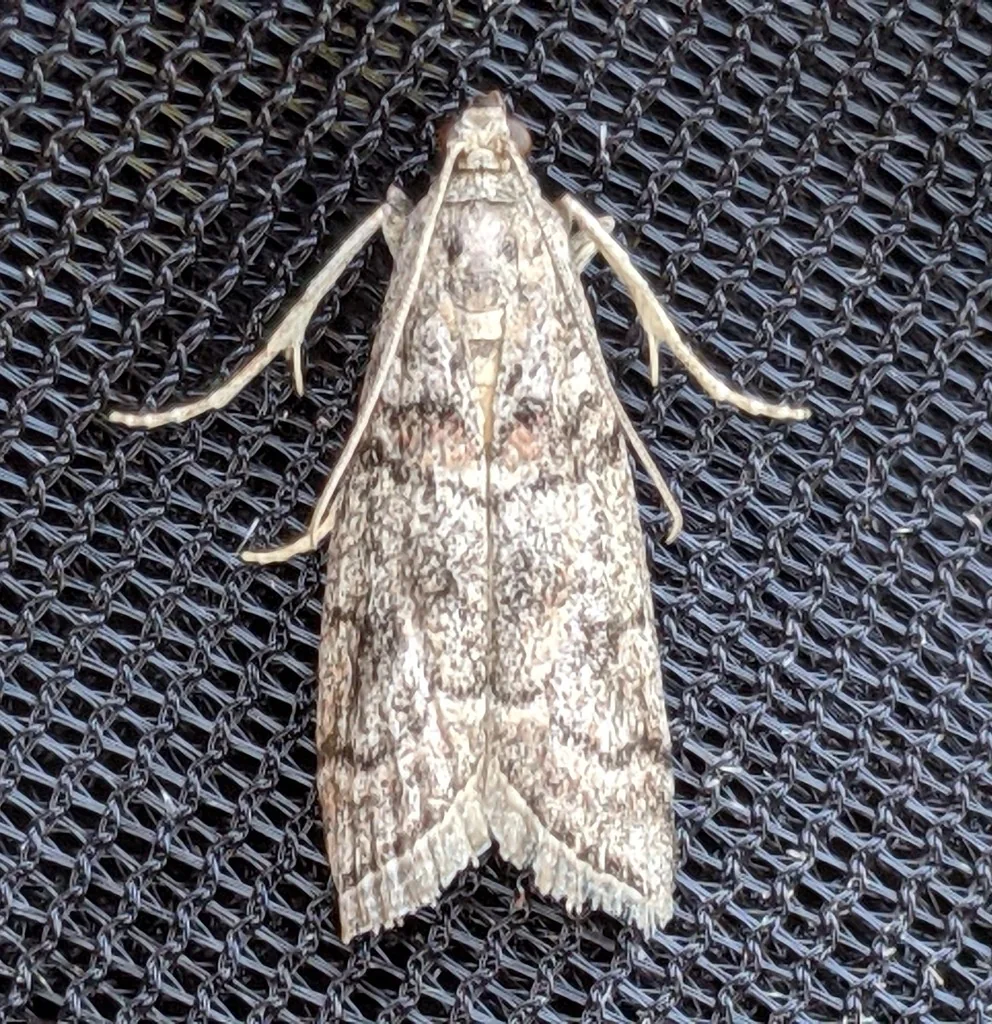
How to identify it
- The full-grown caterpillar is up to 20 mm long and green, with a yellowish-green back and a broad yellow stripe below the spiracles. The head is light green with dark mottling.[1]
- Natural Resources Canada says pupation takes place in June and July and the adults emerge from July to early August.[1]
- Caterpillars are found feeding in the open on conifer foliage from May to mid-June, one to a site.[1]
Look-alikes
| Look-alike | How to tell them apart |
|---|---|
| Dioryctria pseudotsugella | Dioryctria pseudotsugella is another innocuous pyralid defoliator on the same Douglas-fir and fir foliage in British Columbia, but its caterpillar is brown with a rusty back and creamy stripes rather than green, and it feeds from May to July.[3][1] |
Where it lives
Natural Resources Canada says it occurs throughout south coastal British Columbia and south to California. GBIF holds 45 U.S. records since 1990: 37 from Washington, 3 each from California and Oregon, and 2 from New Mexico.[1][4]
Biology and life cycle
Grand fir is the principal host, and it also occurs on amabilis fir. Natural Resources Canada lists amabilis fir, grand fir, Rocky Mountain Douglas-fir and western hemlock as main hosts and red alder, Sitka spruce, western redcedar and white spruce as secondary hosts.[1]
The moth appears to overwinter in the egg stage. Caterpillars are present from May to mid-June, pupation takes place from June to July, and the adults emerge from July to early August.[1]
It is a free-living solitary defoliator, feeding on and moving about freely on the foliage.[1]
Damage and signs
- Natural Resources Canada classes it as a common innocuous solitary defoliator and describes no damage.[1]
Health risk
Natural Resources Canada describes it only as a conifer defoliator and mentions no effect on people or pets.[1]
Control
Prevention
No control is needed: the insect is rated innocuous. A green, yellow-striped caterpillar found on grand fir or Douglas-fir needles in late spring can be left where it is.[1]
Where the sources disagree
Range: Natural Resources Canada describes it from south coastal British Columbia south to California, while GBIF's U.S. records since 1990 also include 3 from Oregon and 2 from New Mexico.[1][4]
Common questions
- Is Promylea lunigerella a pest?
- No. Natural Resources Canada classes it as a common innocuous solitary defoliator of grand fir and other conifers.[1]
- When and where would I find the caterpillar?
- From May to mid-June on the foliage of grand fir, amabilis fir, Douglas-fir or western hemlock on the Pacific coast, feeding singly in the open.[1]
Sources
- Natural Resources Canada, Canadian Forest Service, “Promylea lunigerella Ragonot, Trees, insects and diseases of Canada's forests.” tidcf.nrcan.gc.ca/en/insects/factsheet/11598 (accessed 2026-11-13)
- Butterflies and Moths of North America (BAMONA), “Promylea lunigerella (species account).” www.butterfliesandmoths.org/species/Promylea-lunigerella (accessed 2026-11-13)
- Natural Resources Canada, Canadian Forest Service, “Dioryctria moth (Dioryctria pseudotsugella), Trees, insects and diseases of Canada's forests.” tidcf.nrcan.gc.ca/en/insects/factsheet/11444 (accessed 2026-11-13)
- Global Biodiversity Information Facility (GBIF), “Promylea lunigerella: U.S. occurrence records since 1990 by state (GBIF occurrence search).” api.gbif.org/v1/occurrence/search?taxonKey=1877513&country=US&hasGeospatialIssue=false&occurrenceStatus=PRESENT&year=1990%2C2026&facet=stateProvince&facetLimit=400&limit=0 (accessed 2026-11-13)
- Global Biodiversity Information Facility (GBIF), “Promylea lunigerella Ragonot, 1887 (GBIF Backbone Taxonomy).” api.gbif.org/v1/species/1877513 (accessed 2026-11-13)
- iNaturalist, “Promylea lunigerella taxon page (order and family).” www.inaturalist.org/taxa/477707 (accessed 2026-11-10)