On this page
How to identify it
- The mature caterpillar is up to 25 mm long. Its back is tan with a rusty tinge, with a creamy yellow stripe edged by fine dark lines on each side of the back and a broad yellow stripe, also edged with fine dark lines, along the breathing pores. The tan areas turn green just before pupation.[1]
- Its head is tan with black spots; Western Forest Insects describes it as square, tan on the top and sides and pale yellow in front.[1][2]
- Partly eaten needles litter heavily infested trees, because the caterpillar often eats only part of a needle and then chews it off at the base. The accumulated needles make the tree look scorched.[1]
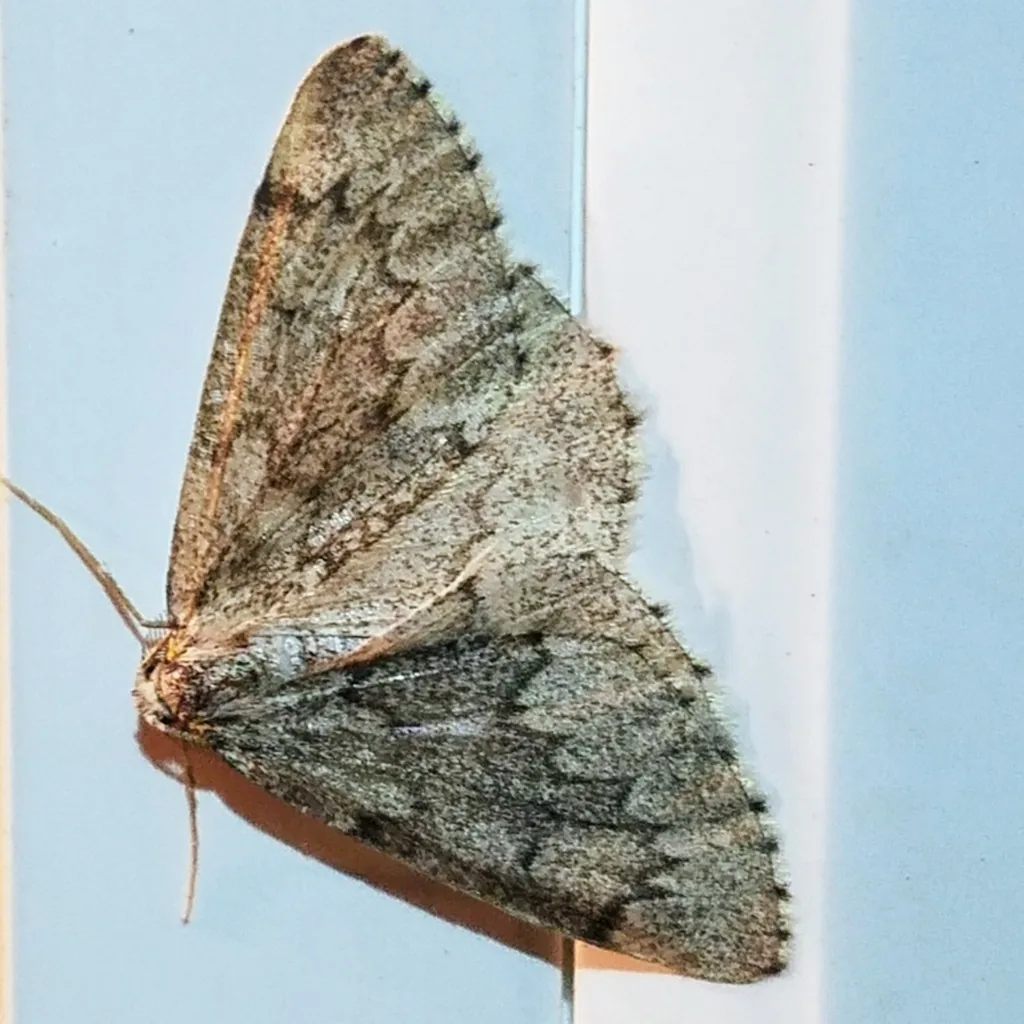
- BAMONA gives the moth's wingspan as about 2.2 cm, and Western Forest Insects figures an adult with a 25 mm wingspread. The moth resembles the phantom hemlock looper's, but its wings are gray rather than white and the top of its head is gray, without yellow tints.[3][2]
- Western Forest Insects describes the mature larva as 24 to 32 mm long and slim, alternately striped with tan and yellow outlined in black above, and pinkish below.[2]
Look-alikes
| Look-alike | How to tell them apart |
|---|---|
| Phantom hemlock looper | Natural Resources Canada describes the phantom hemlock looper (Nepytia phantasmaria) caterpillar with a green head bearing ten prominent black spots, a yellowish green back and white stripes on each side of the back; the western false hemlock looper's head and back are tan, with creamy yellow stripes. Western Forest Insects says phantom hemlock looper adults are generally white to very light gray with strong black markings and a yellowish top of the head, and that it occurs in British Columbia, Oregon and California.[4][1][2] |
| False hemlock looper (Nepytia canosaria) | Western Forest Insects says this eastern species attacks various conifers in the Eastern States and Provinces and extends into Manitoba and Saskatchewan on spruce; earlier records of it from the Rocky Mountains westward generally refer to N. freemani.[2] |
Where it lives
Natural Resources Canada records it in British Columbia and the United States; Western Forest Insects gives British Columbia, Idaho and Utah; BAMONA gives British Columbia and Alberta, and Washington to Montana and Utah, in montane coniferous forest. GBIF holds 35 U.S. records since 1990, from Montana (15), Idaho (9), Washington (6) and Colorado (4).[1][2][3][5]
Biology and life cycle
Natural Resources Canada's main hosts are Engelmann spruce, ponderosa pine, Rocky Mountain Douglas-fir, subalpine fir and western hemlock.[1]
The egg overwinters. Adults emerge from August to October, and females lay an average of 70 eggs on both sides of the needles. Western Forest Insects says the eggs are laid in late summer and early fall in small clusters on the needles and hatch in spring, with one generation a year.[1][2]
The caterpillars emerge in late May and feed first on the new growth, then move toward the trunk onto older foliage.[1]
They are solitary, wasteful feeders, often eating only part of a needle and chewing it off at the base. Pupation takes place on twigs or foliage in late July or August.[1]
Researchers in British Columbia identified 3,13-dimethylheptadecane as the major sex pheromone component; traps baited with it attracted large numbers of males, and the authors suggest it may already be used to monitor populations. A later study found the (3S,13R) form is the major component, and a blend of all four forms was 3.6 times more attractive than it alone.[6][7]
Western Forest Insects says Douglas-fir is the preferred host in British Columbia and white fir in Utah, with western larch, western hemlock and Engelmann spruce also fed upon; new foliage is eaten first, then the old.[2]
Damage and signs
- Natural Resources Canada calls it a common and occasionally destructive solitary defoliator. The build-up of partly eaten needles makes heavily infested trees appear scorched. Western Forest Insects says local outbreaks occur in pole- and sapling-sized stands but so far have not caused damage warranting control.[1][2]
Health risk
It is a conifer defoliator. Natural Resources Canada, the USDA Forest Service manual and BAMONA don't mention any risk to people or pets.[1][2][3]
Control
Prevention
Natural Resources Canada gives no control measures, and Western Forest Insects says local outbreaks have so far not caused damage warranting control. The pheromone researchers suggest baited traps could be used to monitor populations.[1][2][6]
Where the sources disagree
Hosts: Natural Resources Canada lists Engelmann spruce, ponderosa pine, Rocky Mountain Douglas-fir, subalpine fir and western hemlock as main hosts; Western Forest Insects names white fir as the preferred host in Utah and adds western larch; BAMONA lists only Douglas-fir.[1][2][3]
Range: BAMONA includes Alberta and Utah, and Western Forest Insects names British Columbia, Idaho and Utah; GBIF's U.S. records since 1990 come from Montana, Idaho, Washington and Colorado, with none from Utah.[3][2][5]
Caterpillar size: Natural Resources Canada says up to 25 mm; Western Forest Insects gives 24 to 32 mm.[1][2]
Seriousness: Natural Resources Canada calls it occasionally destructive; Western Forest Insects says its outbreaks have so far not caused damage warranting control.[1][2]
Common questions
- Why does my Douglas-fir look scorched, with half-eaten needles everywhere?
- A looper that eats only part of each needle and then chews it off at the base produces that scorched look. In British Columbia and the interior West, the western false hemlock looper is one such caterpillar; look for slim inchworms with a tan, black-spotted head and yellow side stripes.[1]
- Is the western false hemlock looper a serious pest?
- Natural Resources Canada calls it common and occasionally destructive, but the USDA Forest Service manual says its local outbreaks in pole- and sapling-sized stands have so far not caused damage warranting control. Neither gives control measures.[1][2]
Sources
- Natural Resources Canada, Canadian Forest Service, “Western false hemlock looper, Trees, insects and diseases of Canada's forests.” tidcf.nrcan.gc.ca/en/insects/factsheet/1000001 (accessed 2026-11-14)
- USDA Forest Service, “Western Forest Insects, Miscellaneous Publication 1339 (R. L. Furniss and V. M. Carolin, November 1977; scanned copy).” archive.org/details/CAT78702369 (accessed 2026-11-14). Scanned USDA publication on the Internet Archive; full text read through archive.org's own djvu.txt download.
- Butterflies and Moths of North America (BAMONA), “Nepytia freemani (Munroe, 1963).” www.butterfliesandmoths.org/species/Nepytia-freemani (accessed 2026-11-14)
- Natural Resources Canada, Canadian Forest Service, “Phantom hemlock looper, Trees, insects and diseases of Canada's forests.” tidcf.nrcan.gc.ca/en/insects/factsheet/1000004 (accessed 2026-11-14)
- Global Biodiversity Information Facility (GBIF), “Nepytia freemani: U.S. occurrence records since 1990 by state (GBIF occurrence API).” api.gbif.org/v1/occurrence/search?taxonKey=1971997&country=US&hasGeospatialIssue=false&occurrenceStatus=PRESENT&year=1990%2C2026&facet=stateProvince&facetLimit=400&limit=0 (accessed 2026-11-14). 35 records from 4 states (Montana 15, Idaho 9, Washington 6, Colorado 4); fetched 2026-11-13.
- Journal of Chemical Ecology (via PubMed), “Gries et al. 1993, 3,13-Dimethylheptadecane: major sex pheromone component of the western false hemlock looper, Nepytia freemani (J. Chem. Ecol. 19:1501-10).” pubmed.ncbi.nlm.nih.gov/24249179/ (accessed 2026-11-14). Cited from the abstract, read through NCBI E-utilities.
- Journal of Chemical Ecology (via PubMed), “King, Gries, Gries and Slessor 1995, Optical isomers of 3,13-dimethylheptadecane: sex pheromone components of the western false hemlock looper (J. Chem. Ecol. 21:2027-45).” pubmed.ncbi.nlm.nih.gov/24233904/ (accessed 2026-11-14). Cited from the abstract, read through NCBI E-utilities.
- Global Biodiversity Information Facility (GBIF), “Nepytia freemani Munroe, 1963 (GBIF Backbone Taxonomy).” api.gbif.org/v1/species/1971997 (accessed 2026-11-14). ACCEPTED; order Lepidoptera, family Geometridae; vernacular name Western False Hemlock Looper