On this page
How to identify it
- The first sign, in May and June, is tiny caterpillars inside needle tubes or bundles of larch needles webbed together with silk. Older caterpillars wrap silk around longer bundles to make compact tubes.[1]
- Natural Resources Canada's photographs show a caterpillar 10 to 12 mm long and a pupa about 8 mm long.[1]
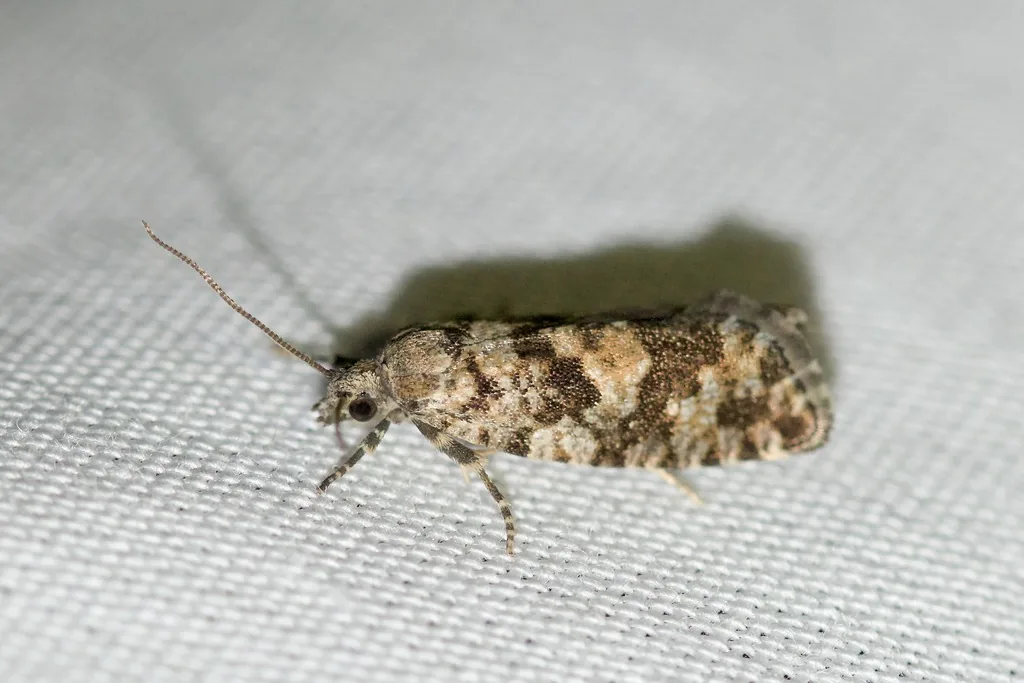
- The adult in Natural Resources Canada's photograph has a wingspan of about 17 mm.[1]
- Heavily infested larch turn red and put out shorter new needles later in the season.[1]
Look-alikes
| Look-alike | How to tell them apart |
|---|---|
| Spruce bud moth | A USDA Forest Service Alaska survey report groups the larch needleworm with the spruce bud moth (Zeiraphera canadensis) and other Zeiraphera species under one entry, with spruce and larch as preferred hosts. The sources read give no feature for telling the caterpillars apart; host tree is the practical clue.[3] |
Where it lives
Natural Resources Canada describes outbreaks on western larch in British Columbia and on tamarack in eastern Canada, with later isolated pockets in Ontario and eastern Quebec. A USDA Forest Service species review lists it as an insect pest of western larch, and the Forest Service's Alaska region says the Zeiraphera bud moths occur throughout the range of spruce and larch statewide. GBIF holds 81 records, 52 from Canada and 27 from the US; its 15 US records since 1990 come from New Jersey, Alaska, New Hampshire, Montana and Washington.[1][2][3][6][7]
Biology and life cycle
Natural Resources Canada lists black spruce and tamarack as its main hosts. A USDA Forest Service species review names it among the insect pests of western larch, and the Forest Service's Alaska region lists spruce and larch as preferred hosts of its Zeiraphera bud moths, with true firs as occasional hosts.[1][2][3]
Eggs are laid in clusters and tucked into cones of the current year's crop. They hatch the following spring, and the young caterpillars feed on bundles of young needles.[1]
Older caterpillars attack longer bundles of needles, wrapping silk around them to form compact tubes. When feeding is finished they drop to the ground and spin a cocoon in the litter, where they pupate.[1]
The insect was first reported in Canada in 1937, having long been confused with the European Zeiraphera diniana.[1]
The first recorded infestation was in 1965 on western larch in British Columbia. By the early 1970s the only outbreaks reported were on tamarack in eastern Canada, and after a decline in 1975 only isolated pockets remained in Ontario and eastern Quebec.[1]
Damage and signs
- When the caterpillar population is large, severe defoliation turns the trees red and reduces their growth. Because the feeding comes early in the season, the trees produce new needles before winter, although these are shorter than normal.[1]
- Natural Resources Canada says outbreaks are usually short-lived and not very extensive. A 1981 USDA Forest Service research note from Alaska says the eastern larch beetle normally attacks tamarack stands that have been weakened, in some instances by defoliation during outbreaks of the larch sawfly or the larch budmoth.[1][4]
- The Forest Service's Alaska region recorded no larch bud moth activity in its 2024 surveys.[3]
Health risk
Natural Resources Canada and the USDA Forest Service describe it only as a defoliator of larch and spruce; no cited source describes any risk to people or pets.[1][2]
Control
Prevention
Natural Resources Canada says no control measures are required, because tamarack stands cover a small area and infestations are short. A reddened larch produces a new flush of shorter needles before winter.[1]
Where the sources disagree
Hosts: Natural Resources Canada lists black spruce and tamarack as main hosts; the USDA Forest Service species review names it as a pest of western larch, and the Forest Service's Alaska region lists spruce and larch as preferred hosts of its Zeiraphera bud moths and true firs as occasional hosts.[1][2][3]
Impact: Natural Resources Canada calls outbreaks short-lived and not very extensive and says no control is required; a 1981 Forest Service research note from Alaska lists larch budmoth defoliation as one way tamarack stands are weakened before eastern larch beetle attack.[1][4]
Name: Natural Resources Canada lists Zeiraphera diniana as a synonym, but also says the North American insect was long confused with that European species; GBIF lists Zeiraphera improbana (Walker, 1863) as an accepted species.[1][5]
Common questions
- Why is my tamarack turning red in early summer?
- Caterpillars of the larch needleworm web bundles of young needles into silk tubes in May and June, and heavy feeding reddens the tree. The tree normally grows a new set of shorter needles before winter.[1]
- Is the larch needleworm the European larch bud moth?
- Natural Resources Canada says the larch needleworm (Zeiraphera improbana) was long confused with the European species Zeiraphera diniana, and lists Z. diniana among its synonyms; it was first reported in Canada in 1937.[1]
- Do I need to spray?
- Natural Resources Canada says no control measures are required; outbreaks are short-lived and the trees refoliate the same season.[1]
Sources
- Natural Resources Canada, Canadian Forest Service, “Larch needleworm, Trees, insects and diseases of Canada's forests.” tidcf.nrcan.gc.ca/en/insects/factsheet/11213 (accessed 2026-11-13)
- USDA Forest Service, Rocky Mountain Research Station, “Larix occidentalis, western larch (J. S. Scher, 2002), Fire Effects Information System.” research.fs.usda.gov/feis/species-reviews/larocc (accessed 2026-11-13)
- USDA Forest Service, Alaska Region (R10), “Forest Health Conditions in Alaska: Species Updates 2024.” www.fs.usda.gov/sites/nfs/files/r10/publication/ForestHealthConditionsinAlaska_SpeciesUpdates2024.pdf (accessed 2026-11-13)
- USDA Forest Service, Pacific Northwest Forest and Range Experiment Station (Treesearch), “Effects on eastern larch beetle of its natural attractant and synthetic pheromones in Alaska, Research Note PNW-371 (R. A. Werner and others, 1981).” research.fs.usda.gov/download/treesearch/7637.pdf (accessed 2026-11-13)
- Global Biodiversity Information Facility (GBIF), “Zeiraphera improbana (Walker, 1863) (GBIF Backbone Taxonomy).” api.gbif.org/v1/species/11813928 (accessed 2026-11-13)
- Global Biodiversity Information Facility (GBIF), “Zeiraphera improbana: occurrence records by country (GBIF occurrence search).” api.gbif.org/v1/occurrence/search?taxonKey=11813928&facet=country&facetLimit=20&limit=0 (accessed 2026-11-13)
- Global Biodiversity Information Facility (GBIF), “Zeiraphera improbana: U.S. occurrence records since 1990 by state (GBIF occurrence search).” api.gbif.org/v1/occurrence/search?taxonKey=11813928&country=US&hasGeospatialIssue=false&occurrenceStatus=PRESENT&year=1990%2C2026&facet=stateProvince&facetLimit=400&limit=0 (accessed 2026-11-13)