On this page
How to identify it
- The full-grown caterpillar is up to 42 mm long and comes in two distinct forms. The common form ranges from dark brown to pale grey, with a pale grey head marked dark on each lobe; the top of each abdominal segment carries a pair of dark spots in its front third (faint on light individuals) and a pair of dark D-shaped marks near its rear edge.[1]
- The second form is rusty brown with a broken creamy yellow stripe down the middle of the back and prominent yellow spots along the sides.[1]
- Caterpillars are present from June to September on Douglas-fir, lodgepole pine, ponderosa pine, western white pine or western hemlock, and the moths fly in September and October.[1]
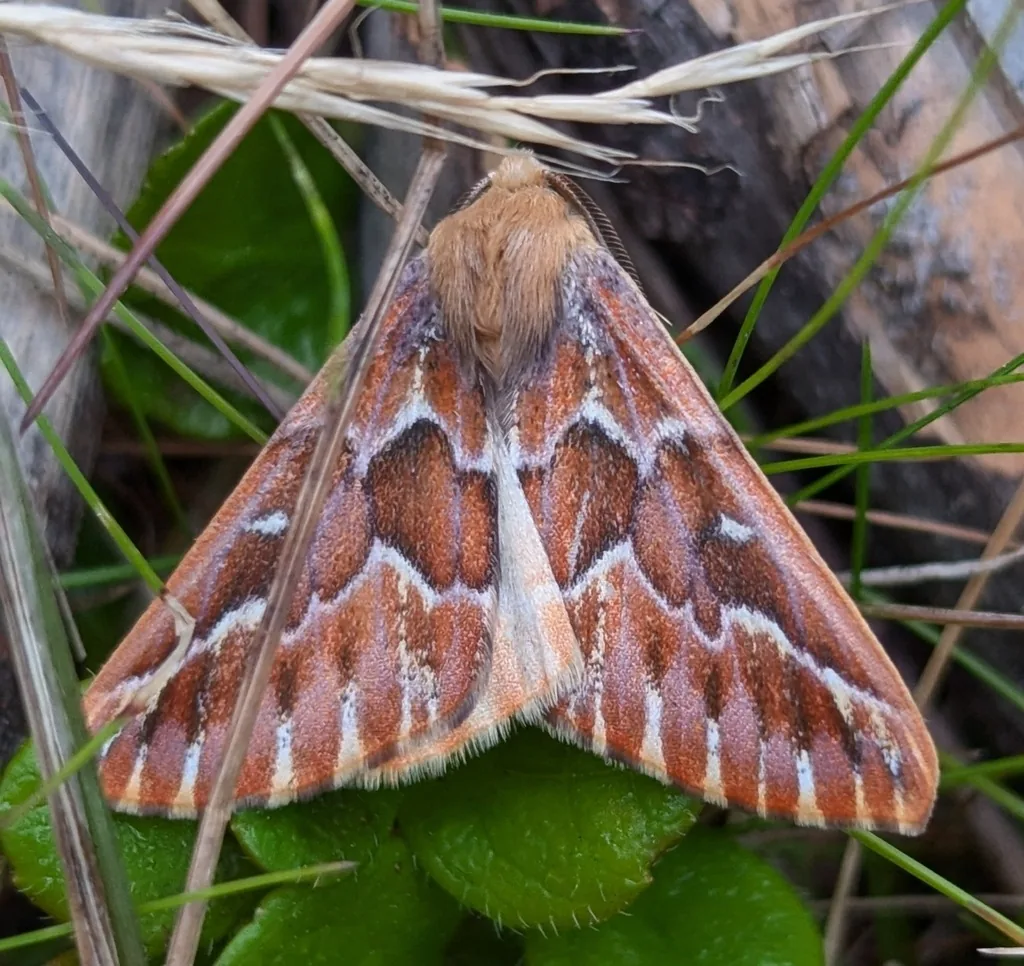
- The moth's forewing is pale red-brown with two jagged median lines, a small pale discal spot and prominent orange dashes near the outer margin; the wingspan is about 4.0 cm.[3]
Look-alikes
| Look-alike | How to tell them apart |
|---|---|
| Variable girdle moth (Enypia venata) | Another western conifer-feeding geometrid. Its moth is grey with heavy speckling and a black discal spot, not the small pale spot of Caripeta.[3][4] |
| Gray spruce looper (Caripeta divisata) | Western Forest Insects says the western conifer looper resembles the gray forest looper, C. divisata, as a larva but is much less common in British Columbia. C. divisata's mature larva is about 37 mm long, with a pale brown head with dark herringbone markings and a yellowish and gray or brown body with off-white or yellowish stripes, and its pupae overwinter, whereas the western conifer looper overwinters as an egg.[2][1] |
Where it lives
Natural Resources Canada records it from the south coast and southern interior of British Columbia, mountainous western Alberta and south to Oregon; Western Forest Insects lists Oregon, British Columbia and Alberta. GBIF holds about 2,200 records, about 1,580 from the US and 600 from Canada; its roughly 1,280 US records since 1990 come mostly from California, Colorado, Arizona, Montana and Washington.[1][2][5][6]
Biology and life cycle
The principal hosts are Douglas-fir, lodgepole pine and ponderosa pine; western white pine and western hemlock are also fed on. The caterpillar is a free-living defoliator that moves about on the foliage.[1]
The species overwinters as an egg. Caterpillars feed from June to September, pupate in September, and the moths emerge from September to October.[1]
Western Forest Insects lists Douglas-fir, pine and hemlock as its food plants.[2]
Damage and signs
Health risk
Natural Resources Canada describes it only as a needle-feeding caterpillar of conifers; no cited source describes any risk to people or pets.[1]
Control
Prevention
No control is recommended. Natural Resources Canada rates it a relatively uncommon solitary defoliator, and the USDA Forest Service manual records no significant damage from Caripeta larvae.[1][2]
Where the sources disagree
Range: Natural Resources Canada describes British Columbia, western Alberta and south to Oregon, and Western Forest Insects lists Oregon, British Columbia and Alberta, but most of GBIF's US records since 1990 come from California, Colorado and Arizona.[1][2][6]
Common name: Butterflies and Moths of North America calls it the western conifer looper; GBIF's vernacular name is red girdle moth.[3][7]
Common questions
- What is the large grey or brown inchworm on my Douglas-fir?
- In British Columbia, Alberta or Oregon, a grey-to-brown inchworm up to 42 mm long with paired dark spots and D-shaped marks on its back, feeding on Douglas-fir or pine needles between June and September, matches the western conifer looper.[1]
- Does it harm the tree?
- No meaningful harm is recorded. Natural Resources Canada rates it a relatively uncommon solitary defoliator and records no outbreaks, and the USDA Forest Service says Caripeta larvae cause no significant damage.[1][2]
- When do the moths fly?
- Adults emerge from September to October, and the eggs they lay overwinter.[1]
Sources
- Natural Resources Canada, Canadian Forest Service, “Caripeta aequaliaria, Trees, insects and diseases of Canada's forests.” tidcf.nrcan.gc.ca/en/insects/factsheet/8494 (accessed 2026-11-14)
- USDA Forest Service, “Western Forest Insects, Miscellaneous Publication 1339 (R. L. Furniss and V. M. Carolin, November 1977; scanned copy).” archive.org/details/CAT78702369 (accessed 2026-11-14). Scanned USDA publication on the Internet Archive; full text read through archive.org's own djvu.txt download.
- Butterflies and Moths of North America (BAMONA), “Western Conifer Looper, Caripeta aequaliaria (species account).” www.butterfliesandmoths.org/species/Caripeta-aequaliaria (accessed 2026-11-14)
- Butterflies and Moths of North America (BAMONA), “Variable Girdle Moth, Enypia venata (species account).” www.butterfliesandmoths.org/species/Enypia-venata (accessed 2026-11-14)
- Global Biodiversity Information Facility (GBIF), “Caripeta aequaliaria: occurrence records by country (GBIF occurrence search).” api.gbif.org/v1/occurrence/search?taxonKey=5144583&facet=country&facetLimit=20&limit=0 (accessed 2026-11-14)
- Global Biodiversity Information Facility (GBIF), “Caripeta aequaliaria: U.S. occurrence records since 1990 by state (GBIF occurrence search).” api.gbif.org/v1/occurrence/search?taxonKey=5144583&country=US&hasGeospatialIssue=false&occurrenceStatus=PRESENT&year=1990%2C2026&facet=stateProvince&facetLimit=400&limit=0 (accessed 2026-11-14)
- Global Biodiversity Information Facility (GBIF), “Caripeta aequaliaria Grote, 1883 (GBIF Backbone Taxonomy).” api.gbif.org/v1/species/5144583 (accessed 2026-11-14)