On this page
How to identify it
- The grown caterpillar is a large inchworm, up to 37 mm long, green with broad whitish-green stripes along the back and a narrow white stripe low on each side. Each spiracle is marked by a prominent yellow spot, and the head is plain green.[1]
- The moths are on the wing early: Natural Resources Canada gives mid-March on the south coast to mid-June in the central interior, and on Vancouver Island they emerged in April or May.[1][2]
- Feeding is heaviest in the upper crown, and the caterpillars prefer the previous year's needles.[1][2]
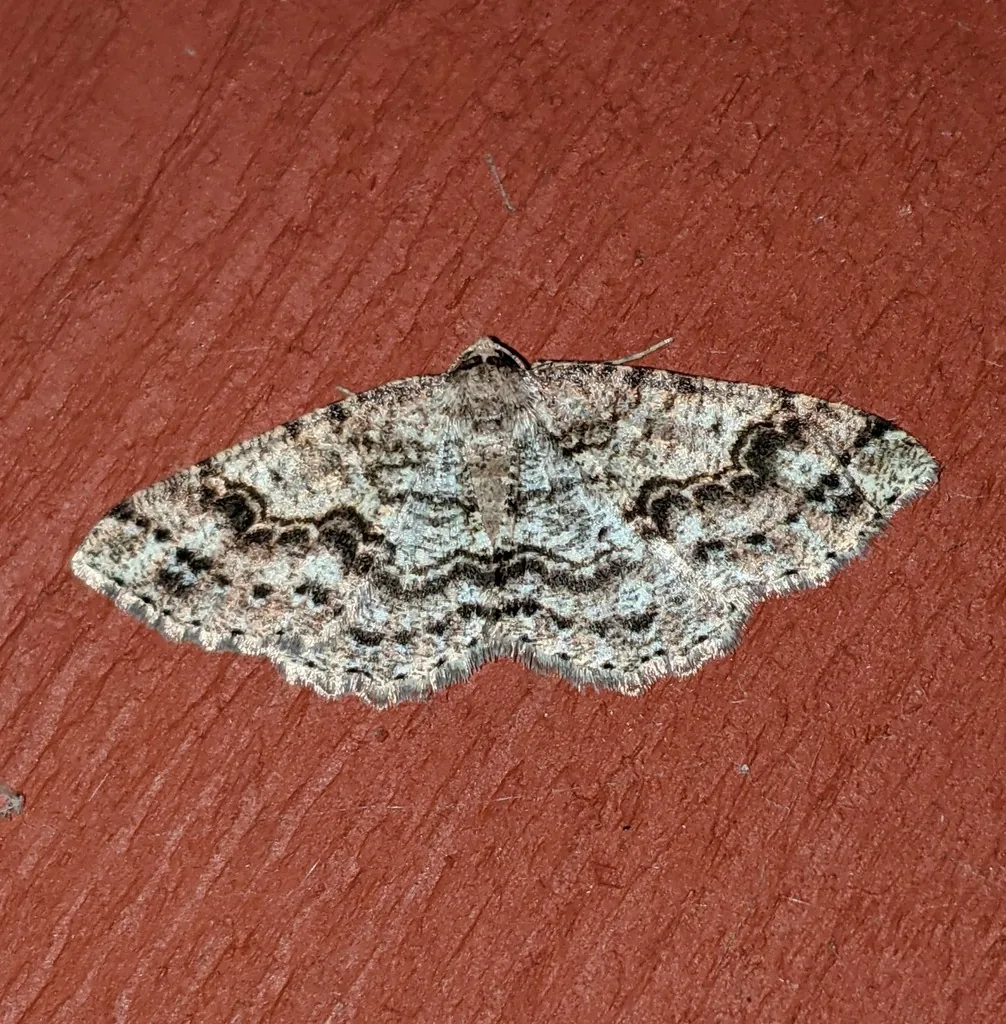
- The USDA Forest Service manual describes the moth as mottled gray brown with a wingspread of 25 to 39 mm and the mature caterpillar as apple green with whitish and yellowish stripes, 30 to 37 mm long.[7]
Look-alikes
| Look-alike | How to tell them apart |
|---|---|
| Gray spruce looper | Also a solitary looper on western hemlock, Sitka spruce and other conifers, but its grown caterpillar is yellow to light brown with wavy rusty brown to gray lines on the back and a pale brown head with a dark herringbone pattern.[3][1] |
| Phantom hemlock looper (Nepytia phantasmaria) | A looper the Forest Service manual lists as commonly associated with this one on Pacific coast conifers. Its grown caterpillar is smaller, 28 mm long, lime green with a green, black-dotted head and dark-edged yellowish lines, and its moth is white to very light gray with strong black markings rather than mottled gray brown.[7] |
| Western hemlock looper (Lambdina fiscellaria lugubrosa) | Another commonly associated geometrid in the same forests. The Forest Service manual says it is periodically destructive in coastal forests of Oregon, Washington and British Columbia, where outbreaks develop in stands dominated by its preferred host, western hemlock.[7] |
Where it lives
Natural Resources Canada lists it in British Columbia. GBIF holds about 1,000 U.S. records since 1990 from 8 state-level areas, the most from California (299), Washington (271), Oregon (218) and Alaska (144). The USDA Forest Service's Western Forest Insects says it is distributed along the Pacific coast from Alaska to southern California and east to Alberta, with a preference for the more humid areas.[1][4][7]
Biology and life cycle
The caterpillars are solitary feeders on conifers. Natural Resources Canada's main hosts are amabilis, grand and subalpine fir; Engelmann, Sitka and white spruce; mountain and western hemlock; Rocky Mountain Douglas-fir; western larch; western redcedar; and western white pine. On Vancouver Island, western hemlock was the preferred host. The USDA Forest Service manual names Douglas-fir, western hemlock, western redcedar, true firs and spruce as the principal hosts.[1][2][7]
The insect overwinters as a pupa buried in the duff. Natural Resources Canada says the moths emerge from mid-March on the south coast to mid-June in the central interior and each female lays up to 80 eggs singly on branches and trunks.[1][2]
The young caterpillars feed first on the undersides of needles; later stages feed openly, taking foliage of all ages but preferring the previous year's needles, mostly in the upper crown.[1][2]
Feeding is finished by early August. The caterpillars then drop to the ground, burrow into the litter and pupate. The Forest Service manual says the larvae drop in late summer, overwinter as pupae in the duff, and complete one generation a year.[1][7]
Damage and signs
- Severe defoliation can kill tree tops and occasionally whole trees. On Vancouver Island it was not regarded as dangerous until 1960, when heavy defoliation was recorded in 32 localities over 22,755 acres, 4,640 of them heavily defoliated. Trees died only where they were 90 percent or more defoliated, and tree mortality up to the fall of 1961 was estimated at 2,400,000 cubic feet of western hemlock.[1][2]
- Natural Resources Canada records outbreaks on the west coast of Vancouver Island in 1952 and 1963, on the Queen Charlotte Islands in 1963 and near Revelstoke in 1952. The 1960 population fell in 1961; parasites and the fungus Cordyceps militaris were among the causes.[1][2]
- The USDA Forest Service manual says the looper is normally quite abundant but was not considered destructive until 1960 and 1961, when an epidemic killed some 2,400,000 cubic feet of western hemlock on the west coast of Vancouver Island. Extensive outbreaks followed in 1963-64 on the Queen Charlotte Islands and in 1968-69 on Vancouver Island, and all three subsided abruptly from natural causes.[7]
Health risk
It is a conifer defoliator. Natural Resources Canada and the 1962 Vancouver Island study don't mention any risk to people or pets. Neither does the USDA Forest Service's Western Forest Insects.[1][2][7]
Control
Prevention
Natural Resources Canada suggests no control. During the 1960 outbreak chemical control was not recommended, though it was considered a possibility for 1961; the population then fell on its own. The USDA Forest Service manual likewise gives no control and says each of its three recorded outbreaks subsided abruptly from natural causes.[1][2][7]
Where the sources disagree
Moth flight: Natural Resources Canada gives mid-March to mid-June depending on the region; the Vancouver Island study says April or May. The USDA Forest Service manual gives mid-March to mid-June.[1][2][7]
Caterpillar season: Natural Resources Canada says feeding ends by early August; the Vancouver Island study says the larvae feed from June to September.[1][2]
Eggs: Natural Resources Canada says up to 80 per female; the Vancouver Island study says an average of 80.[1][2]
Outbreak years: Natural Resources Canada lists 1952 and 1963 on the west coast of Vancouver Island; the 1962 study describes the heavy 1960 outbreak there and says defoliation in 1952 did not exceed 30 percent.[1][2]
Name: BAMONA and GBIF list the moth as the western carpet.[5][6]
Common questions
- What is the big green inchworm with white stripes on my hemlock or Douglas-fir?
- On the Pacific coast, a green looper up to 37 mm long with whitish-green stripes down the back, a plain green head and a yellow spot at each spiracle is the greenstriped forest looper.[1]
- Is it a serious pest?
- Usually not. Natural Resources Canada calls it common and occasionally destructive, but the 1960 outbreak on Vancouver Island killed an estimated 2,400,000 cubic feet of western hemlock by the fall of 1961, and severe defoliation can kill tree tops.[1][2]
- Where does the greenstriped forest looper live?
- Along the Pacific coast from Alaska to southern California and east to Alberta, mostly in the more humid forests, the USDA Forest Service says. Natural Resources Canada lists it in British Columbia.[7][1]
Sources
- Natural Resources Canada, Canadian Forest Service, “Greenstriped forest looper, Trees, insects and diseases of Canada's forests.” tidcf.nrcan.gc.ca/en/insects/factsheet/1000022 (accessed 2026-11-14)
- Entomological Society of British Columbia, “The green-striped forest looper on Vancouver Island (G. T. Silver, D. G. Collis, N. E. Alexander and S. J. Allen, 1962), Journal of the Entomological Society of British Columbia 59: 29-32.” journal.entsocbc.ca/index.php/journal/article/download/1429/1507/3165 (accessed 2026-11-13). Canada Department of Forestry authors; article page https://journal.entsocbc.ca/index.php/journal/article/view/1429
- Natural Resources Canada, Canadian Forest Service, “Gray spruce looper, Trees, insects and diseases of Canada's forests.” tidcf.nrcan.gc.ca/en/insects/factsheet/8496 (accessed 2026-11-13)
- Global Biodiversity Information Facility (GBIF), “Melanolophia imitata: U.S. occurrence records since 1990 by state (GBIF occurrence API).” api.gbif.org/v1/occurrence/search?taxonKey=1962727&country=US&hasGeospatialIssue=false&occurrenceStatus=PRESENT&year=1990%2C2026&facet=stateProvince&facetLimit=400&limit=0 (accessed 2026-11-13). 1,033 records from 8 state-level areas; California 299, Washington 271, Oregon 218, Alaska 144; fetched 2026-11-13.
- Butterflies and Moths of North America (BAMONA), “Western Carpet, Melanolophia imitata (Walker, 1860).” www.butterfliesandmoths.org/species/Melanolophia-imitata (accessed 2026-11-13). Cited only for the moth's common name; the page's text fields are empty.
- Global Biodiversity Information Facility (GBIF), “Melanolophia imitata (Walker, 1860) (GBIF Backbone Taxonomy).” api.gbif.org/v1/species/1962727 (accessed 2026-11-13). ACCEPTED; order Lepidoptera, family Geometridae; vernacular name Western Carpet
- USDA Forest Service (scan at Internet Archive), “Western Forest Insects (R. L. Furniss and V. M. Carolin, issued November 1977).” archive.org/details/CAT78702369 (accessed 2026-11-14)