On this page
How to identify it
- The full-grown caterpillar is up to 35 mm long, elongate and twig-like, and highly variable in color: rusty brown is most common, but it ranges from light tan to dark grey. The head is tan with rust mottling and moderately notched at the top.[1]
- Prominent bumps (tubercles) sit below the spiracles on the second abdominal segment, and raised pairs of dark tubercles run along the back near the rear edge of abdominal segments 2 through 8.[1]
- A USDA Forest Service guide notes that the caterpillar varies in color (shades of off-white, brown and gray) and pattern, and that its lack of notable features, together with mature larvae turning up in early spring, is the best clue to its identity.[2]
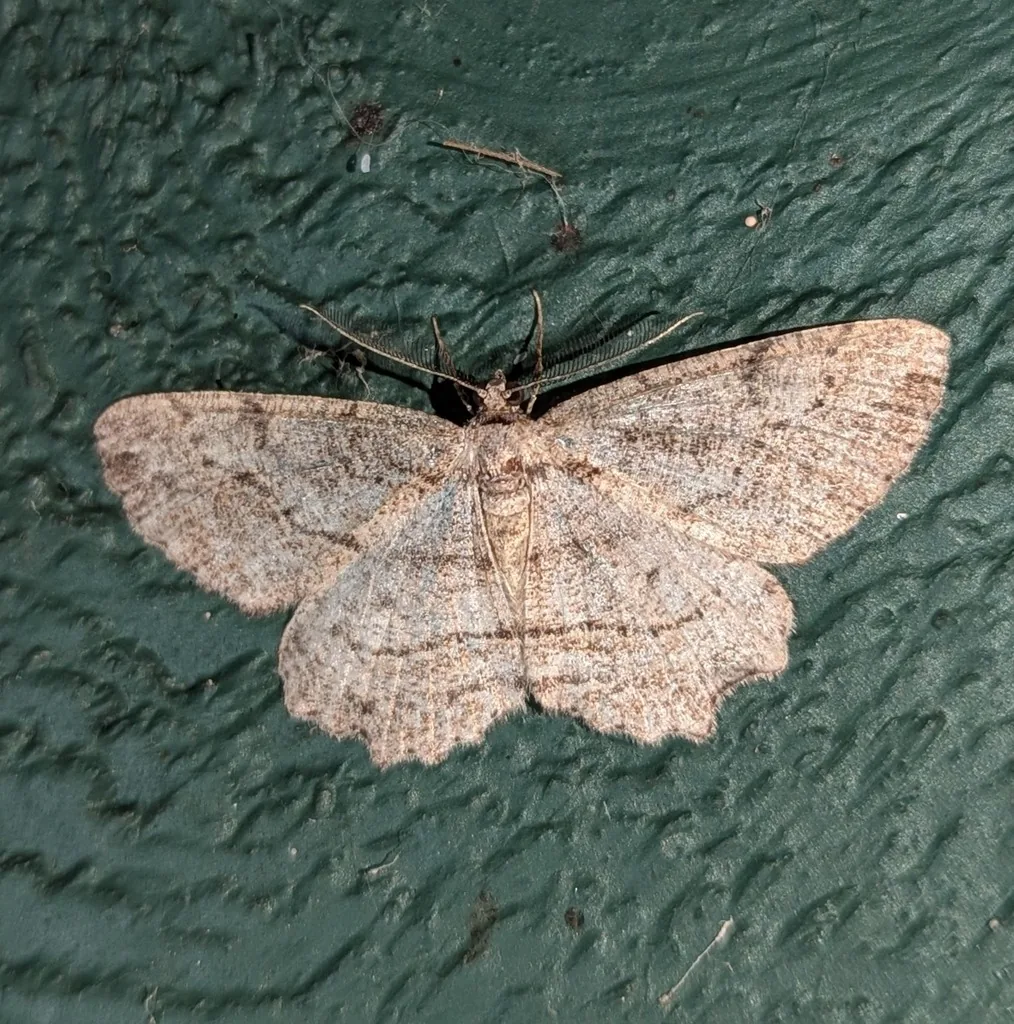
- The moth has a wingspan of about 3.6 cm, with forewings mottled cream to dark brown and crossed by wavy dark lines.[2]
Where it lives
Natural Resources Canada records it in British Columbia; the USDA Forest Service guide says it is distributed from California to British Columbia and is particularly common west of the Cascade Mountains. GBIF holds about 3,900 records, about 2,500 from the US and about 1,500 from Canada; its US records since 1990 come from California, Washington, Oregon and Alaska.[1][2][4][5]
Biology and life cycle
The caterpillar is a solitary, free-living defoliator that feeds on and moves about the foliage. Natural Resources Canada lists grand fir, Rocky Mountain Douglas-fir, western hemlock and western redcedar as its main hosts; the USDA Forest Service guide adds broadleaf trees and shrubs (see Where the sources disagree).[1][2]
The species overwinters as a part-grown (mid-instar) caterpillar. Feeding resumes in spring and continues until June; pupation is in June or July; the moths emerge in August, mate and lay eggs, and the new caterpillars hatch soon after and feed into the fall.[1]
The USDA guide lists it among the few common Pacific Northwest moths that overwinter as caterpillars, and says the adults are nocturnal and fly from late summer into fall.[2]
Damage and signs
Health risk
Natural Resources Canada and the USDA Forest Service guide describe it only as a foliage feeder; no cited source describes any risk to people or pets.[1][2]
Control
Prevention
Neither source recommends any control; Natural Resources Canada classes it as innocuous.[1][2]
Where the sources disagree
Hosts: Natural Resources Canada lists only conifers (grand fir, Rocky Mountain Douglas-fir, western hemlock and western redcedar); the USDA Forest Service guide says the caterpillars feed on broadleaf trees such as big-leaf maple and serviceberry, shrubs such as myrica and blueberry, and conifers such as pines and Douglas-fir.[1][2]
Impact: Natural Resources Canada calls it an innocuous solitary defoliator; the USDA guide calls it the most abundant moth species capable of feeding extensively on the foliage of numerous conifers and broadleaf plants from fall into the following early summer.[1][2]
Range: Natural Resources Canada gives British Columbia and the USDA guide California to British Columbia; GBIF's US records since 1990 also include Alaska.[1][2][5]
Common questions
- What is the twig-like brown inchworm with bumps on my Douglas-fir?
- In the Pacific Northwest, an elongate twig-mimic caterpillar up to 35 mm long, rusty brown to grey, with paired dark bumps along its back and a bump below the spiracle on the second abdominal segment, matches Natural Resources Canada's description of the brownlined looper.[1]
- Will it hurt the tree?
- Natural Resources Canada rates it innocuous. A USDA Forest Service guide calls it the most abundant moth species capable of feeding extensively on conifer and broadleaf foliage, but neither source describes damage to trees.[1][2]
- When are the caterpillars present?
- Overwintered caterpillars feed in spring until June, and a new generation hatches after the August moth flight and feeds into the fall.[1]
Sources
- Natural Resources Canada, Canadian Forest Service, “Brownlined looper, Trees, insects and diseases of Canada's forests.” tidcf.nrcan.gc.ca/en/insects/factsheet/1000024 (accessed 2026-11-13)
- USDA Forest Service, Forest Health Technology Enterprise Team, “Lepidoptera of the Pacific Northwest: Caterpillars and Adults, FHTET-03-11 (J. C. Miller and P. C. Hammond, 2003).” www.fs.usda.gov/foresthealth/technology/pdfs/FHTET_03_11.pdf (accessed 2026-11-13)
- Global Biodiversity Information Facility (GBIF), “Neoalcis californiaria (Packard, 1871) (GBIF Backbone Taxonomy).” api.gbif.org/v1/species/1970119 (accessed 2026-11-13)
- Global Biodiversity Information Facility (GBIF), “Neoalcis californiaria: occurrence records by country (GBIF occurrence search).” api.gbif.org/v1/occurrence/search?taxonKey=1970119&facet=country&facetLimit=20&limit=0 (accessed 2026-11-13)
- Global Biodiversity Information Facility (GBIF), “Neoalcis californiaria: U.S. occurrence records since 1990 by state (GBIF occurrence search).” api.gbif.org/v1/occurrence/search?taxonKey=1970119&country=US&hasGeospatialIssue=false&occurrenceStatus=PRESENT&year=1990%2C2026&facet=stateProvince&facetLimit=400&limit=0 (accessed 2026-11-13)