On this page
How to identify it
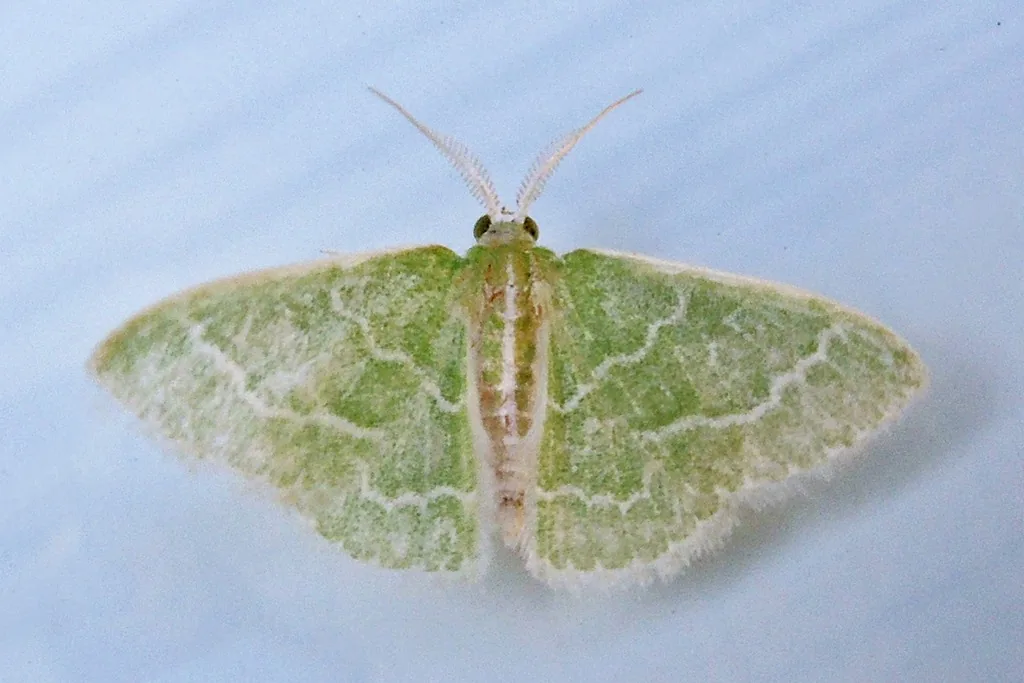
- Like most emeralds, it is a green moth that rests with its wide wings spread out to the sides. Look for mildly wavy white lines across the wings, a pale green fringe along the wing edges, and a long, thin white stripe running the whole length of the abdomen.[1]
- The wingspan is only 1/2 to 1 inch.[1]
- The caterpillar is an inchworm (looper) covered in cut flower parts. On goldenrod it attaches whole tiny flower heads, and on larger flowers such as blazing star it cuts the petals into small pieces first; the pieces are fixed to small spiny projections on its back.[3][1]
- Fresh petal clippings can make the caterpillar pink, purple or golden yellow; as they dry, they look like crumbs.[1]
- If it is not moving it is almost impossible to see; often the first clue is a bit of flower that seems to walk.[2][1]
- A sprinkling of caterpillar droppings (frass) on blossoms can be the first clue: University of Maryland entomologist Michael Raupp found one on his chrysanthemums that way, a little cluster of flowery debris swaying on a flower.[4]
- Under its costume the caterpillar's body is mottled brown, black and white and densely set with tiny spines, with an oblique white line through each breathing pore. Pale projections along the back hold the petal fragments and other debris, bound on with silk. A full-grown caterpillar is up to 1.5 cm long.[11]
Look-alikes
| Look-alike | How to tell them apart |
|---|---|
| Southern emerald | A close relative with similar coloring, but its cross lines are much more scalloped or jagged, forming little points where they cross the wing veins. It is more numerous in the southeastern United States.[1] |
| Red-fringed emerald | Red-fringed emeralds have a reddish fringe on the wing edges and white spots on the abdomen that are usually outlined in red. The wavy-lined emerald's fringe is pale green, and its abdomen has an unbroken white stripe.[5] |
| Blackberry looper (Chlorochlamys chloroleucaria) | Another small emerald caterpillar of fields and composite flowers, but it wears no debris: its slender yellow-green body is salted with tiny whitish granules, the head and first body segment carry forward-pointing horns, and it grows to 2 cm.[11] |
Where it lives
It is found statewide in Missouri, most abundant in and near prairies, pastures, old fields and roadsides. Sources also document it in North Carolina (coastal plain, piedmont and a pollinator demonstration garden) and in Nebraska prairies. The USDA Forest Service guide to geometroid caterpillars gives its range as southern Canada to Florida and Texas, in fields and other open habitats.[1][3][2][6][11]
Biology and life cycle
The caterpillars eat a variety of plants. They are most often seen on sunflowers, coreopsis, coneflowers, blazing stars, goldenrods, asters, black-eyed Susans, yarrows and other members of the sunflower family, and also on many other plants, notably blackberries and others in the genus Rubus. A 1979 study listed 13 genera of the aster family as recorded hosts.[1][3]
NC State Extension found one feeding on lemon beebalm in a pollinator demonstration garden, and The Nature Conservancy has photographed them on purple prairie clover, plains sunflower and black-eyed Susan.[2][6]
Raupp lists ageratum, aster, black-eyed Susan, boneset, daisy, goldenrod, ragweed, raspberry, rose, sage, St. John's wort and yarrow among the flowers it eats, besides chrysanthemum. The Forest Service guide gives much the same list: often composite flowers such as ageratum, aster, black-eyed Susan, boneset, daisy, goldenrod and yarrow, but also blackberry, raspberry, rose, sage and St. John's-wort.[4][11]
Harvard's Museum of Comparative Zoology and GBIF list a subspecies, Synchlora aerata liquoraria Guenée.[7][8]
The costume needs upkeep. In lab observations the caterpillar coated each fragment with a sticky secretion that seems to keep it fresh, swapped wilted pieces for new ones, and, when moved to a different kind of flower, replaced its whole covering with pieces of the new flower.[3][2]
Missouri has two or three broods a year. The species spends the winter as a caterpillar about half developed. In Connecticut and Maryland the Forest Service guide reports two generations, with full-grown caterpillars from April into June and again from July into September, and one generation in northern New England; it overwinters as a middle-instar caterpillar.[1][11]
Damage and signs
Health risk
It is a small flower-feeding caterpillar. The Missouri Department of Conservation, NC State Extension and Treiber's 1979 study describe it only as a feeder on plants; none of them mentions bites, stings or any effect on people or pets. The USDA Forest Service caterpillar guide does not mention any either.[1][2][3][11]
Control
Prevention
Neither the Missouri Department of Conservation nor NC State Extension recommends controlling it. MDC calls finding a decorated caterpillar a special treat and notes that insects like this moth are important food for birds and other predators; an NC State Extension agent who found one in a pollinator garden hoped to spot more.[1][2]
Where the sources disagree
Name: Treiber's 1979 paper treats Synchlora liquoraria liquoraria as a separate species; Harvard's Museum of Comparative Zoology and GBIF list liquoraria as a subspecies of S. aerata.[3][7][8]
Diet: Treiber records it on 13 genera of the aster family, feeding chiefly on anthers and pollen; the Missouri Department of Conservation says it also occurs on many other plants, including woody ones such as blackberries, and Raupp lists raspberry and rose among its foods.[3][1][4]
Broods: the Missouri Department of Conservation reports two or three broods a year in Missouri, while the Forest Service guide gives two generations in Connecticut and Maryland and one in northern New England.[1][11]
Common questions
- What is the little inchworm covered in flower petals?
- It is a camouflaged looper, the caterpillar of the wavy-lined emerald moth. It bites off pieces of the flower it is feeding on and attaches them to its back.[1][2][3]
- Where can I find camouflaged loopers?
- Check the flower heads of sunflowers, goldenrods, asters, coneflowers, black-eyed Susans and other members of the sunflower family for a bit of debris that starts to walk like an inchworm. The Forest Service guide says the larvae are easily found by scanning composite flower heads for anything out of place.[1][3][11]
- Do camouflaged loopers hurt flowers?
- Hardly. In Treiber's observations it ate mostly pollen and anthers plus a little petal and style tissue and never damaged the ovary, and neither the Missouri Department of Conservation nor NC State Extension treats it as a pest or recommends control.[3][1][2]
- Does the caterpillar change its disguise?
- Yes. Moved to a different kind of flower, it replaces its covering with pieces of the new flower. One kept in a jar overnight even tore up the paper towel covering the jar and stuck the paper bits on its back. The Forest Service guide adds that the covering usually includes fresh stamens and petals, which suggests new material is added daily.[3][2][6][11]
- Why are there crumbs on my mum flowers?
- They may be droppings (frass) from a camouflaged looper. Watch the blossom: Raupp spotted the caterpillar as a cluster of flowery debris moving on the flower.[4]
Sources
- Missouri Department of Conservation, “Wavy-Lined Emerald (Field Guide).” mdc.mo.gov/discover-nature/field-guide/wavy-lined-emerald (accessed 2026-11-13)
- NC State Extension, Growing Small Farms, “Critter Spotlight: Camouflaged Looper (February 21, 2026).” growingsmallfarms.ces.ncsu.edu/growingsmallfarms-camouflaged-looper/ (accessed 2026-11-13)
- Journal of the Lepidopterists' Society (archive hosted by Yale Peabody Museum), “Composites as host plants and crypts for Synchlora aerata (Geometridae). Treiber M. Journal of the Lepidopterists' Society 33(4): 239-244 (1979).” images.peabody.yale.edu/lepsoc/jls/1970s/1979/1979-33(4)239-Treiber.pdf (accessed 2026-11-13)
- Michael J. Raupp, Professor of Entomology, University of Maryland (Bug of the Week), “Mystery of the frass revealed: Camouflaged looper, Synchlora aerata.” bugoftheweek.com/blog/2013/1/9/mystery-of-the-frass-revealed-camouflaged-looper-isynchlora-aeratai (accessed 2026-11-13)
- Missouri Department of Conservation, “Red-Fringed Emerald (Field Guide).” mdc.mo.gov/discover-nature/field-guide/red-fringed-emerald (accessed 2026-11-13)
- The Nature Conservancy (Chris Helzer, ecologist), “The Camouflaged Looper: This Inchworm Makes Its Own Flower Costume (May 8, 2023).” blog.nature.org/2023/05/08/the-camouflaged-looper-this-inchworm-makes-its-own-flower-costume/ (accessed 2026-11-13)
- Museum of Comparative Zoology, Harvard University (MCZbase), “Synchlora aerata liquoraria Guenée, [1858] (taxon details).” mczbase.mcz.harvard.edu/name/Synchlora%20aerata%20liquoraria (accessed 2026-11-13)
- Global Biodiversity Information Facility (GBIF), “Synchlora aerata liquoraria Guenée, 1857 (GBIF Backbone Taxonomy).” api.gbif.org/v1/species/9561398 (accessed 2026-11-13)
- Global Biodiversity Information Facility (GBIF), “Synchlora aerata (Fabricius, 1798) (GBIF Backbone Taxonomy).” api.gbif.org/v1/species/1962076 (accessed 2026-11-13)
- iNaturalist, “Synchlora aerata taxon page (order and family).” www.inaturalist.org/taxa/126204 (accessed 2026-11-12)
- USDA Forest Service, Forest Health Technology Enterprise Team (scan at Internet Archive), “Geometroid Caterpillars of Northeastern and Appalachian Forests, FHTET-2001-10 (D. L. Wagner, D. C. Ferguson, T. L. McCabe and R. C. Reardon, September 2001).” archive.org/details/geometroidcaterp00wagn (accessed 2026-11-14)