On this page
How to identify it
- Mature caterpillars are slender and up to about 1 inch long, with five white or light stripes along the body. Penn State and NC State call them grayish to dark brown (NC State says sometimes tinged rose or pink); Iowa State says grayish-brown to light orange. They wriggle hard and drop on silk when disturbed.[1][2][3]
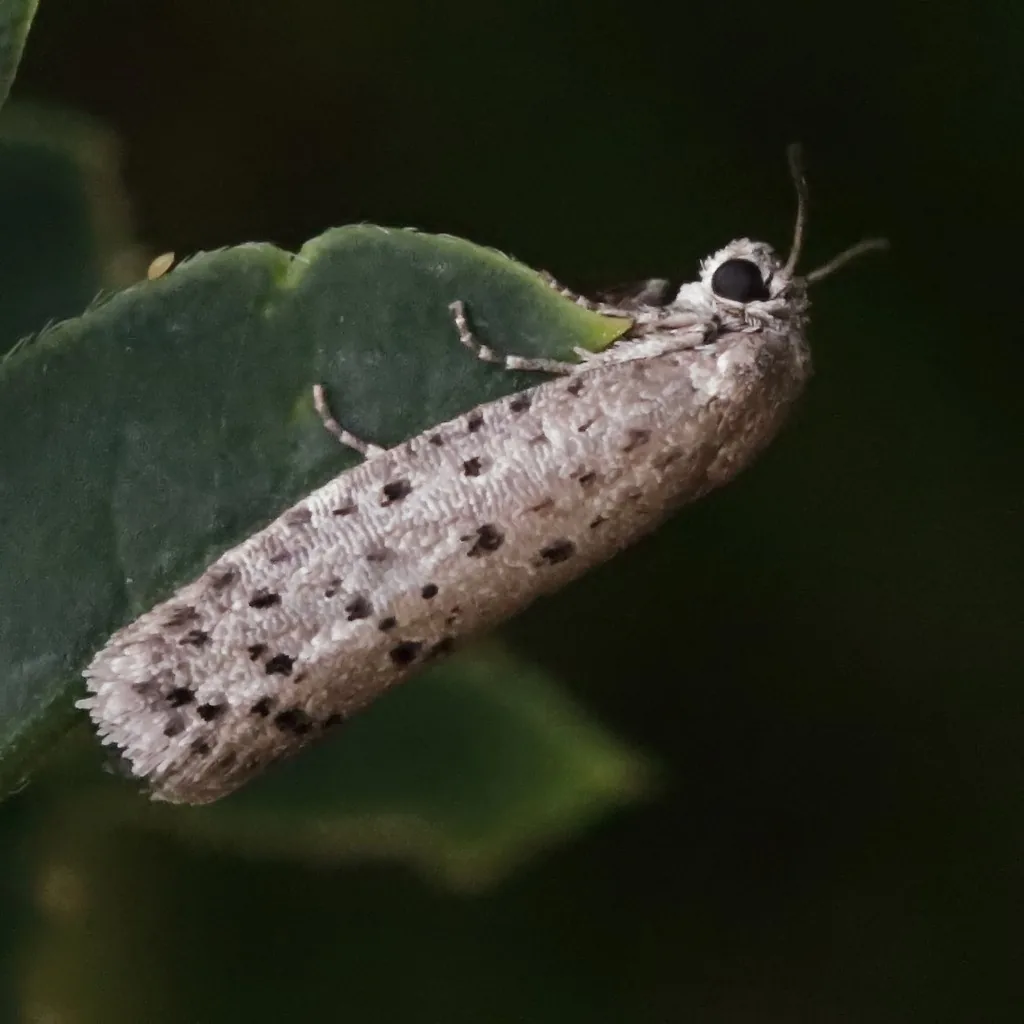
- Adults are small steel-gray moths, about 13 mm (1/2 inch) across the wings, with small black dots on the forewings.[1][2]
- Eggs are tiny, oval and white, turning rose or pink just before hatching. Pupae are yellowish brown, about 6 mm long, inside white silk cocoons that NC State says look like puffed rice and are often found in groups.[1][2]
Look-alikes
| Look-alike | How to tell them apart |
|---|---|
| American ermine moth | The adult can be mistaken for a mimosa webworm moth, but it is white rather than steel gray, with a different pattern of black spots and a different wing shape.[1] |
Where it lives
Native to China and Japan, it was found in Washington, D.C., in the 1940s and has spread through the eastern United States and Canada, west to Texas and Nebraska, wherever its hosts grow.[1]
Biology and life cycle
Penn State and Iowa State report two generations a year: first-generation larvae from mid- to late June into July, second-generation larvae in August (into early September in Pennsylvania). NC State reports two to three generations in North Carolina, with caterpillars from June to September or early October.[1][3][2]
Larvae start feeding on the undersides of leaflets, then spin webs around the leaflets and feed inside them.[1][3]
Second-generation pupae overwinter in cocoons in the webs, bark crevices, mulch, house siding, mortar joints or other sheltered spots. Females lay eggs on terminal leaves and twigs, and on webs left from the year before.[1][2]
Damage and signs
- Webbed foliage is skeletonized and turns brown; damage is most obvious after the second generation in August, and whole trees can be webbed by September. 'Sunburst' honeylocust is especially vulnerable.[1][3][2]
- Mature larvae sometimes come down on silk and wander into homes looking for a place to overwinter, and silk hanging from the trees can be a nuisance.[1][3]
- Sources differ on how serious it is. Iowa State says damage is seldom serious to healthy, established trees and is more about looks; Penn State says healthy trees can withstand a few years of total defoliation, but drought-stressed, recently transplanted and tree-well street trees are at real risk; NC State says trees ravaged several years in a row may be severely stunted or even die.[3][1][2]
Health risk
It feeds on plant leaves. Penn State and Iowa State describe it as a nuisance at most, from caterpillars wandering indoors or silk hanging from trees, and none of the extension sources mention a health risk.[1][3][2]
Control
Prevention
When planting, avoid 'Sunburst' and large stands of susceptible thornless honeylocust; 'Moraine', 'Shademaster', 'Imperial' and 'Skyline' are less susceptible. Rake up leaf debris and webbed foliage under host trees.[1][2]
Biological control
Spraying is rarely needed. If it is, timing matters: Bt or another biorational product works only while caterpillars are small and webbing is light, about mid- to late June and again in early August. Iowa State says spraying after leaves turn brown is a waste that kills natural enemies instead of the pest, and Penn State advises avoiding broad-spectrum sprays because parasitoid wasps attack the caterpillars.[3][1]
NC State suggests Bt rather than a synthetic insecticide if you treat in spring while the trees are blooming, to avoid killing bees.[2]
Pesticides
Penn State says systemic insecticides can be applied as a soil drench, or as a trunk spray or injection; the trunk options are for licensed pesticide applicators only. Follow the label.[1]
Persian silk tree and thornless honeylocust
Persian silk trees are often called mimosa, but Penn State says that name should be avoided, since it also covers unrelated plants, and that the tree is an aggressive invasive species in the United States whose continued planting is discouraged.[1]
Honeylocust is native to the central United States. Thornless forms selected from rare wild trees were first released in 1949 and became popular street trees, but Penn State says thornless varieties are often extremely susceptible to this pest.[1]
How much damage occurs varies greatly from tree to tree and year to year; Iowa State says extensive damage has not been common there in the past decade.[3]
Common questions
- Why is my honeylocust brown and webbed in late summer?
- Mimosa webworm caterpillars web the leaflets together and skeletonize them; damage peaks in August after the second generation.[1][3]
- Will mimosa webworm kill my honeylocust?
- Usually not. Healthy, established trees withstand a few years of defoliation, but stressed or newly planted trees can be seriously harmed, and NC State says repeated years of heavy damage can stunt or kill trees.[1][3][2]
- Is it too late to spray once the tree is brown?
- Yes. Iowa State says sprays after foliage browns don't work and mainly kill the pest's natural enemies; time any treatment to small caterpillars in mid-June and early August.[3][1]
Sources
- Penn State Extension, “Mimosa Webworm.” extension.psu.edu/mimosa-webworm (accessed 2026-11-13)
- NC State Extension, “Mimosa Webworm.” content.ces.ncsu.edu/mimosa-webworm (accessed 2026-11-13)
- Iowa State University Extension and Outreach, “Mimosa Webworm.” yardandgarden.extension.iastate.edu/encyclopedia/mimosa-webworm (accessed 2026-11-13)
- Global Biodiversity Information Facility (GBIF), “Homadaula anisocentra Meyrick, 1922 (GBIF Backbone Taxonomy).” api.gbif.org/v1/species/1992547 (accessed 2026-11-13)
- iNaturalist, “Homadaula anisocentra taxon page (order and family).” www.inaturalist.org/taxa/416957 (accessed 2026-10-06)