On this page
How to identify it
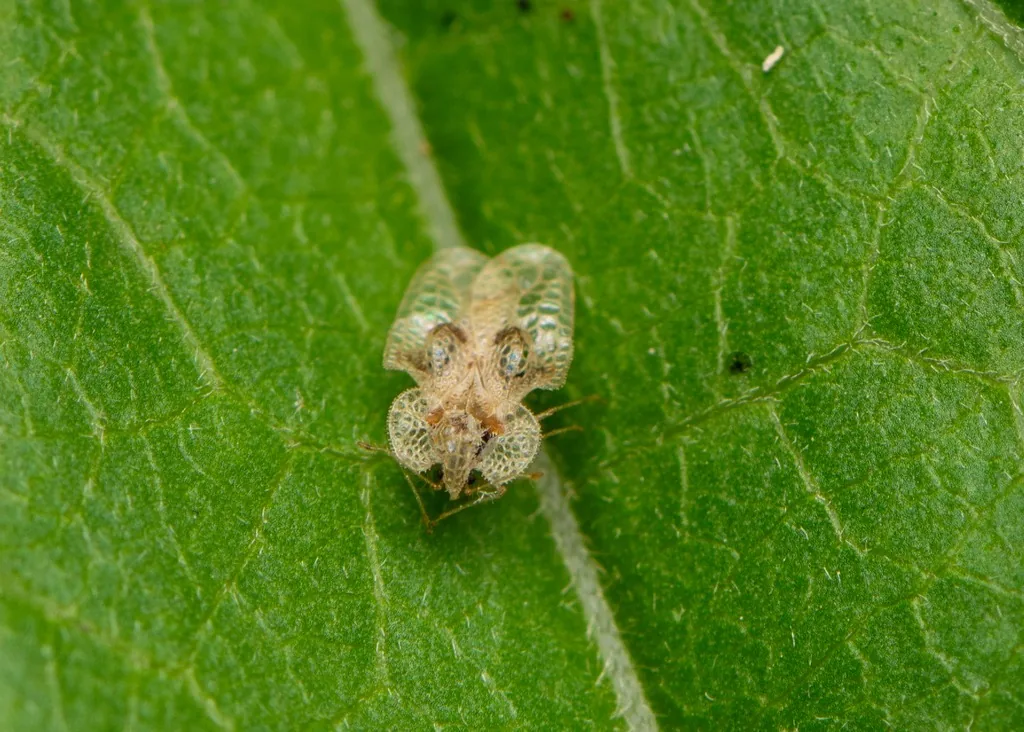
- Adults have light-colored bodies and lacy, net-patterned wings that give them a squared-off, rectangular outline from above. Sizes differ by source: Ohio State gives about 1/8 inch for lace bugs, while the University of Minnesota says 1/4 inch.[1][5][3]
- Nymphs are oval and often covered with long spines; Rutgers says they pass through five stages.[5][1]
- Look under the leaves: the bugs and tar-like black spots of excrement collect there, and the eggs stand upright in clusters of 30 to 50 tiny black spikes, like a miniature Stonehenge, within a circle about 3/4 inch across or less.[2][1]
Look-alikes
| Look-alike | How to tell them apart |
|---|---|
| Oak spider mite | Also stipples oak leaves, but it feeds on the upper leaf surface, so the undersides look clean, and it mainly attacks red-group oaks, especially pin oak; lace bugs leave black excrement specks under the leaves.[1][3] |
Where it lives
Native to North America and reported on oaks by extension services in New Jersey, Ohio and Minnesota. It was first identified in Europe in northern Italy in 2000 and has since spread rapidly; a 2024 study gathered 1,792 records from 21 Eurasian countries.[1][2][3][7][6]
Biology and life cycle
Adults overwinter in sheltered spots in the bark, and the females start laying eggs on the leaf undersides in late spring, after the leaves have expanded.[1]
There are several generations a season (typically three or four in New Jersey), so the damage builds with each generation and is usually most noticeable by late August.[1][2]
Nymphs pass through five stages before they become adults.[1]
Damage and signs
- Feeding makes tiny yellow or whitish spots on the upper leaf surface that can merge into large white patches and later turn yellow to copper; when the bugs are abundant, leaves can drop early.[2][3]
- Infestations are usually most pronounced on white oaks.[1][2]
- In the US the damage is mostly cosmetic: Rutgers says infested oaks usually make enough food before symptoms become severe, so the effect on large landscape trees is usually minimal. European researchers see it differently there, describing the oak lace bug as a significant threat to European oak forests.[1][6][7]
Health risk
It feeds on oaks, and no cited source describes any risk to people or pets.[1][2]
Control
Prevention
Check leaf undersides for eggs, nymphs and adults; if control is wanted, targeting the early nymph stages works better.[1]
Traps and physical control
For lace bugs generally, Ohio State suggests syringing: a hard jet of water from a hose dislodges young nymphs as they hatch in spring. Insecticidal soaps or horticultural oils work only on contact, so cover the leaf undersides, and they spare natural predators better than standard insecticides.[5]
Pesticides
Spraying is usually not necessary, and tall oaks would need large spray volumes; treatment is mainly worth considering for valuable trees in very visible spots. For a key tree infested every year, Rutgers says treatments work best early in the season, and a systemic applied to the roots of a large tree may need at least 2 to 3 months to move through the canopy.[1]
Oak lace bug in Europe
The oak lace bug was first identified as an invasive pest in Europe in northern Italy in 2000 and has since spread rapidly through European oak forests.[7][6]
In southern Romania researchers found three generations a year, with adults overwintering in sheltered spots, matching Rutgers' description of overwintering adults in the US.[8][1]
Croatian researchers say the heavier damage in Europe than in its native range is most likely due to a lack of natural enemies, and they found four insect-killing fungi naturally attacking the bugs there.[7]
Common questions
- Why are my white oak's leaves turning pale and speckled?
- Pale speckling that merges into white patches on the upper surface, with black specks underneath, is typical of oak lace bugs; turn a leaf over to look for them.[2][1]
- Should I spray for oak lace bugs?
- Usually not in landscapes; the damage looks alarming but Rutgers calls it mostly cosmetic, and large oaks are hard to spray.[1]
Sources
- Rutgers Cooperative Extension (Plant & Pest Advisory), “Summer Pests on Oaks: Oak Sawflies, Oak Spider Mites & Oak Lace Bugs (S. K. Rettke, July 15, 2021).” plant-pest-advisory.rutgers.edu/summer-pests-on-oaks-oak-sawflies-oak-spider-mites-oak-lace-bugs (accessed 2026-11-13)
- Ohio State University Extension (Buckeye Yard & Garden onLine), “Oak Lace Bug Stippling Damage Whitens White Oak Leaves (J. Boggs).” bygl.osu.edu/node/369 (accessed 2026-11-13)
- University of Minnesota Extension (What's wrong with my plant?), “Oak: pale, white or opaque discoloration of leaves.” apps.extension.umn.edu/garden/diagnose/plant/deciduous/oak/leavesdiscolored.html (accessed 2026-11-13)
- Global Biodiversity Information Facility (GBIF), “Corythucha arcuata (Say, 1832) (GBIF Backbone Taxonomy).” api.gbif.org/v1/species/2020671 (accessed 2026-11-13)
- Ohio State University Extension (Ohioline), “Lace Bugs (HYG-2150-10).” ohioline.osu.edu/factsheet/HYG-2150-10 (accessed 2026-11-13)
- Science of the Total Environment (via PubMed), “The ongoing range expansion of the invasive oak lace bug across Europe: current occurrence and potential distribution under climate change (Ciceu et al., 2024) (abstract).” pubmed.ncbi.nlm.nih.gov/39067588/ (accessed 2026-11-13)
- Insects (via PubMed), “Identification of entomopathogenic fungi as naturally occurring enemies of the invasive oak lace bug, Corythucha arcuata (Kovac et al., 2020) (abstract).” pubmed.ncbi.nlm.nih.gov/33036392/ (accessed 2026-11-13)
- Insects (via PubMed), “From field data to practical knowledge: investigating the bioecology of the oak lace bug, an invasive insect species in Europe (Balacenoiu et al., 2023) (abstract).” pubmed.ncbi.nlm.nih.gov/37999081/ (accessed 2026-11-13)