On this page
How to identify it
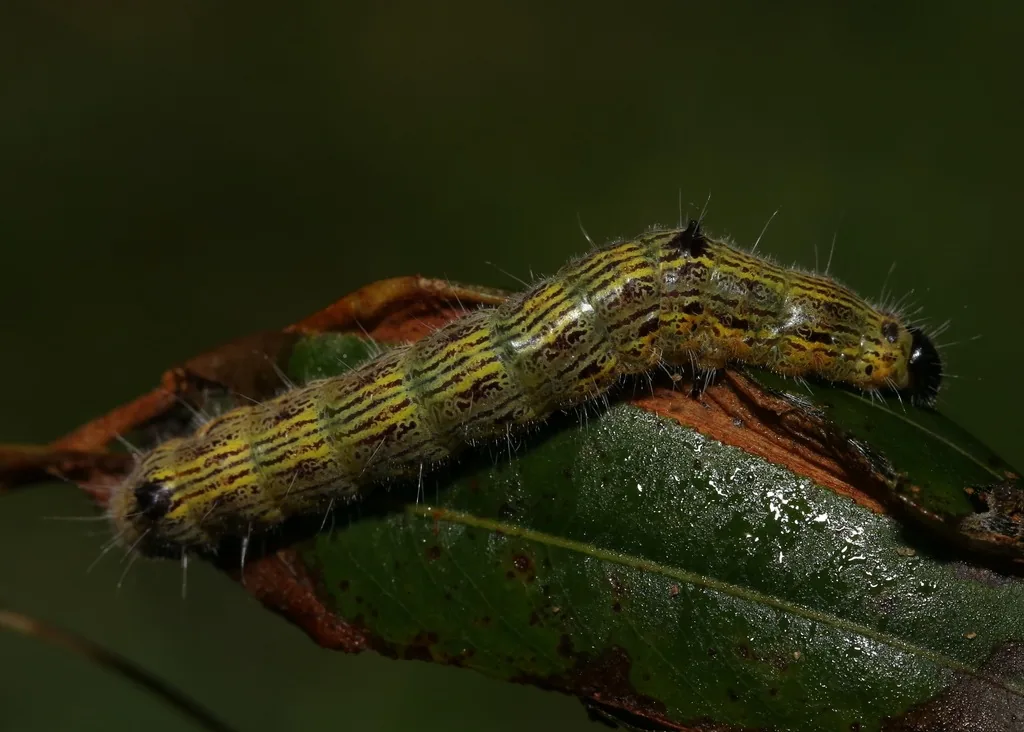
- Full-grown caterpillars are about 1 1/2 inches long (Missouri) to as much as 1 3/4 inches (NC State). Missouri describes them as mottled brown-black and sparsely hairy, with four yellow stripes down the back and a bright yellow line along each side. The Forest Service's 1972 manual Eastern Forest Insects gives up to 42 mm and describes full-grown larvae as brownish to nearly black.[1][2][3]
- Missouri says there is a black bump on top of the first and eighth abdominal segments. NC State describes the markings as two black dots just behind the shiny black head, a larger dot about a third of the way back, and a prominent dot near the tail end.[1][2]
- The brownish-gray moth is about 1/2 inch long with broken white lines and blotches on each wing. The 1972 manual gives a wingspread of about 25 mm, with three whitish lines across each forewing, a crest of dark brown hairs on the front of the thorax and a wavy band across the hindwing.[1][3]
- The moths are fairly well camouflaged on willow bark and are in flight through most of the growing season.[1]
Look-alikes
| Look-alike | How to tell them apart |
|---|---|
| Fall webworm | Poplar tentmakers tie leaves together with silk into tents and hide inside by day, and both sources list only poplar and willow as hosts. Neither source compares them with fall webworm directly, so look at the caterpillar as well as the shelter.[1][2] |
| Other Ichthyura tentmakers | The 1972 Forest Service manual, which lists the poplar tentmaker as Ichthyura inclusa, names I. albosigma on aspen and I. apicalis, I. brucei and I. strigosa on aspen and willow as other species often encountered, and says none are very important.[3] |
Where it lives
The Forest Service's 1972 manual Eastern Forest Insects says it occurs in southern Canada and from New England to Georgia and Colorado, on various poplars and willows. NC State and Missouri Extension cover it in North Carolina and Missouri.[3][1][2]
Biology and life cycle
Moths emerge from cocoons in leaf litter in late spring, mate, and lay eggs in batches of a hundred or more on the undersides of poplar and willow leaves. The eggs are tiny, round and laid close together. The Forest Service says adults appear from March to July and from July to August, depending on location, and lay their eggs in clusters on the undersides of leaves.[1][3]
Missouri says there are two generations a year, with caterpillars present from spring to fall. NC State says there are at least two in North Carolina, overlapping enough that caterpillars can be found from May to October.[1][2]
Caterpillars live in groups inside their leaf tents and retreat into them during the day.[1][2]
Caterpillars feed from May to October, then crawl to the ground and pupate in loose cocoons to spend the winter. The Forest Service gives one and a partial second, or two, generations a year.[3]
Damage and signs
- They can completely defoliate groups of trees by midsummer, mostly trees in the open or at woods' edges, so it is often an urban pest. The Forest Service adds that it often seriously defoliates small groups of trees, especially ones growing more or less in the open, and that twigs holding large webs sag badly.[1][3]
- NC State says defoliation of willow and poplar later in the growing season does little harm to the trees' long-term health, since frost will take the remaining leaves within weeks anyway.[1]
Health risk
Missouri notes that some caterpillars in this family (prominents) raise both ends of the body when disturbed and expose glands that make irritating acidic chemicals. Neither source says this of the poplar tentmaker itself, and no cited source describes any risk to people or pets.[1][2]
Control
Prevention
In late summer and fall, NC State says it's better to wait and see whether the caterpillars come back earlier the next season before using an insecticide, and then only if there are a lot of them.[1]
Biological control
Bacillus thuringiensis or neem extract should give adequate control, especially while caterpillars are young. NC State says they aren't reported to be resistant to pesticides, but the tents make them harder to reach.[1]
Pesticides
NC State also lists carbaryl (Sevin) and says other insecticides labeled for landscape use should work. Read and follow the label.[1]
Common questions
- What caterpillar makes tents of leaves on my willow?
- Often the poplar tentmaker, which ties leaves together with silk.[1][2]
- Will it kill the tree?
- Usually not. NC State says leaf loss late in the season does little long-term harm to poplar and willow.[1]
- When are they active?
- Caterpillars are around from spring to fall, May to October in North Carolina, because two or more generations overlap.[1][2]
- Why didn't my spray reach them?
- The caterpillars hide inside silk-tied leaf tents, which NC State says makes them harder to control even though they aren't known to be resistant. Sprays work best on young caterpillars.[1]
- Are the old tents on my poplar in winter still a problem?
- Usually not. The Forest Service says old, abandoned nests often stay on trees through the winter; by then the caterpillars have crawled to the ground to pupate in loose cocoons.[3]
Sources
- NC State Extension, “Poplar Tentmaker (PDIC Factsheet).” content.ces.ncsu.edu/poplar-tentmaker (accessed 2026-11-13)
- University of Missouri Extension (Caterpillars in Your Yard and Garden, IPM1019), “Caterpillars in Your Yard and Garden, page 35: Poplar tentmaker.” extension.missouri.edu/publications/ipm1019-35 (accessed 2026-11-13)
- USDA Forest Service, “Eastern Forest Insects, Miscellaneous Publication 1175 (W. L. Baker, February 1972; scanned copy).” archive.org/details/easternforestins1175bake (accessed 2026-11-14). Scanned copy of the USDA Forest Service publication on the Internet Archive; text read from the archive.org full-text (djvu.txt) file.
- Global Biodiversity Information Facility (GBIF), “Clostera inclusa Hübner (GBIF Backbone Taxonomy).” api.gbif.org/v1/species/1822805 (accessed 2026-11-13)