On this page
How to identify it
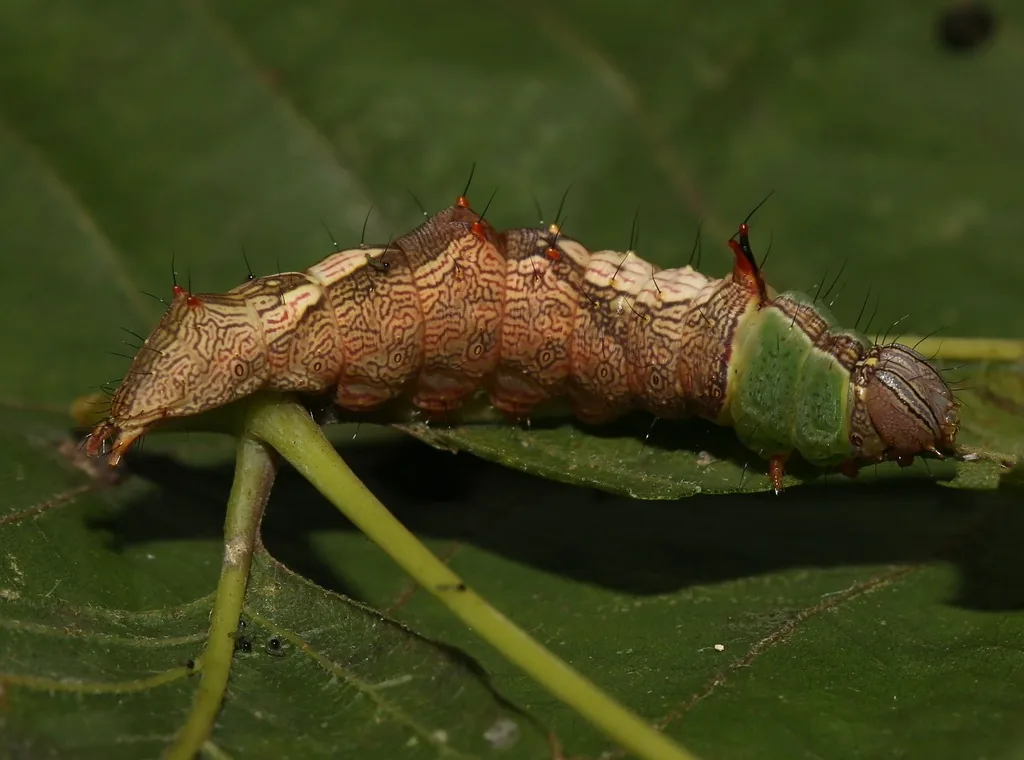
- The caterpillar is tan with brown markings and a green band on the second and third segments behind the head. The body is humped near the rear, on the fifth abdominal segment.[1]
- The UW-Milwaukee Field Station says it is easily confused with the unicorn caterpillar, but the unicorn lacks the morning-glory prominent's striped head and extra hump in the middle of the abdomen, and its abdominal hairs are shorter.[3]
- It is well camouflaged: when it rests along the jagged edge of a leaf it is eating, it looks like a curled, dried or dead part of the leaf margin.[2][1]
- The moth's forewings are drab gray, tan and brown with small black markings that vary a lot. Males have whitish hindwings and females dark gray ones.[1][7]
- The wingspan is 1 1/4 to 2 inches according to the Missouri Department of Conservation (the UW-Milwaukee Field Station gives 1¾"). The University of Alberta's Strickland Entomological Museum gives 3.5 to 4.7 cm. The moth's legs look hairy, and its heavily scaled wings look fuzzy.[1][3][7]
- At rest the moth folds its wings like a roof and sometimes curls the forewing edges under its body, so it looks like a twig. A tuft of hair standing up over the thorax gives the prominents their name.[1]
Where it lives
It lives in deciduous woodlands across the US and southern Canada (the Strickland Entomological Museum gives Nova Scotia west to Vancouver Island, south to Florida, Texas and Utah), and occurs statewide in Missouri. GBIF holds 3545 U.S. records since 1990 from 46 state-level areas, the most from Alabama (322), Ohio (263) and Massachusetts (218).[3][1][5][7]
Biology and life cycle
Caterpillars feed on the leaves of trees and shrubs. Clemson lists maples, oaks, elms and buckeyes, Missouri adds birches and roses, and the UW-Milwaukee Field Station adds beech. In Canada, the University of Alberta's Strickland Entomological Museum lists birch, willows and poplars.[2][1][3][7]
The common name comes from reports of the caterpillars eating morning glories. Missouri lists morning glories as a food plant, but Clemson and the UW-Milwaukee Field Station note that other sources say it probably doesn't eat them.[1][2][3]
Young caterpillars feed in groups on the underside of leaves, skeletonizing them; older ones live alone and eat inward from the leaf edge, carving a half-circle and curling into it.[3]
The moths fly at night from April or May to September and come to lights. They live in woods and nearby areas, where their camouflage hides them on tree bark.[1]
Grown caterpillars pupate below ground or in leaf litter; the UW-Milwaukee Field Station says they overwinter as pre-pupae and pupate in spring.[1][3]
A neat defense in its relatives: caterpillars of two other Schizura species have a gland behind the head that holds formic acid, acetic acid and oily compounds, and they spray it accurately toward an attacker when disturbed.[4]
The Missouri Department of Conservation reasons from the caterpillar's and moth's convincing camouflage that birds and other predators that hunt by sight eat them readily.[1]
Damage and signs
Health risk
Neither Clemson nor the Missouri Department of Conservation mentions any sting, rash or other risk to people from this caterpillar. Caterpillars of two related Schizura species can spray a defensive secretion when disturbed.[2][1][4]
Control
Prevention
No treatment is recommended: the Missouri Department of Conservation describes this species as hardly devastating, and Clemson's note on it gives no control advice.[1][2]
Biological control
Natural enemies: Missouri says predators that hunt by sight, such as birds, apparently relish both caterpillars and moths.[1]
Where sources disagree
Overwintering stage: the UW-Milwaukee Field Station says it overwinters as a pre-pupa and pupates in spring; the University of Alberta's Strickland Entomological Museum says the pupa overwinters.[3][7]
Day or night: the Missouri Department of Conservation says the moths fly at night and come to lights; the Strickland Entomological Museum describes the adults as active by day and also coming to light.[1][7]
Common questions
- What is the caterpillar that looks like a dead leaf edge?
- It may be a morning-glory prominent. The caterpillar rests along the chewed edge of a leaf, where it looks like a curled, dried piece of the leaf margin.[2][1]
- Does it really eat morning glories?
- Possibly. Missouri lists morning glories among its food plants, while Clemson and the UW-Milwaukee Field Station note that other sources doubt it. Its documented hosts include maples, oaks, elms, buckeyes, birches, beech and roses.[1][2][3]
- Is it a unicorn caterpillar?
- They are close relatives and look alike. The morning-glory prominent has a striped head and an extra hump in the middle of the abdomen.[3]
Sources
- Missouri Department of Conservation, “Morning-Glory Prominent (Field Guide).” mdc.mo.gov/discover-nature/field-guide/morning-glory-prominent (accessed 2026-11-12)
- Clemson Cooperative Extension Home & Garden Information Center, “Question of the Week: Morning Glory Prominent Caterpillar (J. Ballew, June 19, 2024).” hgic.clemson.edu/question-of-the-week-morning-glory-prominent-caterpillar/ (accessed 2026-11-12)
- University of Wisconsin-Milwaukee Field Station, “Morning Glory Prominent Moth (Bug of the Week, October 21, 2020).” uwm.edu/field-station/bug-of-the-week/11883-2/ (accessed 2026-11-12)
- J Chem Ecol 1993;19(10):2089-2104, via PubMed, “Defensive secretion of two notodontid caterpillars (Schizura unicornis, S. badia).” pubmed.ncbi.nlm.nih.gov/24248561/ (accessed 2026-11-12)
- Global Biodiversity Information Facility (GBIF), “Schizura ipomaeae: U.S. occurrence records since 1990 by state (GBIF occurrence search).” api.gbif.org/v1/occurrence/search?taxonKey=5118944&country=US&hasGeospatialIssue=false&occurrenceStatus=PRESENT&year=1990%2C2026&facet=stateProvince&facetLimit=400&limit=0 (accessed 2026-11-12)
- iNaturalist, “Schizura ipomaeae taxon page (order and family).” www.inaturalist.org/taxa/204014 (accessed 2026-11-12)
- University of Alberta E.H. Strickland Entomological Museum, “Species Details: Schizura ipomoeae.” search.museums.ualberta.ca/g/2-459 (accessed 2026-11-12)