On this page
How to identify it
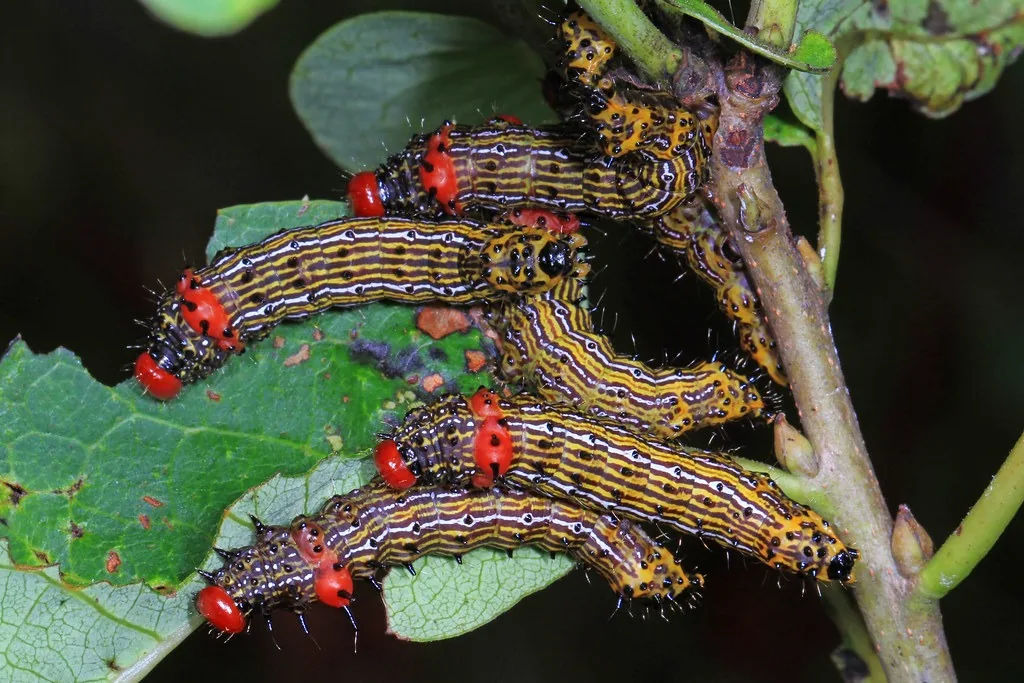
- UC IPM says older caterpillars reach 1 to 1-1/2 inches and are yellowish orange with lengthwise black and white stripes; the PNW handbook calls mature larvae 1 inch long and reddish or yellow, with several spines on each segment.[1][2]
- In late instars, the first abdominal segment has a reddish hump with two prominent black spines; young larvae have dark heads, faint stripes and rows of bristly bumps.[1]
- Larger caterpillars often hold the rear end raised above the leaf. Unlike some other caterpillars on the same trees, they don't tie leaves with webbing.[1]
- Eggs are laid in groups of 25 to 100 on leaf undersides. If tiny Trichogramma wasps have parasitized them, the empty eggs have smooth round exit holes instead of ragged chewed ones.[1]
Where it lives
UC IPM says it's found throughout much of the United States, with high populations in California usually limited to the Central Valley. The PNW handbook calls it one of the most widely distributed large caterpillars in North America.[1][2]
Biology and life cycle
Timing varies by region: UC IPM says moths emerge in April and May in California, while the PNW handbook gives June and July for adults, with caterpillars feeding in groups through September.[1][2]
Grown caterpillars drop to the ground to spin cocoons in topsoil or litter and spend the winter there as prepupae.[1][2]
There are two or more generations a year in California's Central Valley, so UC IPM suggests checking again in late June and July for the second.[1]
Damage and signs
Health risk
The spines are part of how this caterpillar is identified; neither UC IPM nor the PNW handbook describes a risk to people or pets.[1][2]
Control
Traps and physical control
On trees that have had them before, check in April and May for chewed or browning shoots, and prune out shoots with egg masses or caterpillar groups.[1]
Biological control
Parasitic wasps such as Cotesia schizurae and Hyposoter fugitivus often keep numbers low, and bigeyed bugs, damsel bugs, lacewings and spiders eat the caterpillars.[1]
Avoid long-lasting carbamate, organophosphate and pyrethroid sprays, which kill natural enemies; UC IPM recommends flowering insectary plants to support them.[1]
If spraying is needed, UC IPM favors spot treatment with Bacillus thuringiensis (Bt), which works best on young caterpillars and has little or no toxicity to people, bees and natural enemies. Spinosad also works but is toxic to bees until it dries. Follow the label.[1]
In Pacific Northwest orchards
The PNW handbook covers it as a cherry pest: the moths pupate in early summer, the caterpillars feed in groups through September, and then they move to the ground to make their overwintering cocoons.[2]
Common questions
- What are the striped caterpillars with red heads on my plum tree?
- If they feed in groups and have a red hump with black spines behind the head, they're likely redhumped caterpillars.[1][2]
- Do I need to spray?
- Usually not. Pruning out infested shoots and leaving natural enemies alone is enough in most cases; if not, spot-treat with Bt while caterpillars are young.[1]
Sources
- University of California Statewide IPM Program, “Pest Notes: Redhumped Caterpillar (Publication 7474).” ipm.ucanr.edu/home-and-landscape/redhumped-caterpillar/ (accessed 2026-11-13)
- Pacific Northwest Pest Management Handbooks (OSU, WSU, University of Idaho), “Cherry-Redhumped caterpillar.” pnwhandbooks.org/insect/tree-fruit/cherry/cherry-redhumped-caterpillar (accessed 2026-11-13)
- Global Biodiversity Information Facility (GBIF), “Schizura concinna (J.E. Smith, 1797) (GBIF Backbone Taxonomy).” api.gbif.org/v1/species/5118927 (accessed 2026-11-13)
- iNaturalist, “Oedemasia concinna taxon page (order and family).” www.inaturalist.org/taxa/1391456 (accessed 2026-10-06)