On this page
How to identify it
- Mature caterpillars are over 2 inches long and black with lengthwise stripes. NC State describes the stripes as yellow; UMass describes them as orange.[1][2]
- A pair of slender spines or horns sticks up behind the head (UMass places them on the second thoracic segment). Young caterpillars are greenish to greenish yellow.[1][2]
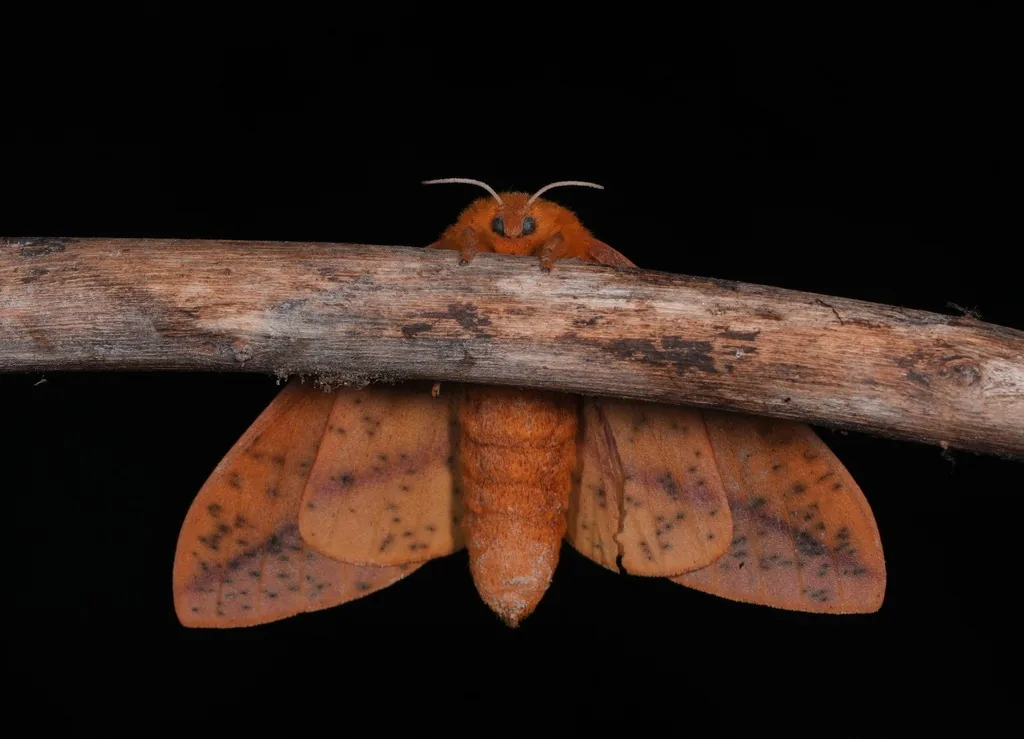
- Moths have a single white spot on each forewing. NC State describes the moth as brown with a dark stripe on each forewing; UMass says females are pale orange and males darker rusty orange. Males are smaller, and NC State says their forewings are darker and somewhat transparent.[1][2]
- Females have wingspans up to about 2 inches and males about 1.5 inches. The moths come to lights at night.[2]
Look-alikes
| Look-alike | How to tell them apart |
|---|---|
| Spiny oakworm, pinkstriped oakworm and greenstriped mapleworm | UMass says these related caterpillars are often found feeding on oak along with orangestriped oakworm, and that other insects also skeletonize oak leaves, so look at the caterpillar itself before deciding what you have.[2] |
| Short-horned oakworm (Anisota finlaysoni) | A close relative that a 2025 study confirmed only from the north shore of eastern Lake Ontario. The authors say it differs from nearby orangestriped oakworms as both adults and caterpillars, and that DNA barcodes don't reliably separate the two.[3] |
Where it lives
UMass calls it a native insect of the eastern United States. It also occurs in Ontario, Canada: a 2025 study reassigned caterpillar populations along Lake Erie to this species and compared it with populations in the Lake Huron region.[2][3]
Biology and life cycle
Moths emerge in June and July. Each female lays up to 500 eggs in clusters of several hundred, one layer deep, on the undersides of oak leaves, usually on the lower branches. UMass says egg-laying takes a female about a month and the eggs are bright yellow when first laid; NC State says they hatch in about a week.[1][2]
Young caterpillars feed in groups and skeletonize leaves down to a lace of veins. Older ones tend to feed alone and eat everything but the midvein, and there can be thousands on one tree in late August and September.[1][2]
Mature caterpillars leave the tree (UMass says typically by September) and burrow into the soil to pupate and overwinter. NC State gives a depth of 3 to 4 inches; UMass gives 2.5 to 10 cm (about 1 to 4 inches). NC State says there is usually one generation a year; UMass says one in the northern part of the range.[1][2]
Damage and signs
- Oaks are the main host, with white oak and scrub oak listed as preferred by UMass. Birch, hazelnut, hickory and maple have also been recorded.[1][2]
- NC State says small trees are sometimes stripped by midsummer and that young landscape trees seem to be preferred, while UMass says forest oaks are usually hit hardest, with shade and park trees fed on during outbreaks. NC State adds that even mature oaks are sometimes defoliated to the point of twig dieback from sun scald or other factors.[1][2]
- The larger caterpillars drop many dark, dry frass pellets from infested trees.[1]
- UMass says healthy trees can tolerate a single year of defoliation, but repeated years, or feeding combined with other stresses, may harm them. Outbreaks in New England have defoliated thousands of acres.[2]
Health risk
It feeds on tree leaves, and no cited source describes any risk to people or pets.[1][2]
Control
Prevention
If oakworms are a problem every year, NC State suggests putting up paper wasp nest boxes nearby the next spring. UMass says black-light traps can detect moths during an outbreak.[1][2]
Traps and physical control
Knock caterpillars off small trees by shaking limbs with a pole or rope, or thumping a small trunk, and trample them. UMass suggests picking off clusters of young caterpillars while they still feed in groups, before they do their heaviest feeding.[1][2]
Biological control
In mid to late summer on big trees, NC State says it's probably better to rely on birds, paper wasps, diseases and parasites to lower next year's numbers. UMass, citing a 1961 study, lists a wasp parasitoid of pupae (about 10% killed a year), a fungus and a virus (about 14%), a tachinid fly (16 to 42%), and egg parasitoids that attacked 22 to 74% of eggs.[1][2]
Pesticides
On trees small enough to treat, NC State suggests Bacillus thuringiensis or neem products, but only while caterpillars are young. Most home sprayers can't reach high into shade trees, and caterpillars crawling on the ground are very resistant to pesticides.[1]
Common questions
- What are the black and orange striped caterpillars crawling on my driveway?
- In late summer they are often orangestriped oakworms leaving oak trees to dig into the soil and pupate.[1][2]
- Will oakworms kill my oak?
- Usually not. NC State says late-summer defoliation is much less harmful than early spring defoliation, and UMass says healthy trees tolerate one year of it; repeated years or other stresses are what cause harm.[1][2]
- Is it worth spraying a big oak?
- Usually not; sprays can't reach high in shade trees, and late caterpillars resist pesticides, so natural enemies are the better bet.[1]
- Are these caterpillars dangerous to touch?
- Its horns are described as spines, but no cited source describes any risk to people or pets; the extension pages cited here cover it only as a leaf feeder on trees.[1][2]
Sources
- NC State Extension, “Orangestriped Oakworm (PDIC Factsheet).” content.ces.ncsu.edu/orangestriped-oakworm-1 (accessed 2026-11-13)
- UMass Extension Landscape, Nursery and Urban Forestry Program (Landscape Insect & Mite Guide), “Anisota senatoria (Orangestriped Oakworm).” www.umass.edu/agriculture-food-environment/landscape/publications-resources/insect-mite-guide/anisota-senatoria (accessed 2026-11-13)
- Zootaxa (via PubMed), “Ecology, morphology and distribution of Anisota finlaysoni Riotte (Lepidoptera, Saturniidae). Schmidt & Gartshore 2025 (abstract).” pubmed.ncbi.nlm.nih.gov/41119662/ (accessed 2026-11-13)
- Global Biodiversity Information Facility (GBIF), “Anisota senatoria J.E.Smith, 1797 (GBIF Backbone Taxonomy).” api.gbif.org/v1/species/1867029 (accessed 2026-11-13)