On this page
How to identify it
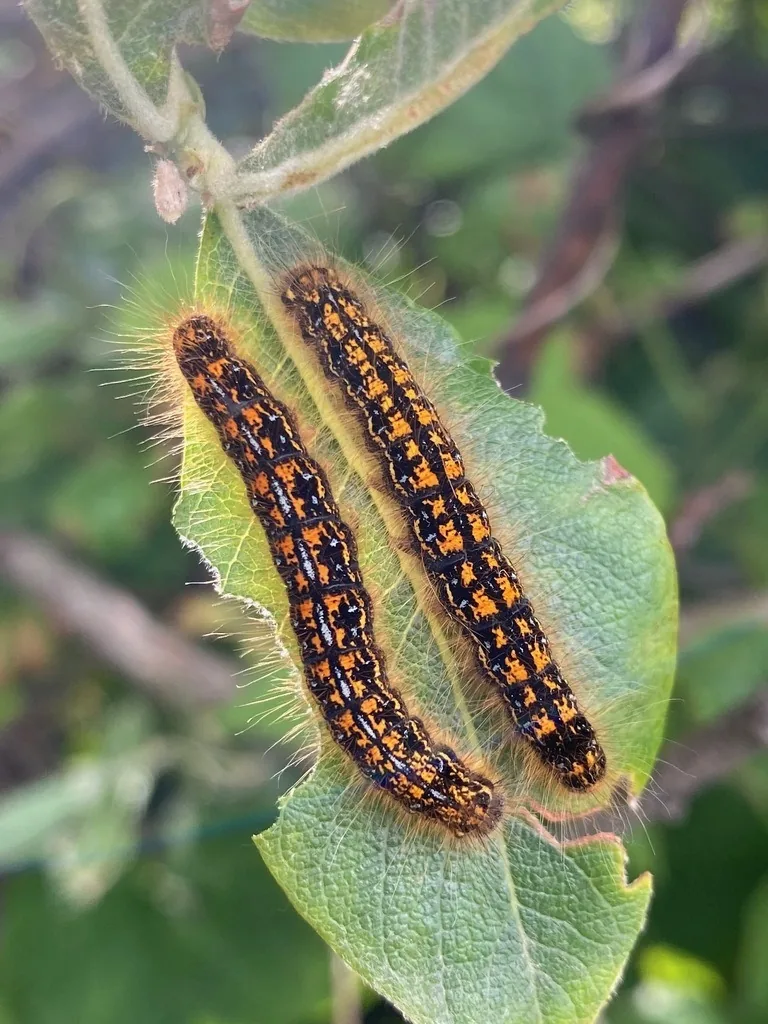
- Mature larvae are about 1 3/4 to 2 inches long, hairy and very variable. UC IPM describes them as reddish brown with some blue spots and tufts of orange to white hairs; the Forest Service says most have a pale blue head and body speckled with black, a line of blue-white dashes down the back edged in black or yellow-orange, and orange hairs with white tips.[1][2][7]
- Caterpillars spin large silk tents on leaves and twigs and feed on foliage mostly within the tents.[1]
- Egg masses are shiny brown to gray and covered with a frothy coating that hardens, protecting the eggs over winter.[2][3]
- Adults are heavy-bodied moths in dark red-brown, yellow, tan or gray, with two lines across each forewing. The Forest Service gives wingspans of 1 to 1 1/2 inches for males and 1 1/2 to 2 inches for females.[2][7]
- Newly hatched larvae are about 1/8 inch long, dark brown to black, with whitish hairs. Pupae are 3/4 to 1 inch long and reddish brown to black, inside white silk cocoons dusted with white or yellow powder.[7]
Look-alikes
| Look-alike | How to tell them apart |
|---|---|
| Eastern tent caterpillar | The eastern species is black with a white stripe down the back and blue spots on the sides, and builds its tents in branch crotches of wild cherry and apple.[4] |
| Fall webworm | Fall webworms appear in late summer and early fall and build their webs over branch ends, while tent caterpillars are spring feeders.[5][1] |
| Forest tent caterpillar | Mostly dark blue with wavy reddish-brown lines and white keyhole-shaped marks on the back; it feeds in groups on foliage without building a tent.[1] |
Where it lives
Found through much of the western U.S., southern Canada and parts of northern Mexico, it is the widest-ranging and most variable North American tent caterpillar. The Forest Service recognizes six subspecies: three with local ranges in California, M. c. pluviale in the Pacific Northwest and across southern Canada (with isolated populations in Minnesota, New Hampshire and New York), M. c. lutescens on the Great Plains from eastern Montana to Oklahoma and Texas, and M. c. fragile in the Southwest. In Alaska it has been reported in the Southeast at Annette Island, Ketchikan and Hyder.[7][3][8]
Biology and life cycle
It overwinters as unhatched larvae inside egg masses on host twigs; each female lays a single mass, often on the sunny side of the tree.[2][3]
Larvae hatch around budbreak and feed as a colony in a silk tent, which grows as they do; larvae from two or more egg masses may share one tent. Later stages feed alone. The Forest Service says larvae mature in 30 to 42 days, faster in dry, warm weather, and Utah State puts pupation 1 to 1 1/2 months after hatch.[2][7]
Cocoons are white silk dusted white to yellow, attached to host trees, other plants or tucked in leaf litter, and the pupal stage lasts 12 to 18 days. Sources give slightly different flight periods: late July through August (Utah State) or late July to early August (Forest Service).[2][7]
There is one generation a year, and outbreaks tend to be cyclic, rising and falling over roughly 6 to 11 years in British Columbia.[3][1]
Each egg mass holds 150 to 250 eggs coated in spumaline, a frothy material that hardens. The larvae are ready 3 to 4 weeks after the eggs are laid but stay inside them until the following spring.[7][3]
Damage and signs
- Larvae chew leaves, leaving ragged foliage and obvious silk webbing on infested branches.[1]
- Hosts include aspen, alder, chokecherry, cottonwood, crabapple and other fruit trees, oak, poplar, serviceberry, willow and wild rose.[2][1]
- Damage is usually aesthetic, but defoliation year after year can reduce growth or kill trees.[3][2]
- In the central and southern Rockies and northern Mexico, quaking aspen is a favorite host. Outbreaks there can last three to five years and completely defoliate thousands of acres; several years of defoliation of aspen, red alder and other hosts can cause branch dieback, top kill, lower fruit production and sometimes tree death. Heavy infestations have killed large areas of bitterbrush, a browse plant for deer and livestock, in eastern Oregon and northern California.[7]
Health risk
It's a pest of trees and shrubs; the harm is chewed leaves and unsightly tents, which are mostly cosmetic. The Forest Service notes that large hordes of larvae are a nuisance in residential and recreation areas.[1][3][7]
Control
Prevention
Keep trees healthy and tolerate light feeding; severe damage to ornamentals is uncommon and insecticides generally aren't warranted.[2][1]
Traps and physical control
Inspect plants in spring and, while larvae are young, prune out tents or clip infested branches if you can do it without cutting large limbs. The Forest Service suggests doing this in early morning or evening, when most larvae are in the tent, and dropping tents into soapy water or sealing them in plastic bags; on small trees, egg masses can be stripped or pruned off in winter.[1][3][7]
Biological control
Natural enemies often control outbreaks, though sources count them differently: UC IPM says over 100 species of parasitic flies and wasps attack tent caterpillars, while the Forest Service lists about 36 species of parasites and predators documented on the western tent caterpillar. Sources also differ on birds: UC IPM says birds eat the eggs, larvae and moths, while Oregon State says birds generally find the caterpillars distasteful. A nuclear polyhedrosis virus can collapse outbreaks; larvae it kills hang head-down or in an upside-down V and look wilted.[1][7][3]
Pesticides
Bacillus thuringiensis (Bt) works on small larvae if the spray penetrates the webbing and covers nearby foliage; a second spray 7 to 10 days later is recommended.[1][2]
Spinosad is also effective but can harm bees and some natural enemies, so don't spray it on flowering plants.[1]
Utah State lists Bacillus thuringiensis var. kurstaki, carbamate, organophosphate, pyrethroid and spinosyn insecticides for foliage sprays aimed at small larvae. Oregon State says chemical control is rarely recommended, and the Forest Service says infestations are usually left to run their course, with direct control mainly for fruit trees, timber stands, busy recreation sites and homes at the wildland edge.[2][3][7]
Common questions
- Will western tent caterpillars kill my tree?
- Usually not. Healthy plants tolerate some leaf loss; only repeated yearly defoliation can reduce growth or kill trees.[1][2]
- Should I burn out a tent caterpillar nest?
- No. Kentucky Extension and the Forest Service say burning tents can do more damage to the tree than the caterpillars; pruning out young tents or clipping infested branches is the better approach.[4][7][1]
Sources
- University of California Statewide IPM Program, “Tent Caterpillars (Home and Landscape).” ipm.ucanr.edu/home-and-landscape/tent-caterpillars/ (accessed 2026-11-12)
- Utah State University Extension, Integrated Pest Management, “Western Tent Caterpillar (Ornamental Pest Guide).” extension.usu.edu/planthealth/ipm/ornamental-pest-guide/arthopods/moths/western-tent-caterpillar (accessed 2026-11-12)
- Oregon State University, Department of Horticulture, “Western Tent Caterpillar (Nursery Pest Management).” agsci.oregonstate.edu/nurspest/insects/western-tent-caterpillar (accessed 2026-11-12)
- University of Kentucky Entomology, “ENTFACT-423: Eastern Tent Caterpillar (revised January 2026).” entomology.mgcafe.uky.edu/ef423 (accessed 2026-11-12)
- Penn State Extension, “Fall Webworm (updated June 24, 2026).” extension.psu.edu/fall-webworm (accessed 2026-11-12)
- iNaturalist, “Malacosoma californica taxon page (order and family).” www.inaturalist.org/taxa/359294 (accessed 2026-11-12)
- USDA Forest Service, “Western Tent Caterpillar (Forest Insect & Disease Leaflet 119), Ciesla and Ragenovich.” www.fs.usda.gov/foresthealth/docs/fidls/FIDL-119-WesternTentCaterpillar.pdf (accessed 2026-11-12)
- USDA Forest Service, Alaska Region, “Western Tent Caterpillar (Alaska Region forest health).” www.fs.usda.gov/r10/natural-resources/forest-health/western-tent-caterpillar (accessed 2026-11-12)