On this page
How to identify it
- Adults are elongate, soft-bodied and parallel-sided, with soft, flexible wing covers that give them the name leatherwings. Size varies by species; the sources' figures are compared under Where the sources disagree.[2][3][4][1]
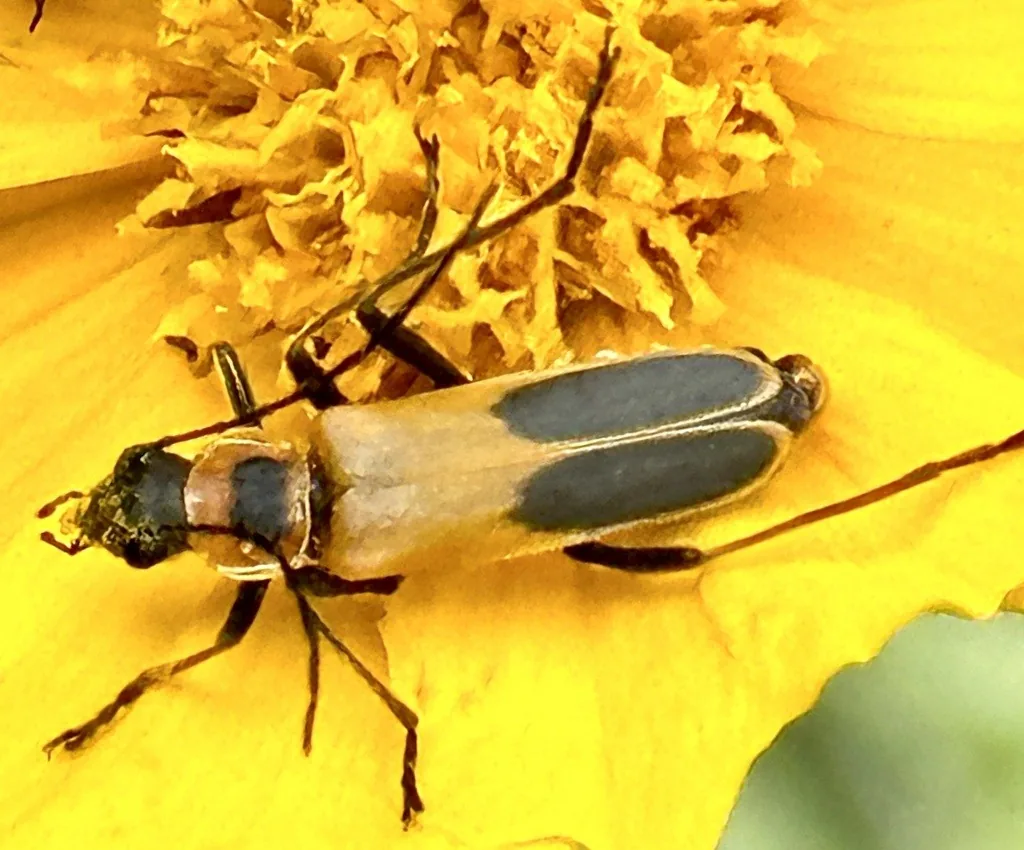
- Colors run from yellow, orange or red to brown or black. The goldenrod soldier beetle, also called the Pennsylvania leatherwing, is yellow to tannish brown with a black head and legs, a black spot behind the head and a large oval black spot on each wing cover.[2][3][4]
- The antennae are long and threadlike, and the head is often bent downward but stays visible from above, unlike a firefly's, which is hidden under a shield-like plate.[1][4]
- They're related to fireflies but have no light-producing organs.[3][2]
- Larvae are velvety and bristly, dark brown, black, tan or whitish, look like small alligators, and grow up to 3/4 inch long.[2][3][1][4]
Look-alikes
| Look-alike | How to tell them apart |
|---|---|
| Blister beetles | Blister beetles have a square head and a visible neck, because the thorax is narrower than the head and abdomen.[2] |
| Fireflies | Fireflies have light-producing organs and a plate that covers the head when seen from above; soldier beetles have no lights and their head shows.[3][2][4] |
| Glowworm beetles | UC IPM also lists glowworm beetles (Phengodidae) among the beetles soldier beetle adults can be mistaken for.[1] |
Where it lives
Missouri counts nearly 500 species in North America north of Mexico, and UC IPM about 160 in California alone; they are found statewide in Missouri and Minnesota reports large numbers in gardens in summer. GBIF's public U.S. records since 1990 for the family (about 99,000) come from all 50 states and the District of Columbia, most from California (8,792), Ohio (6,753) and Pennsylvania (6,072).[4][1][3][7]
Biology and life cycle
Females lay eggs in clusters or masses in soil or organic litter, and the eggs hatch in about a week.[2][1]
Most of the life cycle is spent as ground-dwelling larvae, which UC IPM says can live 1 to 3 years and which overwinter in soil, debris or loose bark.[1][3][2]
Adults are relatively short-lived, and when they are out differs by species and place (see Where the sources disagree).[1][3][4]
Adults are active by day and fly well, darting between flowers like small wasps or bees. When disturbed they may pull in their legs and drop as if dead.[1][3][4]
Adults, larvae and pupae can release noxious defensive chemicals, and the bright colors are thought to warn predators that they taste bad; the family name means 'blistering fly' in Greek, likely for those chemicals.[1][3][4]
Damage and signs
- Kentucky says they do not damage plant foliage, and Minnesota says they do not damage flowers or other plants. What adults eat differs by genus (see Where the sources disagree).[2][3][1]
- Kentucky reports occasional feeding on soft fruits such as raspberries and cherries but calls it generally uncommon; UC IPM says larvae of some species also eat seeds and fleshy roots but are not pests.[2][1]
Health risk
Minnesota describes them as beneficial pollinators that do not damage plants; no cited source describes any risk to people or pets.[3][2][4]
Control
Prevention
No control is needed. Ignore them and they'll leave on their own.[3]
Spare them when spraying. Missouri notes they are beneficial to agriculture because they pollinate and some eat aphids and other crop pests. In lab and field trials in Brazil on a South American soldier beetle and two other beneficial insects, chlorantraniliprole was the least toxic of seven insecticides tested, and surfaces treated with pyrethroids, neonicotinoids and organophosphates repelled them.[4][6]
Keep them out
If larvae wander indoors in fall looking for winter shelter, weather-stripping and caulking will keep them out.[2]
Traps and physical control
A vacuum cleaner safely removes any that get inside.[2]
Where the sources disagree
Size: Kentucky and Minnesota give about 1/2 inch, Missouri says most are 1/4 to just over 1/2 inch, and UC IPM gives 1/16 to 1-1/8 inches across all species.[2][3][4][1]
What adults eat: Kentucky says adults prey on caterpillars, eggs, aphids and other soft insects and eat nectar and pollen when no prey is around; UC IPM says adults of some genera, including Chauliognathus, the goldenrod soldier beetle's genus, feed only on honeydew, nectar and pollen while Cantharis adults also prey on aphids; Minnesota says they mainly feed on pollen and nectar.[2][1][3]
When adults are out: UC IPM says adults are usually seen only in spring through early summer; Minnesota's goldenrod soldier beetle is active from late July to September; Missouri finds soldier beetles most numerous in spring, late summer and fall.[1][3][4]
Life cycle length: UC IPM says larvae can live 1 to 3 years and species have 1 or 2 generations a year; Minnesota describes one generation a year.[1][3]
Common questions
- Are these lightning bugs?
- No. Soldier beetles are related to fireflies and look similar, but they have no light-producing organs.[3][2]
- Why are there so many on my goldenrod?
- Adults feed on pollen and nectar, and the goldenrod soldier beetle's genus favors goldenrod and other members of the sunflower family; Minnesota notes they are particularly drawn to yellow flowers, and they're often seen mating there in late summer.[3][2][4]
- Why are dead soldier beetles stuck to my flowers with their wings spread?
- A fungus disease. In Arkansas, researchers found goldenrod soldier beetles killed by the fungus Eryniopsis lampyridarum on asters, boneset and goldenrod in September and October; about 20% of beetles collected were infected. Dying beetles clamp their jaws into the flower head, and hours after death the fungus makes them lift their wing covers and spread their wings.[5]
Sources
- University of California Statewide IPM Program, “Soldier Beetles (Natural Enemies Gallery).” ipm.ucanr.edu/natural-enemies/soldier-beetles/ (accessed 2026-11-13)
- University of Kentucky Entomology Extension, “Soldier Beetles, ENTFACT-707.” entomology.mgcafe.uky.edu/ef707 (accessed 2026-11-13)
- University of Minnesota Extension, “Soldier beetles.” extension.umn.edu/yard-and-garden-insects/soldier-beetles (accessed 2026-11-13)
- Missouri Department of Conservation, “Soldier Beetles (Cantharids).” mdc.mo.gov/discover-nature/field-guide/soldier-beetles (accessed 2026-11-13)
- Journal of Invertebrate Pathology, via PubMed, “Zombie soldier beetles: epizootics in the goldenrod soldier beetle caused by Eryniopsis lampyridarum (Steinkraus et al. 2017).” pubmed.ncbi.nlm.nih.gov/28535871/ (accessed 2026-11-13). Cited from the PubMed abstract.
- Chemosphere, via PubMed, “Lethal and sublethal effects of seven insecticides on three beneficial insects in laboratory assays and field trials (Fernandes et al. 2016).” pubmed.ncbi.nlm.nih.gov/27160634/ (accessed 2026-11-13). Cited from the PubMed abstract.
- Global Biodiversity Information Facility (GBIF), “Cantharidae: occurrence records in the U.S., 1990-2026 (GBIF occurrence search).” api.gbif.org/v1/occurrence/search?taxonKey=7777&country=US&hasGeospatialIssue=false&occurrenceStatus=PRESENT&year=1990%2C2026&facet=stateProvince&facetLimit=400&limit=0 (accessed 2026-11-13). Fetched 2026-11-13: 98,657 U.S. records since 1990 from all 50 states and DC; California 8,792, Ohio 6,753, Pennsylvania 6,072. State counts are records reported (community observations, museum specimens, surveys), not abundance.
- Global Biodiversity Information Facility (GBIF), “Cantharidae (GBIF Backbone Taxonomy).” api.gbif.org/v1/species/7777 (accessed 2026-11-13)
- Global Biodiversity Information Facility (GBIF), “Chauliognathus pensylvanicus (DeGeer, 1774) (GBIF Backbone Taxonomy).” api.gbif.org/v1/species/7596343 (accessed 2026-11-13)