On this page
How to identify it
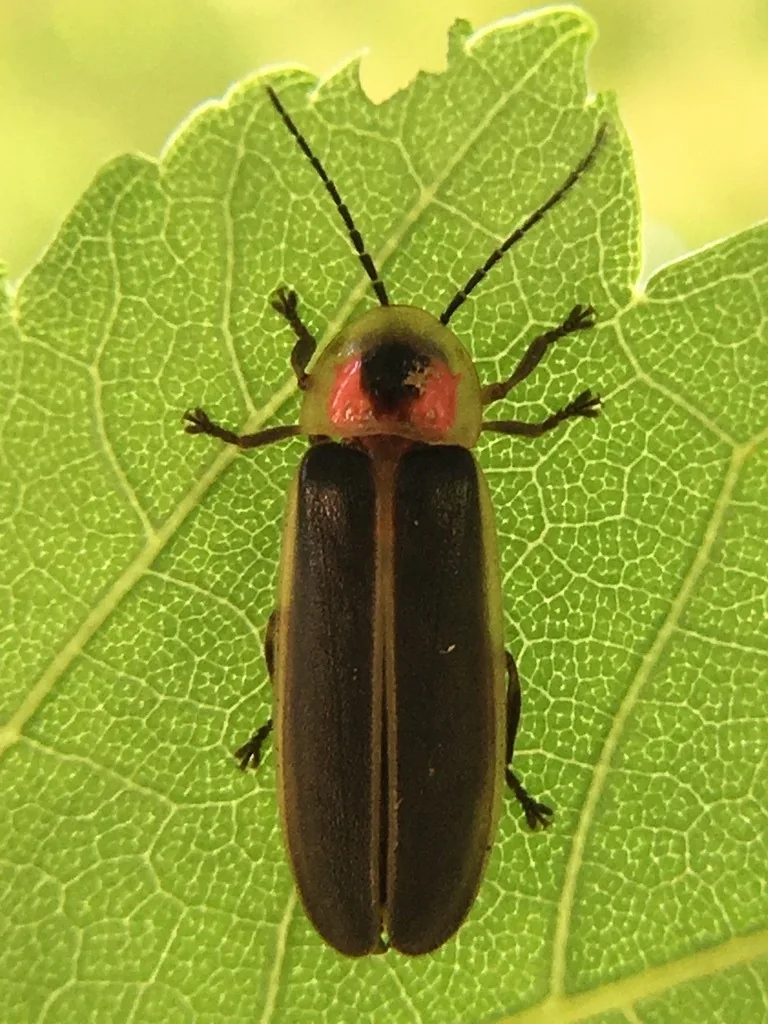
- Adults are elongate-oval, slightly flattened beetles with soft, somewhat leathery dark wing covers and a broad plate behind the head, usually edged or colored with yellow, red or orange; Colorado State gives most species as 10 to 15 mm long, and the Missouri Department of Conservation up to about 3/4 inch.[1][3]
- The big dipper firefly, the most common species in Missouri, is about half an inch long with a red plate behind the head marked with a black central spot and wing covers outlined in yellow.[2]
- In flashing species the light organ (lantern) sits at the tip of the abdomen and can glow yellow, green or amber depending on the species; some species never light up and are active by day.[1][2][3]
- Larvae, sometimes called glowworms, are wingless and flattened, with plates covering the body. They glow steadily rather than blinking and are usually found on damp ground near grass and brush.[3]
Where it lives
Fireflies occur statewide in Missouri in pastures, old fields, yards, woodland edges and along streams. In drier western areas such as Colorado, flashing species are local and tied to permanent, shaded wetlands, while non-flashing species are common in irrigated lawns. GBIF holds about 46,000 US records since 1990 from 46 states, counting the District of Columbia, most from Massachusetts, North Carolina and Ohio.[3][1][11]
Biology and life cycle
Light comes from luciferin reacting with the enzyme luciferase. Each species has its own flash pattern, males and females flash differently to find each other, and many species can be told apart only by their flashes.[1][2][3]
Big dipper firefly males flash a J-shaped streak about every six seconds while hovering about 2 feet up at dusk, and a female in the grass flashes back if she accepts him.[2]
Eggs are laid on or in moist soil; big dipper eggs hatch in 18 to 25 days, and the larvae feed on snails, slugs and worms, using jaws equipped with toxin.[1][2][3]
Most species spend the winter as larvae; some day-active species overwinter as adults under tree bark.[1][3]
Females of the genus Photuris copy the flash replies of Photinus females to lure in Photinus males and eat them. That way they gain defensive chemicals called lucibufagins that they can't make themselves, and jumping spiders reject Photuris females that carry them.[3][8]
Larvae are most common in damp places such as wetlands, damp pastures and the edges of ponds and streams, and some are aquatic. Now and then a whole group of adults in a creek valley flashes in unison.[3]
Damage and signs
Health risk
None of the sources describes a risk to people. Fireflies contain defensive steroids called lucibufagins, related to toad toxins, that made them distasteful to thrushes in feeding tests. A 2026 veterinary review says fireflies are highly toxic to bearded dragons and other lizards, causing fatal heart poisoning with no documented antidote, so keep them away from pet lizards.[1][9][10]
Control
Prevention
To keep fireflies around, leave a small area of leaf litter or grass clippings to hold moisture, use pesticides only when needed, and limit outdoor lighting when they are active (red bulbs disturb them less).[2]
Avoid broad-spectrum insecticides: insecticides and herbicides cut firefly numbers directly and also reduce the prey their larvae need.[3]
Why fireflies are declining
A 2021 assessment of 132 firefly species from the United States and Canada, about 79 percent of those described, found at least 18 (14 percent) threatened with extinction, mainly from habitat loss, light pollution and climate change; 53 percent had too little data to assess.[4]
The Missouri Department of Conservation points to habitat loss and degradation, pesticides and light pollution, and Colorado State says draining wetlands and heavy cattle traffic along waterways have wiped out some local populations.[3][1]
In lab tests, larvae of two common eastern species, Photuris versicolor complex and the big dipper firefly, were intoxicated or killed in soil with more than 1 ppm of the neonicotinoid clothianidin, and at lower doses they fed less.[5]
Dim light at night, like city skyglow, did not change larval survival in a lab study, but late-stage Photuris larvae placed near a bright point light were more likely to burrow than to move away from it.[6]
Where sources disagree
How many species: MU Extension gives about 125 in North America; the Missouri Department of Conservation gives about 175 north of Mexico, and the 2021 assessment's 132 species were about 79 percent of those described in the United States and Canada.[2][3][4]
How long larvae live: MU Extension says the big dipper firefly's larval stage lasts one to two years, while Colorado State assumes a one-year life cycle for all Colorado fireflies.[2][1]
Outdoor lights: MU Extension and the Missouri Department of Conservation treat light pollution as a threat. Field tests found it depends on the species: artificial light had little effect on the mating of the big dipper firefly and Photinus marginellus but strongly affected mate finding in Photinus greeni, and in the lab direct light stopped mating entirely in Photinus obscurellus.[2][3][7]
Common questions
- Are fireflies harmful?
- Not to people or gardens: they are predatory beetles that don't feed on plants, and their larvae eat slugs and snails. They are toxic to pet lizards such as bearded dragons, though.[1][2][10]
- Why are there fewer fireflies than there used to be?
- Habitat loss, outdoor lighting and pesticides all play a part, and draining wetlands has wiped out some local populations; at least 18 North American species are considered threatened.[2][3][1][4]
- Why do some fireflies never light up?
- Some species lack light organs and are active by day; Colorado State says they are presumed to find mates by scent (sex pheromones) instead of flashes.[1][3]
- Do fireflies live in the West?
- Yes, but flashing species are patchy there and tied to permanent, shaded wetlands; non-flashing species are more common in irrigated yards.[1]
Sources
- Colorado State University Extension (Colorado Insects of Interest, W. Cranshaw), “Fireflies (Lightningbugs) (Colorado Insects of Interest).” wci.extension.colostate.edu/wp-content/uploads/sites/14/2017/03/Fireflies.pdf (accessed 2026-11-11)
- University of Missouri Extension, “Fireflies illuminate landscapes with summer love (June 7, 2023).” extension.missouri.edu/news/fireflies-illuminate-landscapes-with-summer-love (accessed 2026-11-11)
- Missouri Department of Conservation, “Fireflies (Lightning Bugs) (field guide).” mdc.mo.gov/discover-nature/field-guide/fireflies-lightning-bugs (accessed 2026-11-11)
- PLoS One, via PubMed, “Evaluating firefly extinction risk: initial red list assessments for North America (Fallon et al. 2021).” pubmed.ncbi.nlm.nih.gov/34788329/ (accessed 2026-11-11). Cited from the PubMed abstract.
- PeerJ, via PubMed, “Toxicity of clothianidin to common eastern North American fireflies (Pearsons et al. 2021).” pubmed.ncbi.nlm.nih.gov/34820205/ (accessed 2026-11-11). Cited from the PubMed abstract.
- Journal of Insect Physiology, via PubMed, “Effects of artificial light on growth, development, and dispersal of two North American fireflies (Owens and Lewis 2021).” pubmed.ncbi.nlm.nih.gov/33607160/ (accessed 2026-11-11). Cited from the PubMed abstract.
- Royal Society Open Science, via PubMed, “Artificial light impacts the mate success of female fireflies (Owens and Lewis 2022).” pubmed.ncbi.nlm.nih.gov/35958085/ (accessed 2026-11-11). Cited from the PubMed abstract.
- Proceedings of the National Academy of Sciences, via PubMed, “Firefly femmes fatales acquire defensive steroids (lucibufagins) from their firefly prey (Eisner et al. 1997).” pubmed.ncbi.nlm.nih.gov/9275191/ (accessed 2026-11-11). Cited from the PubMed abstract.
- Proceedings of the National Academy of Sciences, via PubMed, “Lucibufagins: defensive steroids from the fireflies Photinus ignitus and P. marginellus (Eisner et al. 1978).” pubmed.ncbi.nlm.nih.gov/16592501/ (accessed 2026-11-11). Cited from the PubMed abstract.
- Veterinary Clinics of North America: Exotic Animal Practice, via PubMed, “Dietary intoxications of the exotic animal patient (Cowan and Berg, 2026).” pubmed.ncbi.nlm.nih.gov/42509053/ (accessed 2026-11-11). Cited from the PubMed abstract.
- Global Biodiversity Information Facility (GBIF), “Lampyridae: US occurrence records since 1990 by state (GBIF occurrence search API).” api.gbif.org/v1/occurrence/search?taxonKey=4737&country=US&hasGeospatialIssue=false&occurrenceStatus=PRESENT&year=1990%2C2026&facet=stateProvince&facetLimit=400&limit=0 (accessed 2026-11-11). State counts are records reported (iNaturalist research-grade, museum specimens, surveys), not abundance.
- iNaturalist, “Photinus taxon page (order and family).” www.inaturalist.org/taxa/47730 (accessed 2026-11-11)