On this page
How to identify it
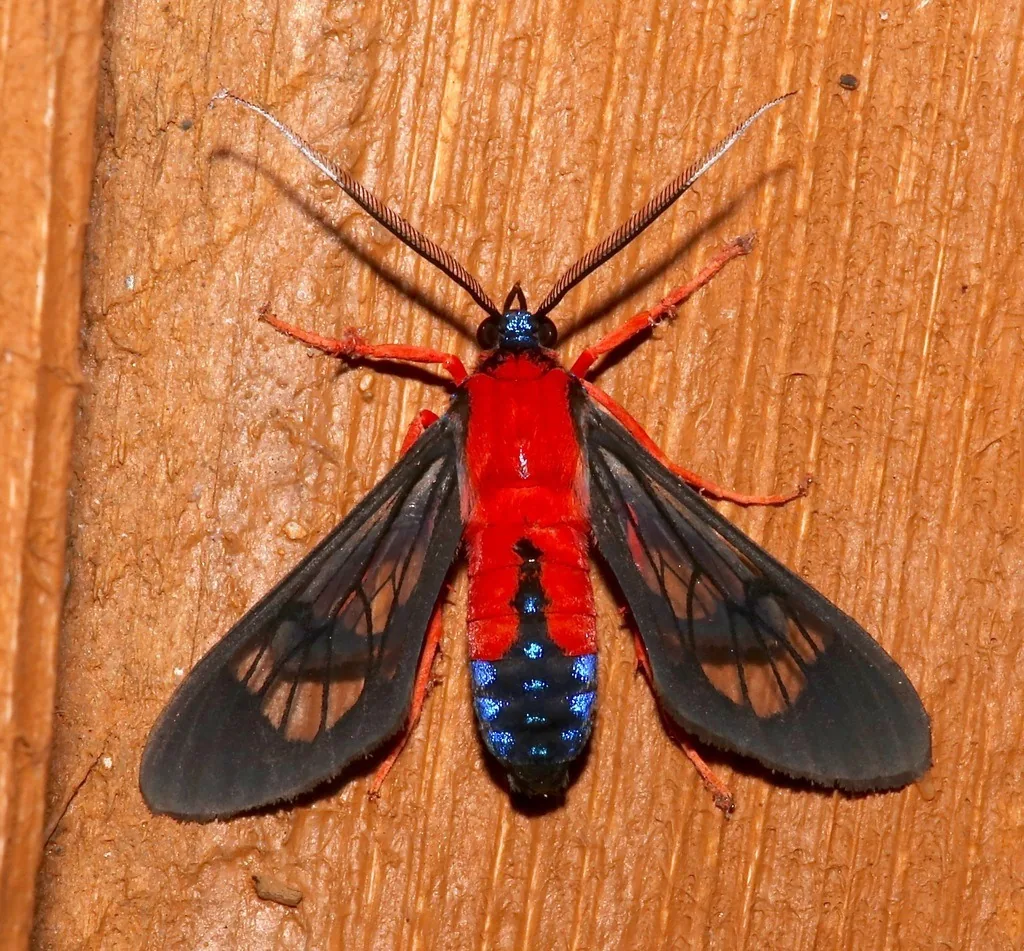
- Adults are mid-sized moths, with a body about 0.6 inch long and a 1.2-inch wingspan. UF/IFAS measured adults at 1.52 cm (0.60 inch) long.[1][2]
- The wings are clear with black tips, and the body is velvety red with blue and black markings. UF/IFAS says the red abdomen carries metallic blue dots on top.[1][2]
- Males have a pair of pouches on the abdomen packed with fine filaments. UF/IFAS says females lack the pouches.[1][3][2]
- Caterpillars are covered in white hairs that UF/IFAS describes as non-urticating (non-stinging); they are whitish when young and turn bright yellow, growing from 2.80 mm to about 21.61 mm.[2]
- The pupa, 1.40 cm long, sits in a cocoon of the last caterpillar's hairs about 2.31 cm long; it starts white and turns red and black.[2]
- Eggs are white, about 0.88 mm across, and laid one at a time.[2]
Where it lives
Mississippi State Extension says it occurs only in Florida and a narrow band of coastal counties in other southeastern states, plus parts of Mexico and Central America; in Mississippi most reports come from the lower two tiers of counties. NatureServe lists it in Florida, Georgia, South Carolina, North Carolina, Alabama, Mississippi, Louisiana, Texas and Arkansas. Winter temperatures, not host plants, seem to limit it. UF/IFAS says it is found throughout Florida and in coastal Texas, Louisiana, Mississippi, Alabama, Georgia and South Carolina.[1][4][2]
Biology and life cycle
There are several generations a year, but in Mississippi sightings are most common in fall and early winter.[1]
Before mating, males feed on the fluids of dog fennel (Eupatorium capillifolium) and take up pyrrolizidine alkaloids, which protect them from spiders.[3][1]
During courtship the male showers the female with the alkaloid-laden filaments from his pouches, and he also passes alkaloid to her when mating; she passes some of it on to the eggs.[3][1]
The coating works. In Cornell tests, golden silk spiders cut all seven females mated to alkaloid-fed males out of their webs and let them go, but ate five of the six females mated to alkaloid-free males.[1][3]
Dog fennel is neither a caterpillar host nor an important nectar plant for this moth; males visit it only for the toxins.[1]
UF/IFAS says the life cycle takes 50 to 60 days and a female lays 75 to 170 eggs.[2]
Newly hatched caterpillars eat their eggshells; the last-stage caterpillar moves to a sheltered spot on the plant or to the ground to spin its cocoon.[2]
In spring 2012, caterpillars collected in St. Lucie County, Florida, were parasitized by a tachinid fly, Hyphantrophaga sellersi, and an undescribed eulophid wasp.[2]
Damage and signs
Health risk
None. It is a moth that only looks like a wasp, a disguise colorful day-flying moths use for protection from birds and other predators.[1]
Control
Prevention
No control is called for. It is a native moth whose caterpillars eat only a weedy native vine, and NatureServe ranks the species G5, describing it as widespread, common and not declining.[1][4]
Where the sources disagree
Caterpillar hosts: Mississippi State says climbing hempvine only; UF/IFAS says two native Mikania vines, climbing hempvine and Florida Keys hempvine.[1][2]
Common questions
- What is the red wasp-like moth with clear wings?
- Likely a scarlet-bodied wasp moth: velvety red body, blue and black markings, clear black-tipped wings, about a 1.2-inch wingspan.[1]
- Does it sting?
- No. It is a moth that mimics wasps for protection.[1]
- What does the caterpillar eat?
- Mississippi State names only climbing hempvine (Mikania scandens); UF/IFAS adds Florida Keys hempvine (Mikania cordifolia).[1][2]
- Why do males visit dog fennel?
- To collect plant toxins that they pass to their mates and eggs, which makes spiders reject them.[1][3]
- Do the fuzzy caterpillars sting?
- UF/IFAS describes their white hairs as non-urticating, meaning non-stinging.[2]
Sources
- Mississippi State University Extension (Bug's Eye View), “Scarlet-bodied Wasp Moth, Vol. 9, No. 29.” extension.msstate.edu/newsletters/bugs-eye-view/2023/scarlet-bodied-wasp-moth-vol-9-no-29 (accessed 2026-11-14)
- University of Florida/IFAS Extension (Featured Creatures), “Scarlet-Bodied Wasp Moth, Cosmosoma myrodora (Dyar), EENY-557/IN996.” ask.ifas.ufl.edu/publication/IN996 (accessed 2026-11-14)
- Proceedings of the National Academy of Sciences, via PubMed, “Conner WE et al. (2000), Chemical defense: bestowal of a nuptial alkaloidal garment by a male moth on its mate, Proceedings of the National Academy of Sciences 97(26):14406-14411.” pubmed.ncbi.nlm.nih.gov/11114202/ (accessed 2026-11-14). Cited from the PubMed abstract.
- NatureServe, “Cosmosoma myrodora, Scarlet-bodied Wasp Moth (NatureServe Explorer species record).” explorer.natureserve.org/Taxon/ELEMENT_GLOBAL.2.119179/Cosmosoma_myrodora (accessed 2026-11-14). State list and rank read from NatureServe Explorer's public taxon data.
- iNaturalist, “Cosmosoma myrodora taxon page (order and family).” www.inaturalist.org/taxa/217647 (accessed 2026-11-14)