On this page
How to identify it
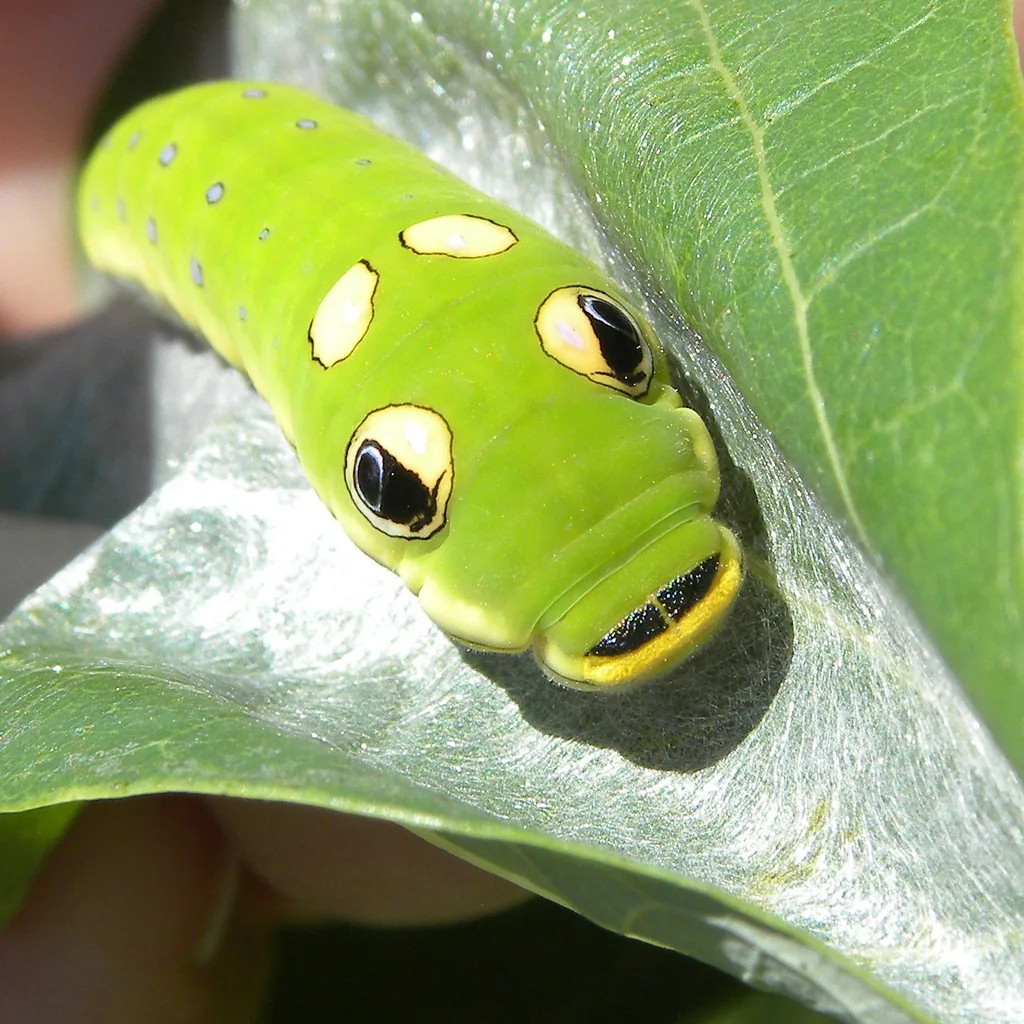
- Older caterpillars are bright green, sometimes yellow, and smooth. Missouri's field guide describes a prominent pair of black and yellow eyespots on a hump behind the real head, with two more yellow spots behind those; NC State says they have two pairs of eyespots and blue spots, and mature caterpillars are brownish underneath. UF/IFAS says full-grown caterpillars reach up to 5.5 cm (about 2.17 inches), with a pale yellow side line, a band of six blue dots ringed in black on each abdominal segment, and large tan eyespots with a black "pupil" and a white highlight.[2][1][3]
- Young caterpillars are shiny olive-green and white and look like bird droppings. UF/IFAS says young caterpillars are brown or black with a white stripe and false eyespots, mimicking bird or lizard droppings.[1][2][3]
- When disturbed, the caterpillar pushes out a forked, orange organ (the osmeterium) from behind the head that gives off a foul-smelling chemical. A lab study found the scent chemicals in this species change between the fourth and fifth (last) larval stages. UF/IFAS describes the organ as bright yellow in all larval stages.[2][4][3]
- The butterfly is black with a tail on each hind wing and a row of white spots near the edge of the forewing. Each hind wing has a pale blue area: Missouri's guide says it is iridescent blue in females and green in males. Missouri gives a wingspan of 2½ to 4 inches; BAMONA gives 3 to 4 inches (7.5 to 10 cm).[1][2][5]
- On the underside, the hind wings carry orange spots, and the row of yellow spots is broken in the middle by a blue area.[2][6]
- Just before pupating, the full-grown caterpillar stops feeding and turns yellow.[3]
Look-alikes
| Look-alike | How to tell them apart |
|---|---|
| Pipevine swallowtail | The pipevine swallowtail is black with an iridescent blue-green sheen, only faint white spots on the upper side and a single row of spots below. The spicebush swallowtail has white spots on the upper side, and its yellow underside spots are broken by a blue area.[6] |
| Eastern black swallowtail | Wisconsin Extension says black swallowtails are sometimes confused with the spicebush swallowtail. The black swallowtail's hind-wing underside has bands of orange spots separated by pale blue, while the spicebush's yellow underside spots are interrupted in the middle by a blue area.[6] |
Where it lives
BAMONA gives its range as the eastern states from southern Canada to Florida and west to Oklahoma and central Texas, with occasional strays to North Dakota, central Colorado and Cuba. At the western and northern edges it thins out: Missouri's field guide calls it a breeding resident in the Ozarks but rare in other parts of the state, and Wisconsin Extension calls it an uncommon stray into Wisconsin. GBIF holds 49,736 U.S. records since 1990, the most from Florida, Virginia, Pennsylvania and Ohio. UF/IFAS says it occurs from southern Canada south to southern Florida, except the Miami area and the Keys, and west to Texas, becoming less common west of the Mississippi River.[5][2][6][7][3]
Biology and life cycle
Females lay eggs one at a time on the undersides of host leaves. UF/IFAS says females pick young trees and new leaves, laying eggs 2 to 5 meters (6.6 to 16.4 feet) up, and that saplings 1 to 6 feet tall are most attractive.[1][3]
The caterpillar folds a leaf over itself and lines it with silk, and stays inside this shelter when it isn't feeding. UF/IFAS says caterpillars hide in the shelter by day and come out to feed at night, and eat their eggshells and shed skins.[1][2][3]
Just before pupating, the caterpillar curls into a comma shape. The chrysalis has two horns at the front and hangs from a twig by a narrow silk band; it can be green or brown, but chrysalides that spend the winter are always brown. UF/IFAS says the yellow prepupa wanders off the host plant and usually pupates near the ground on slender stems; the brown overwintering pupa is the stage that spends the winter.[1][3]
Sources count the yearly broods differently: NC State says several generations occur each year, Missouri's guide gives three broods with adults flying from April into October, and BAMONA gives two generations from April to October, with several in Florida between March and December.[1][2][5]
Adults are most at home in forested areas but wander widely for nectar, especially from butterfly weed, and they also take moisture and nutrients from puddles and wet ground. UF/IFAS says courtship and mating happen in the afternoon, with the male hovering over the female.[2][3]
UF/IFAS says the adults are palatable mimics of the distasteful pipevine swallowtail, and lists two tachinid flies and an ichneumonid wasp as parasitoids.[3]
Damage and signs
- Caterpillars feed mainly on spicebush and sassafras; NC State also lists sweet bay and tulip tree, and BAMONA adds prickly ash, camphor and redbay as possible hosts. UF/IFAS says the caterpillars are thought to feed only on laurel-family plants: red bay, swamp bay, sassafras, spicebush, southern spicebush and the invasive camphortree, and probably silk bay and pond spice in Florida. It cites Scriber's report that red bay is the preferred host in Florida and spicebush and sassafras elsewhere.[2][1][5][3]
- NC State says the leaf folding and feeding are usually minor enough to go unnoticed.[1]
Health risk
Missouri's guide describes the forked scent organ only as a defense that surprises predators and gives off a foul-smelling chemical; neither it nor NC State reports a bite, sting or venom.[2][1]
Control
Prevention
No control is needed. NC State says the caterpillars are seldom noticed and advises against spraying or dusting them; Missouri's guide notes butterflies pollinate plants and are good indicators of ecosystem health.[1][2]
Why the eyespots work
In a field experiment with 659 artificial caterpillars made to look like this species, eyespots cut bird attacks only when the model sat inside a leaf roll; on open leaves the eyespots made no difference. Leaf rolls lowered predation for models with or without eyespots.[8]
That matches how the real caterpillar lives: it rests inside a folded, silk-lined leaf shelter whenever it is not feeding.[1][2]
Where the sources disagree
Broods: NC State says several generations a year, Missouri three broods, and BAMONA two generations (several in Florida).[1][2][5]
Wingspan: Missouri gives 2½ to 4 inches; BAMONA gives 3 to 4 inches.[2][5]
Hind-wing color: Missouri says iridescent blue in females and green in males; BAMONA says bluish in females and bluish-green in males; NC State says the markings are usually greenish blue.[2][5][1]
Name: Missouri's field guide uses Pterourus troilus; GBIF, BAMONA and NC State use Papilio troilus.[2][9][5][1]
Sweet bay and tulip tree: NC State lists them as hosts and BAMONA adds prickly ash; UF/IFAS says such non-laurel reports need checking, and cites a lab study in which newly hatched caterpillars starved rather than feed on sweetbay, tuliptree or common pricklyash.[1][5][3]
Wingspan (more): UF/IFAS gives 92 to 124 mm (3.83 to 4.78 inches), larger than Missouri's or BAMONA's figures.[3]
Broods (more): UF/IFAS says at least three generations in the Deep South and two farther north.[3]
Scent organ color: Missouri's guide calls swallowtail osmeteria orangish; UF/IFAS says this species' are bright yellow in all larval stages.[2][3]
Laurel wilt and its host plants
UF/IFAS says the spicebush swallowtail is threatened throughout its range because laurel wilt, a fungus carried by the introduced redbay ambrosia beetle, is killing its host plants, and every known host is on the list of laurel-family plants the fungus infects.[3]
Only the exotic camphortree has shown any resistance, but UF/IFAS classes it as invasive and does not recommend planting it; for caterpillars it recommends red bay, sassafras or spicebush, depending on where you live.[3]
Common questions
- What is the green caterpillar that looks like a snake?
- Most likely a spicebush swallowtail caterpillar. Its big fake eyespots make it look like a tiny green snake or tree frog.[1][2]
- Is it poisonous?
- Neither NC State nor Missouri's guide reports a bite, sting or venom. If you poke it, it may push out an orange forked organ that gives off a foul smell, which Missouri describes as a defense against predators.[1][2]
- Will it hurt my spicebush or sassafras?
- Usually not; the feeding is minor enough to go unnoticed. UF/IFAS lists spicebush and sassafras among the plants it recommends growing for these caterpillars.[1][3]
- What does the spicebush swallowtail butterfly look like?
- A large black swallowtail with white spots along the forewing edge and a blue (female) or green (male) wash on the hind wings, about 2½ to 4 inches across.[2][1]
- Why are spicebush swallowtails declining in some areas?
- UF/IFAS says laurel wilt, spread by the redbay ambrosia beetle, is killing the laurel-family plants the caterpillars depend on.[3]
Sources
- NC State Extension, “Spicebush Swallowtail (PDIC Factsheet).” content.ces.ncsu.edu/spicebush-swallowtail (accessed 2026-11-14)
- Missouri Department of Conservation, “Spicebush Swallowtail (Field Guide).” mdc.mo.gov/discover-nature/field-guide/spicebush-swallowtail (accessed 2026-11-14)
- University of Florida/IFAS Extension (Featured Creatures), “Spicebush Swallowtail, Papilio (Pterourus) troilus Linnaeus, EENY-636/IN1107.” ask.ifas.ufl.edu/publication/IN1107 (accessed 2026-11-14)
- Journal of Chemical Ecology, via PubMed, “Omura H, Honda K, Feeny P (2006), From terpenoids to aliphatic acids: further evidence for late-instar switch in osmeterial defense as a characteristic trait of swallowtail butterflies in the tribe Papilionini, Journal of Chemical Ecology 32(9):1999-2012.” pubmed.ncbi.nlm.nih.gov/16902823/ (accessed 2026-11-14). Cited from the PubMed abstract.
- Butterflies and Moths of North America (BAMONA), “Spicebush Swallowtail, Papilio troilus (species account).” www.butterfliesandmoths.org/species/Papilio-troilus (accessed 2026-11-14)
- University of Wisconsin-Madison Extension, “Black Swallowtail, Papilio polyxenes.” hort.extension.wisc.edu/articles/black-swallowtail-papilio-polyxenes/ (accessed 2026-11-14)
- Global Biodiversity Information Facility (GBIF), “Papilio troilus: U.S. occurrence records since 1990 by state (GBIF occurrence search).” api.gbif.org/v1/occurrence/search?taxonKey=1938104&country=US&hasGeospatialIssue=false&occurrenceStatus=PRESENT&year=1990%2C2026&facet=stateProvince&facetLimit=400&limit=0 (accessed 2026-11-14)
- Journal of Animal Ecology, via PubMed, “Postema EG (2025), Eyespot peek-a-boo: Leaf rolls enhance the antipredator effect of insect eyespots, Journal of Animal Ecology 94(5):814-822.” pubmed.ncbi.nlm.nih.gov/39722121/ (accessed 2026-11-14). Cited from the PubMed abstract.
- Global Biodiversity Information Facility (GBIF), “Papilio troilus Linnaeus, 1758 (GBIF Backbone Taxonomy).” api.gbif.org/v1/species/1938104 (accessed 2026-11-14)
- iNaturalist, “Papilio troilus taxon page (order and family).” www.inaturalist.org/taxa/58525 (accessed 2026-11-14)