On this page
How to identify it
- Full-grown caterpillars are green, darker on top, and about 1.5 inches long. The swollen front end carries a pair of yellow, black-outlined eyespots, each with a smaller light purple spot inside, and each abdominal segment has a crosswise row of small bluish spots.[2][1]
- Younger caterpillars have a yellow patch on top of the third and fourth abdominal segments that is gone on full-grown ones.[2]
- When disturbed, the caterpillar rears back and pushes out a forked, orange scent gland (osmeterium) that gives off a bad smell.[2][1]
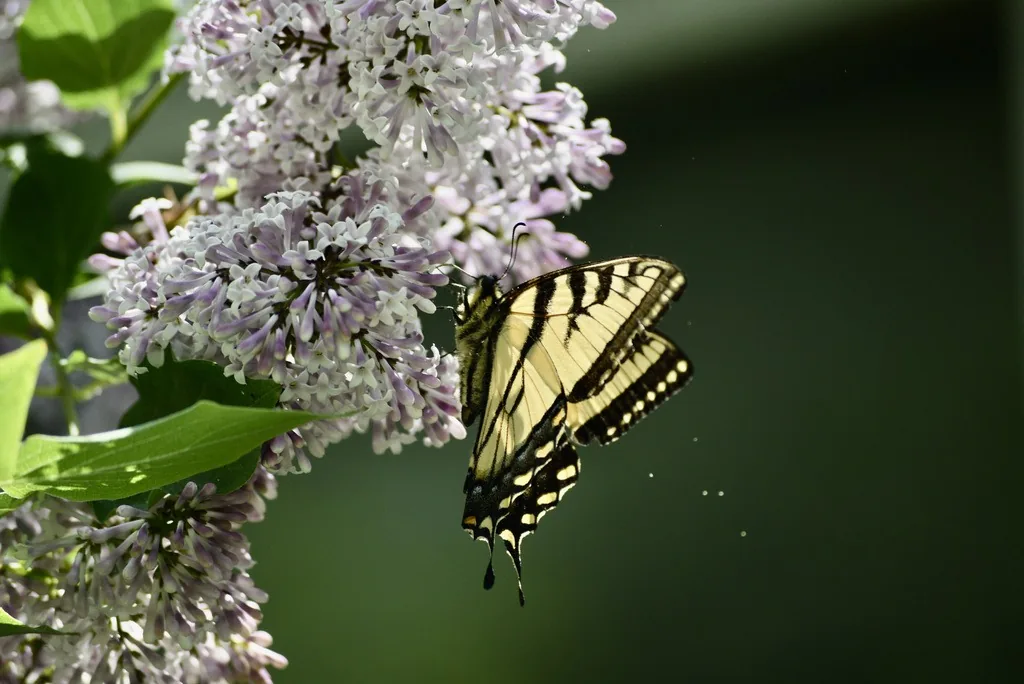
- Males are yellow with dark tiger stripes. Females come in two forms, one yellow like the male and one black with shadows of the stripes, and both have blue on the upper side of the hind wings. Wingspan is 2½ to 4½ inches.[1][3]
Look-alikes
| Look-alike | How to tell them apart |
|---|---|
| Pipevine swallowtail | Dark-form tiger females look a lot like the pipevine swallowtail, a distasteful butterfly, and they occur only where the two ranges overlap. Look for the faint tiger stripes on the dark female; MDC adds that dark females lack two complete rows of orange spots under the hind wing.[1][3] |
| Canadian tiger swallowtail | In spring, the row of spots along the edge of the forewing underside may merge into a solid band, which makes an eastern tiger swallowtail look like the Canadian tiger swallowtail.[3] |
Where it lives
Eastern North America from Ontario south to the Gulf Coast and west to the Colorado plains and central Texas. In Missouri it is found statewide.[3][1]
Biology and life cycle
Females lay eggs one at a time on host leaves. Caterpillars rest on silk mats on the upper surface of leaves, and the chrysalis spends the winter.[3]
MU Extension finds caterpillars from May to October, with two to three generations a year. Butterflies and Moths of North America gives two broods in the North, flying May to September, and three in the Deep South, flying February to November; in Missouri adults fly from late March into October.[2][3][1]
Males are more likely than females to sip from puddles and damp soil, and they pass the salts on to females when they mate, which helps the females lay more eggs.[1]
Males prefer yellow females, but the dark-form females seem to survive longer, giving them time to lay more eggs.[1]
Damage and signs
Health risk
The caterpillar's scent gland only releases a disagreeable odor; none of these sources reports a risk to people or pets.[2][1]
Control
Prevention
No control is needed. MU Extension says very few swallowtail species would be considered important pests, and Butterflies and Moths of North America lists no management needs.[2][3]
To enjoy the adults, grow nectar plants: they visit wild cherry and lilac, and milkweed and Joe-Pye weed are summer favorites.[3]
Common questions
- What is the green caterpillar with big eyes on my cherry tree?
- Possibly an eastern tiger swallowtail caterpillar, since cherry is one of its hosts. The big eyes are false eyespots on its swollen front end.[2][1]
- What is the orange forked thing it pushes out?
- An osmeterium, a forked scent gland swallowtail caterpillars push out when disturbed; it releases a disagreeable odor that deters predators.[2][1]
- Is it a pest?
- No. MU Extension says very few swallowtails would be considered important pests.[2]
Sources
- Missouri Department of Conservation, “Eastern Tiger Swallowtail (Field Guide).” mdc.mo.gov/discover-nature/field-guide/eastern-tiger-swallowtail (accessed 2026-11-11)
- University of Missouri Extension (Caterpillars in Your Yard and Garden, IPM1019), “Caterpillars in Your Yard and Garden, page 44: Tiger swallowtail.” extension.missouri.edu/publications/ipm1019-44 (accessed 2026-11-11)
- Butterflies and Moths of North America, “Eastern Tiger Swallowtail, Papilio glaucus (species account).” www.butterfliesandmoths.org/species/Papilio-glaucus (accessed 2026-11-11)
- iNaturalist, “Papilio glaucus taxon page (order and family).” www.inaturalist.org/taxa/1613196 (accessed 2026-10-06)