On this page
How to identify it
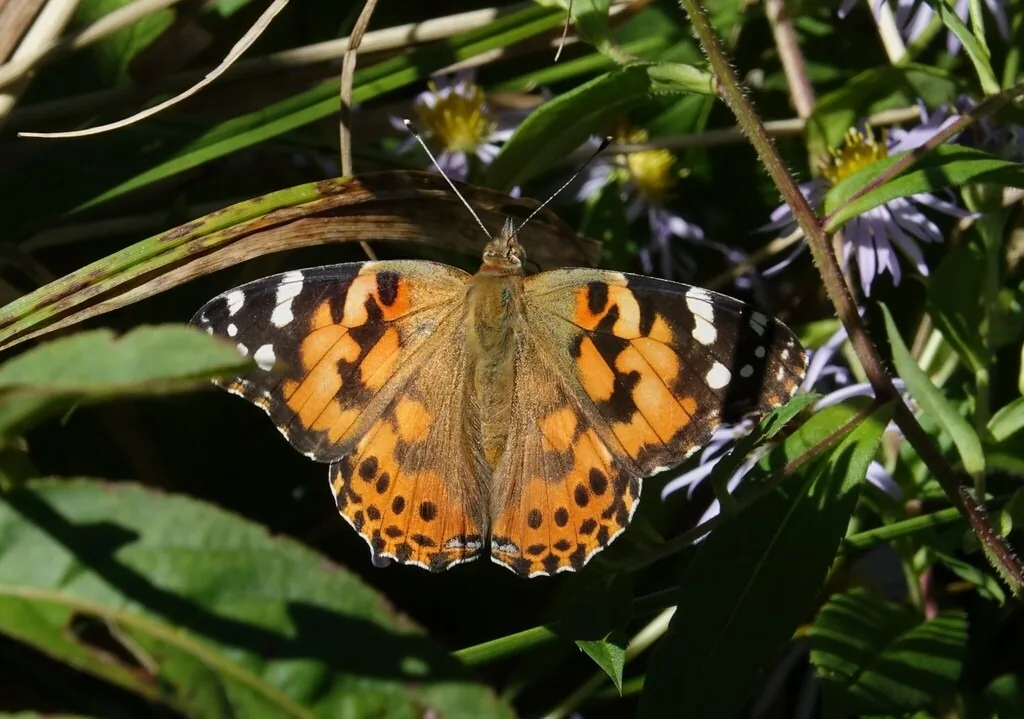
- Wingspan is 1 3/4 to 2 1/2 inches by MDC's measure and 2 to 2 7/8 inches according to Butterflies and Moths of North America (BAMONA). From above it is orange and black, with dark forewing tips spotted white and a white bar on the forewing's leading edge.[1][4]
- The underside is brown with a white cobweb pattern, and each hindwing has four small eyespots near its outer edge.[1][4]
- Seen from above, the two parts of the dark band across the middle of the forewing are joined by a heavy dark bar, and the hindwing spots are well separated and about the same size; BAMONA notes those spots sometimes carry blue scales.[1][4]
- Caterpillars are spiny. MDC describes them as greenish yellow to lavender with yellowish spines and a yellow stripe along the side, and Utah State as brown-black with yellow markings. They often hide in a leaf tent tied with silk.[1][3]
Look-alikes
| Look-alike | How to tell them apart |
|---|---|
| American lady | Nearly identical. Under the hindwing it has two large eyespots instead of four small ones, the outer edge of its forewing is somewhat notched, and from above the dark forewing band has no heavy connecting bar.[5][1] |
| Red admiral | Black above, not mostly orange, with an orange-red band across each forewing and along the trailing edge of the hindwing. It belongs to the same genus and also migrates.[6][1] |
Where it lives
The sources disagree about the edges of its world range: MDC says it lives everywhere except South America and Antarctica, while BAMONA says every continent except Australia and Antarctica. In North America it winters in northern Mexico (Utah State adds the southwestern U.S.) and spreads north each spring to repopulate most of the United States and Canada; in Missouri it arrives in late March and flies until November.[1][4][3]
Biology and life cycle
Adults can't survive cold northern winters. Iowa State says they fly south to subtropical regions in fall, and BAMONA says adults hibernate only in the South and in mild winters.[2][4]
Several generations follow the spring arrival. BAMONA counts one to three flights in the East from May to October, and three to four in South Texas from October to April.[1][3][4]
Numbers swing widely from year to year. An Iowa butterfly survey recorded 747 painted ladies in one September 2017 survey, against a top September count of 21 the year before. Spring migrations in North America can total millions of butterflies in some years, and are thought to be driven by winter weather in breeding grounds near the U.S.-Mexico border.[2][7]
Females lay eggs singly on top of host leaves. Caterpillars emerge three to five days later, feed inside silk nests, and pupate in protected spots on or off the host plant.[4][3]
Males perch and patrol in the afternoon for females: on hilltop shrubs in the West, on bare open ground in the East.[4]
Adults take nectar from many flowers. BAMONA lists thistles, aster, cosmos, blazing star, ironweed and joe-pye weed, plus red clover, buttonbush, privet and milkweeds. A community-science study in California sage scrub counted more than 329 nectar plants, 195 of them not previously known as painted lady nectar sources.[4][7]
Damage and signs
- Caterpillars prefer thistles but feed on many plants, mostly in the aster, mallow, borage and legume families (MDC and BAMONA count more than 100 host plants, Utah State over 300), chewing ragged holes and webbing leaves together.[1][4][3]
- Utah State rates the threat as low: natural enemies usually keep numbers down and crop damage insignificant. It has been seen in hemp in neighboring states but has not been identified as a pest in Utah hemp.[3]
- In years when caterpillars are especially numerous, MDC says they help keep thistles in check.[1]
Health risk
None of the sources describe any risk to people or pets. MDC notes that schoolchildren often raise painted ladies to watch metamorphosis.[1]
Control
Prevention
Plants tolerate low levels of feeding, and Utah State says no management is necessary.[3]
BAMONA lists no management needs for the species, and MDC notes that the adults help pollinate flowers.[4][1]
Traps and physical control
If caterpillars are chewing a plant you care about, Utah State suggests hand-picking them.[3]
How far painted ladies travel
MDC groups the painted lady with the American lady and red admiral as migrants, much like the monarch.[1]
In 2024 researchers reported painted ladies that crossed the Atlantic from West Africa to French Guiana, in South America: a flight of at least 4,200 km lasting 5 to 8 days, possible only with help from the wind. The butterflies probably hatched in Western Europe.[8]
Not every painted lady is a long-distance migrant. In California, community-science records placed them in the same areas in years with and without a big migration, which the authors read as sparse migrants or resident populations.[7]
Common questions
- Why are there so many orange butterflies this fall?
- In good years painted ladies build up over summer and gather on fall flowers before migrating south.[2]
- What do painted lady caterpillars eat?
- Mostly thistles, plus hollyhock, mallows, legumes and many other plants; sources count well over 100 hosts.[1][4][3]
- How do I tell a painted lady from an American lady?
- Count the eyespots under the hindwing: four small on the painted lady, two large on the American lady.[1][5]
- Do painted ladies live in South America?
- MDC says no, but BAMONA's range takes in every continent except Australia and Antarctica, and a 2024 study documented painted ladies reaching French Guiana after crossing the Atlantic.[1][4][8]
- Should I spray the caterpillars on my hollyhocks?
- Usually not. Utah State says plants tolerate low damage and suggests hand-picking if needed.[3][4]
Sources
- Missouri Department of Conservation, “Painted Lady (Field Guide).” mdc.mo.gov/discover-nature/field-guide/painted-lady (accessed 2026-11-11)
- Iowa State University Extension and Outreach (Yard and Garden), “It Was a Very Good Year for Painted Lady Butterflies (September 15, 2017).” yardandgarden.extension.iastate.edu/article/2017/09/it-was-very-good-year-painted-lady-butterflies (accessed 2026-11-11)
- Utah State University Extension (Integrated Pest Management), “Painted Lady (Larvae), Vanessa cardui (hemp pests).” extension.usu.edu/planthealth/ipm/notes_ag/hemp-painted-lady.php (accessed 2026-11-11)
- Butterflies and Moths of North America (BAMONA), “Painted Lady, Vanessa cardui (species account).” www.butterfliesandmoths.org/species/Vanessa-cardui (accessed 2026-11-11)
- Missouri Department of Conservation, “American Lady (Field Guide).” mdc.mo.gov/discover-nature/field-guide/american-lady (accessed 2026-11-11)
- Missouri Department of Conservation, “Red Admiral (Field Guide).” mdc.mo.gov/discover-nature/field-guide/red-admiral (accessed 2026-11-11)
- Environmental Entomology, via PubMed, “Community science reveals high diversity of nectaring plants visited by painted lady butterflies in California sage scrub (Saldivar et al. 2022).” pubmed.ncbi.nlm.nih.gov/36178323/ (accessed 2026-11-11)
- Nature Communications, via PubMed, “A trans-oceanic flight of over 4,200 km by painted lady butterflies (Suchan et al. 2024).” pubmed.ncbi.nlm.nih.gov/38918383/ (accessed 2026-11-11)
- iNaturalist, “Vanessa cardui taxon page (order and family).” www.inaturalist.org/taxa/48548 (accessed 2026-10-06)