On this page
How to identify it
- Wingspan is 1 3/4 to 2 5/8 inches according to BAMONA and 1 3/4 to 2 1/2 inches according to the Illinois DNR; the Missouri Department of Conservation lists its size as 1 1/2 to 2 1/4 inches.[2][3][1]
- The upper side is orange and black, with a black patch and white spots at the forewing tip. A small white spot in the orange area of the forewing, when present, sets it apart, and the outer edge of the forewing is slightly notched.[1][2]
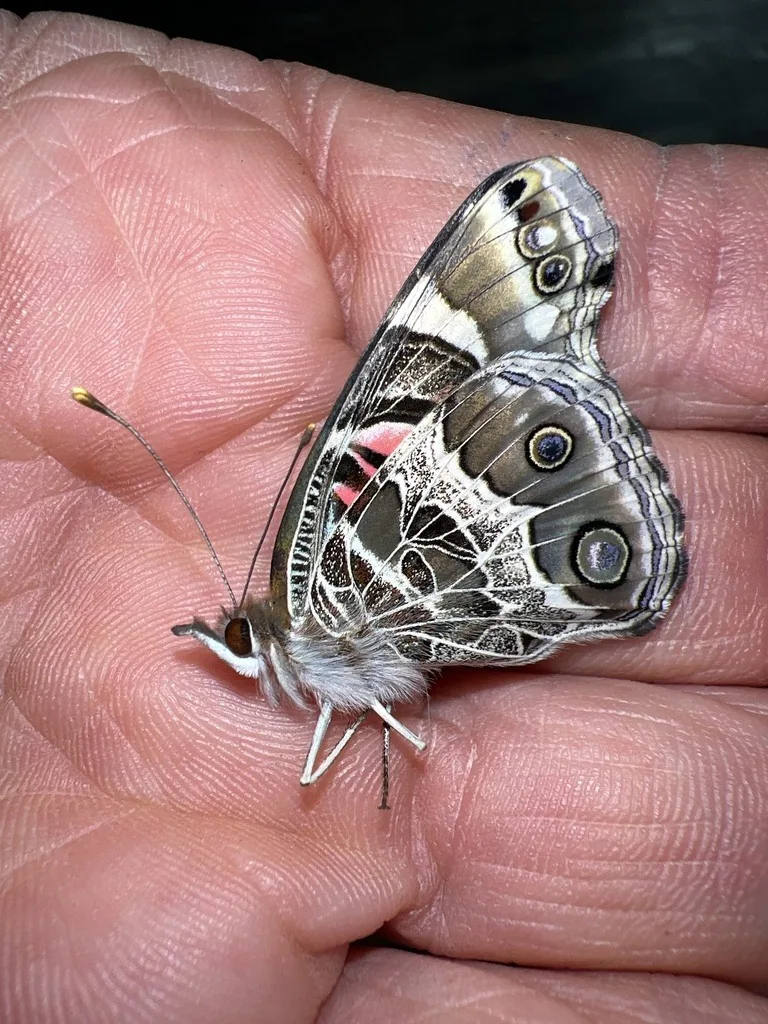
- Under each hindwing are two large eyespots on a brown background with white cobweb-like lines; the painted lady has four small eyespots instead.[1][2]
- Caterpillars are black with yellowish crossbands, black spines, white spots along the sides and a black head, and grow to about 1 1/2 inches.[1]
- BAMONA notes a smaller, paler winter form and a larger, brighter summer form.[2]
Look-alikes
| Look-alike | How to tell them apart |
|---|---|
| Painted lady | Very similar, but it has four small eyespots under the hindwing instead of two large ones.[1][2] |
Where it lives
BAMONA lists it as resident in the southern United States, Mexico and Central America south to Colombia, migrating to and temporarily colonizing the northern U.S., southern Canada, the West Indies and Europe. The Illinois DNR lists it as common and native statewide, flying April through October. GBIF holds 58795 U.S. records since 1990 from 77 state-level areas, the most from Texas (12430), California (5313) and Massachusetts (3071).[2][3][7]
Biology and life cycle
It has several generations a year: BAMONA lists three to four broods from May to November, and all year in the Deep South and South Texas. In Missouri adults arrive from the south in March and fly into November.[2][1]
Adults hibernate but don't survive very cold winters, so regions with cold winters are recolonized each spring by butterflies moving north. The Illinois DNR says it overwinters in Illinois as an adult or chrysalis, with more butterflies migrating in from the south each spring.[1][2][3]
Females lay eggs one at a time on host plant leaves. Each caterpillar ties leaves together with silk into a nest, often at the tip of a flower stalk, and feeds from inside it.[1][2]
In the afternoon, males perch on hilltops while they look for females; BAMONA says they use low vegetation where there are no hills, and MDC says they may patrol hilltops or perch atop large plants.[1][2]
In laboratory work, chilling young pupae with a severe cold shock produced adults with abnormal wing patterns.[5]
Damage and signs
- No damage worth worrying about: caterpillars feed on everlastings, pussytoes, wormwood, ironweed, burdock and other members of the sunflower family. Adults take nectar from flowers; MDC adds that they can be drawn to tree sap and rotting fruit, while BAMONA says they feed almost only on flower nectar.[2][1]
Health risk
It isn't a health pest; MDC, BAMONA and the Illinois DNR describe no bite, sting or other risk to people or pets.[1][2][3]
Control
Prevention
No control is needed: BAMONA reports no management needs. It lives in open places with low plants, such as meadows, parks, vacant lots and gardens.[2][1][3]
To invite it instead, grow its native caterpillar food plants: Cornell Cooperative Extension lists pearly everlasting (Anaphalis margaritacea), and the Illinois DNR names pussytoes (Antennaria).[4][3]
Common questions
- How do I tell an American lady from a painted lady?
- Look under the hindwing: two large eyespots on the American lady, four small ones on the painted lady.[1][2]
- What plants do American lady caterpillars eat?
- Aster-family plants such as everlastings, pearly everlasting, pussytoes, wormwood, ironweed and burdock, usually from inside a silk-tied leaf nest.[2][1]
- Is it rarer than the painted lady?
- Not always. Wisconsin Extension says the red admiral and American lady are actually more abundant than the painted lady in Wisconsin in most years.[6]
- What should I plant for American lady caterpillars?
- Pearly everlasting, pussytoes and other aster-family plants.[4][3][2]
Sources
- Missouri Department of Conservation, “American Lady (Field Guide).” mdc.mo.gov/discover-nature/field-guide/american-lady (accessed 2026-11-12)
- Butterflies and Moths of North America (BAMONA), “American Lady, Vanessa virginiensis (Drury, 1773).” www.butterfliesandmoths.org/species/Vanessa-virginiensis (accessed 2026-11-12)
- Illinois Department of Natural Resources, “American painted lady (Vanessa virginiensis): Wild About Illinois Butterflies.” dnr.illinois.gov/education/wildaboutpages/wildaboutinvertebrates/wildaboutbutterflies/family-nymphalidae.html (accessed 2026-11-12)
- Cornell Cooperative Extension of Monroe County, “Native Host Plants for Butterflies.” monroe.cce.cornell.edu/resources/native-host-plants-for-butterflies (accessed 2026-11-12)
- Journal of Embryology and Experimental Morphology, via PubMed, “Nijhout HF (1984), Colour pattern modification by coldshock in Lepidoptera, Journal of Embryology and Experimental Morphology 81:287-305.” pubmed.ncbi.nlm.nih.gov/6470611/ (accessed 2026-11-12). Cited from the PubMed abstract.
- University of Wisconsin-Madison Extension, Wisconsin Horticulture, “Painted Lady Butterfly, Vanessa cardui.” hort.extension.wisc.edu/articles/painted-lady-butterfly-vanessa-cardui/ (accessed 2026-11-12)
- Global Biodiversity Information Facility (GBIF), “Vanessa virginiensis (American lady): occurrence records in the U.S., 1990-2026 (GBIF occurrence search).” api.gbif.org/v1/occurrence/search?taxonKey=4299370&country=US&hasGeospatialIssue=false&occurrenceStatus=PRESENT&year=1990%2C2026&facet=stateProvince&facetLimit=400&limit=0 (accessed 2026-11-12). State counts are records reported (iNaturalist research-grade, museum specimens, surveys), not abundance.
- iNaturalist, “Vanessa virginiensis taxon page (order and family).” www.inaturalist.org/taxa/48549 (accessed 2026-11-11)