On this page
How to identify it
- Full-grown caterpillars are about 1 1/4 inches long, salmon red with four broken white stripes along the body, many small black spines and a pair of black-knobbed horns at the front.[1]
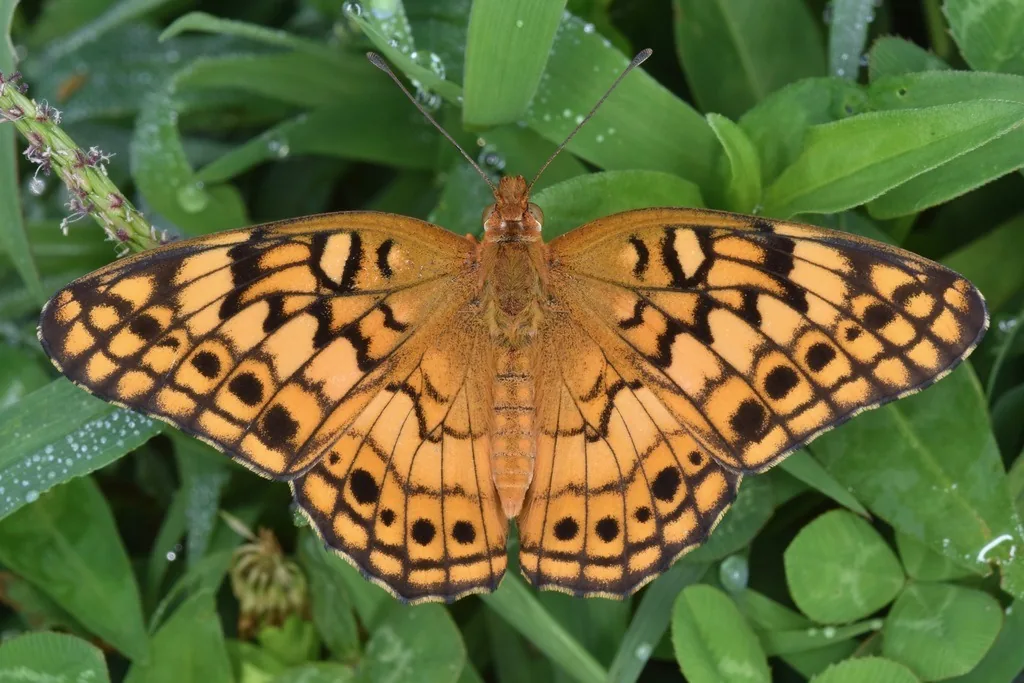
- The butterfly is tawny orange above with thick dark veins and markings and black spots near the edge; the underside of the hind wing is mottled, without silver spots, and the wingspan is about 1 3/4 to 3 1/8 inches. The Florida Museum of Natural History gives the wingspan as 1.75 to 3.2 inches.[2][4]
- Adults fly low and somewhat erratically, and UF/IFAS says they are quite difficult to approach closely.[3]
Look-alikes
| Look-alike | How to tell them apart |
|---|---|
| Other fritillaries | The variegated fritillary's hind-wing underside is mottled and lacks silver spots.[2] |
Where it lives
Ranges from Argentina through Central America and Mexico into the southern United States, and regularly spreads north through most of the country except the Pacific Northwest. GBIF has about 54,000 U.S. records since 1990, by far the most from Texas, then Virginia, Maryland and North Carolina, plus about 2,200 from Mexico and about 900 from Canada. UF/IFAS lists it throughout Florida, in open habitats, disturbed sites and coastal areas as well as gardens, parks and neighborhoods; the Florida Museum gives its origin as North, Central and South America.[2][5][6][3][4]
Biology and life cycle
Eggs are laid singly on the stems and leaves of host plants, and the caterpillars eat both leaves and flowers.[2]
Caterpillars are present from June to October in Missouri, with several generations a year: about three broods from April to October in the north and four in the south, where adults fly from February or March into November or December.[1][2]
In Ohio's statewide butterfly monitoring, 956 variegated fritillaries were counted over 19 years; their numbers showed no clear trend up or down over that time.[7]
UF/IFAS lists maypop (a native passionflower) as its host plant in Florida and describes fields, roadsides and occasionally pinelands as typical places to find it.[3]
Damage and signs
Health risk
It feeds only on plants; none of the sources reports any harm to people or pets.[1][2]
Control
Prevention
Usually no management is needed; Butterflies and Moths of North America reports no management needs for this species.[2]
Where the sources disagree
Flight season: UF/IFAS lists the Florida flight period as March to October, while Butterflies and Moths of North America says adults fly from February or March into November or December in the south.[3][2]
Common questions
- What is the spiny red caterpillar on my pansies?
- A salmon-red caterpillar about 1 1/4 inches long with white stripes, small black spines and two black-knobbed horns at the front is a variegated fritillary caterpillar.[1]
- Should I get rid of variegated fritillary caterpillars?
- Usually not; it is at most an occasional minor pest of pansies and violets, and no management is normally needed.[2]
- Will variegated fritillaries come to my butterfly garden?
- Not reliably. UF/IFAS says that in Florida it is not a regular garden visitor and is usually found in open, disturbed places such as fields and roadsides, though maypop is its host plant there.[3]
Sources
- University of Missouri Extension, “Caterpillars in Your Yard and Garden (IPM1019), page 49: variegated fritillary.” extension.missouri.edu/publications/ipm1019/49 (accessed 2026-11-11)
- Butterflies and Moths of North America, “Variegated Fritillary, Euptoieta claudia (species account).” www.butterfliesandmoths.org/species/Euptoieta-claudia (accessed 2026-11-14)
- University of Florida IFAS, Florida-Friendly Landscaping Program, “Variegated Fritillary Butterfly Details (FFL Butterfly Gardens).” ffl-apps.ifas.ufl.edu/butterflies/Butterfly/Details/39 (accessed 2026-11-14)
- Florida Museum of Natural History, University of Florida, “Variegated Fritillary (Butterfly Rainforest exhibit species page).” www.floridamuseum.ufl.edu/exhibits/butterflies/variegated-fritillary/ (accessed 2026-11-14)
- Global Biodiversity Information Facility (GBIF), “Euptoieta claudia: U.S. occurrence records since 1990 by state (GBIF occurrence search).” api.gbif.org/v1/occurrence/search?taxonKey=1894342&country=US&hasGeospatialIssue=false&occurrenceStatus=PRESENT&year=1990%2C2026&facet=stateProvince&facetLimit=400&limit=0 (accessed 2026-11-11). Exact count at access: 53,870 U.S. records since 1990 (Texas 18,326; Virginia 3,541; Maryland 3,358; North Carolina 3,206).
- Global Biodiversity Information Facility (GBIF), “Euptoieta claudia: occurrence records since 1990 by country (GBIF occurrence search).” api.gbif.org/v1/occurrence/search?taxonKey=1894342&hasGeospatialIssue=false&occurrenceStatus=PRESENT&year=1990%2C2026&facet=country&limit=0 (accessed 2026-11-11). Exact counts at access: 57,133 records since 1990; United States 53,870, Mexico 2,185, Canada 899.
- PLoS ONE, via PubMed Central, “Butterfly abundance declines over 20 years of systematic monitoring in Ohio, USA (Wepprich et al. 2019), Table 2.” pmc.ncbi.nlm.nih.gov/articles/PMC6615595/ (accessed 2026-11-11)
- iNaturalist, “Euptoieta claudia taxon page (order and family).” www.inaturalist.org/taxa/68244 (accessed 2026-10-06)