On this page
How to identify it
- The wingspan is about 1 1/2 to 2 1/2 inches according to MDC, or 1 5/8 to 2 3/4 inches (4.2 to 7 cm) according to BAMONA.[1][2]
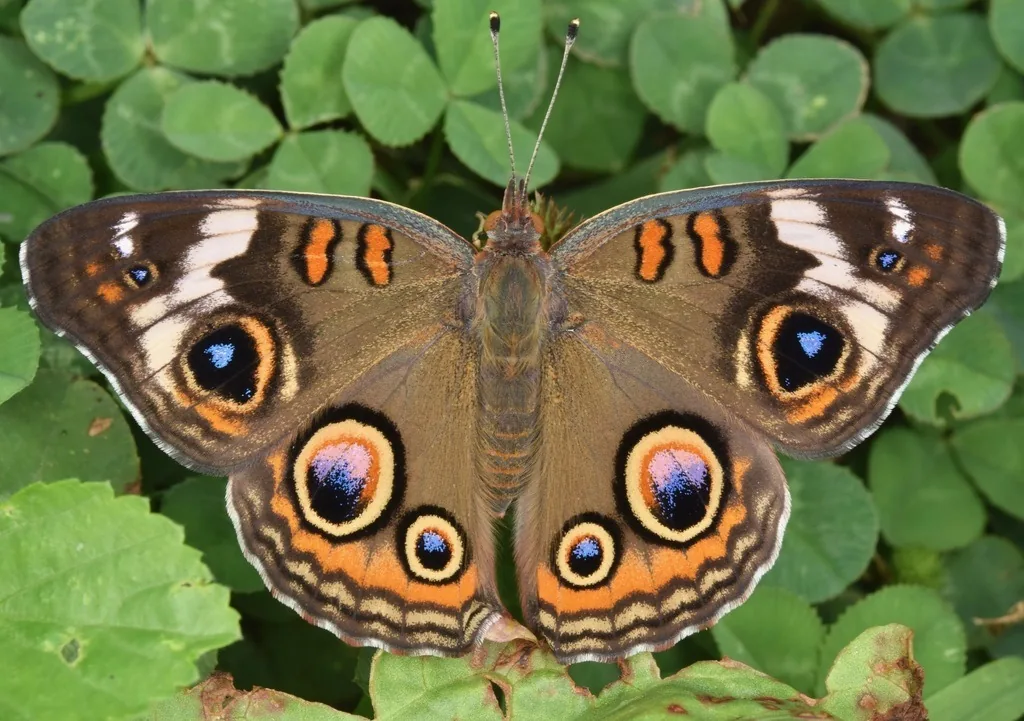
- The forewing has two orange bars and an off-white band that runs into the larger eyespot. The hindwing has two eyespots; the upper one is larger and has a magenta crescent.[1][2]
- Underneath, the hindwing is brown or tan in summer. Fall butterflies are often reddish or rose-red below.[1][2]
- Caterpillars are usually bluish black with yellow to creamy orange stripes and spots and many short, branched, metallic blue-black spines; the side spines rise from orange spots, and the head is black with an orange top.[1]
Look-alikes
| Look-alike | How to tell them apart |
|---|---|
| White peacock | A pale southern butterfly that looks like a washed-out buckeye, with much smaller eyespots above and a point on the hindwing.[1] |
Where it lives
It lives year-round in the southern United States and north along the coasts to central California and North Carolina, and south to Bermuda, Cuba and southern Mexico. Each spring and summer butterflies from the South move north and temporarily colonize most of the country and parts of southern Canada; in Missouri they can't survive a typical winter, and freezes kill them off in fall. GBIF has about 97,000 U.S. records since 1990, most from Texas, then Florida, Illinois, Virginia, North Carolina and Maryland.[2][1][3][4]
Biology and life cycle
Adults fly from spring through fall in several broods, two or three from May to October according to BAMONA, and all year in the Deep South. U.S. records climb through summer and peak in September and October.[2][1][5]
Males perch on low plants or bare ground to watch for females and chase off other insects that fly near.[1][2]
Females lay eggs one at a time on leaf buds or the upper sides of host leaves. The caterpillars live alone.[1][2]
Caterpillars feed mostly on plants in the plantain, snapdragon, verbena and acanthus families, which share defensive compounds called iridoid glycosides. In feeding tests, caterpillars grew poorly and died more often on a diet without these compounds.[6]
Caterpillars store the host-plant chemicals, which help protect them from predators. Adults get rid of them when they emerge from the chrysalis.[1][7]
Numbers change a lot from year to year: some years it is very common, and in others it is almost absent.[1]
Damage and signs
- Caterpillars eat the leaves of verbenas, plantains, toadflax, ruellias, snapdragons and related plants.[1][2]
- Its diet can shift. A 1997 study compared a population on the species' typical host, Plantago lanceolata, with one using a new host, Kickxia elatine; females mostly preferred the host found where they were collected.[7]
Health risk
The caterpillars eat plants, and MDC says the adults play a role in pollination. MDC and BAMONA describe it only as a butterfly and don't mention any risk to people or pets.[1][2]
Control
Prevention
Neither MDC nor BAMONA gives any control advice. Adults take nectar from asters, chicory, tickseed sunflower, dogbane, mints and other flowers.[1][2]
Where the sources disagree
Wingspan: MDC gives 1 1/2 to 2 1/2 inches; BAMONA gives 1 5/8 to 2 3/4 inches (4.2 to 7 cm).[1][2]
Host plants: MDC lists verbenas first among the caterpillars' foods, and a 1984 study counts the verbena family among the four main host families; BAMONA's host list names the snapdragon, plantain and acanthus families but not verbenas.[1][6][2]
Broods: MDC says adults fly from spring through fall in several broods; BAMONA says two to three broods from May to October, and all year in the Deep South.[1][2]
Common questions
- What butterfly has big eyespots on its wings?
- Often the common buckeye, which has bold eyespots on all four wings and orange bars on the forewings.[1][2]
- Is it named after the buckeye tree?
- No. It is named for its bold eyespots and has no link to buckeye trees.[1]
- What do buckeye caterpillars eat?
- Plantains, snapdragons, toadflax, verbenas, ruellias and related plants.[1][2]
Sources
- Missouri Department of Conservation, “Common Buckeye (Field Guide).” mdc.mo.gov/discover-nature/field-guide/common-buckeye (accessed 2026-11-13)
- Butterflies and Moths of North America (BAMONA), “Common Buckeye, Junonia coenia (species page).” www.butterfliesandmoths.org/species/Junonia-coenia (accessed 2026-11-13)
- Global Biodiversity Information Facility (GBIF), “Junonia coenia: U.S. occurrence records since 1990 by state (GBIF occurrence search).” api.gbif.org/v1/occurrence/search?taxonKey=5130514&country=US&hasGeospatialIssue=false&occurrenceStatus=PRESENT&year=1990%2C2026&facet=stateProvince&facetLimit=400&limit=0 (accessed 2026-11-13). Exact count at access: 96,404 U.S. records since 1990 (Texas 26,804; Florida 6,900; Illinois 6,617; Virginia 5,384; North Carolina 5,323; Maryland 4,355).
- Global Biodiversity Information Facility (GBIF), “Junonia coenia: occurrence records since 1990 by country (GBIF occurrence search).” api.gbif.org/v1/occurrence/search?taxonKey=5130514&hasGeospatialIssue=false&occurrenceStatus=PRESENT&year=1990%2C2026&facet=country&limit=0 (accessed 2026-11-13). Exact counts at access: 100,269 records since 1990; United States 96,404, Canada 2,415, Mexico 1,204, Bermuda 78.
- Global Biodiversity Information Facility (GBIF), “Junonia coenia: U.S. occurrence records since 1990 by month (GBIF occurrence search).” api.gbif.org/v1/occurrence/search?taxonKey=5130514&country=US&hasGeospatialIssue=false&occurrenceStatus=PRESENT&year=1990%2C2026&facet=month&facetLimit=12&limit=0 (accessed 2026-11-13). Exact counts at access by month: Jan 914, Feb 955, Mar 3,187, Apr 9,268, May 6,851, Jun 6,977, Jul 9,307, Aug 13,678, Sep 18,644, Oct 17,074, Nov 5,718, Dec 1,359.
- Journal of Chemical Ecology, via PubMed, “Iridoid glycosides and host-plant specificity in larvae of the buckeye butterfly, Junonia coenia (Bowers 1984).” pubmed.ncbi.nlm.nih.gov/24318391/ (accessed 2026-11-13)
- Evolution, via PubMed, “A recent host range expansion in Junonia coenia: oviposition preference, survival, growth, and chemical defense (Camara 1997).” pubmed.ncbi.nlm.nih.gov/28568594/ (accessed 2026-11-13)
- Global Biodiversity Information Facility (GBIF), “Junonia coenia Hübner (GBIF Backbone Taxonomy).” api.gbif.org/v1/species/5130514 (accessed 2026-11-13)
- iNaturalist, “Junonia coenia taxon page (order and family).” www.inaturalist.org/taxa/48505 (accessed 2026-10-06)