On this page
How to identify it
- Small: the Missouri Department of Conservation gives a wingspan of 3/4 to 1 inch, Butterflies and Moths of North America 7/8 to 1 1/4 inches.[1][2]
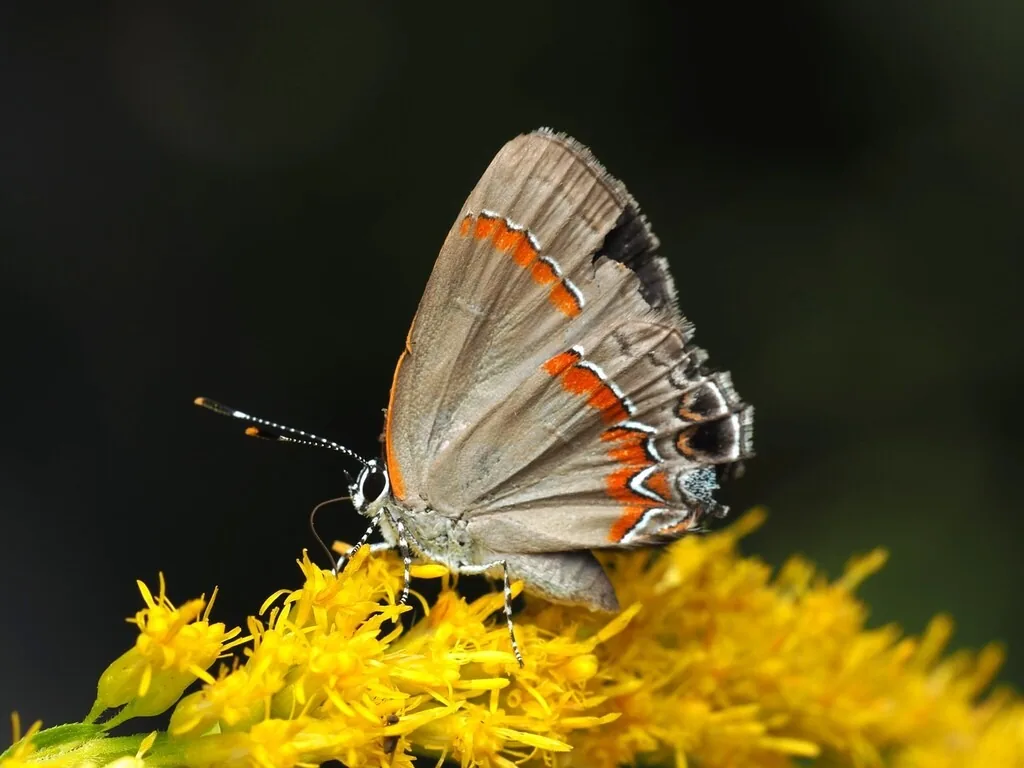
- The tannish-gray underside has white, black and red-orange bands just past the middle of the wing; the red-orange band is wider than the white and black together and sits closer to the body. Each hindwing has two thin tails.[1][2]
- The upper side is blackish brown. Females often show iridescent blue on the upper hindwings, especially in spring.[1][2]
- Caterpillars are drab brownish yellow-green with a faint bluish-green line down the back and a heavy coat of short brownish hairs, reaching about 1/2 inch.[1]
Look-alikes
Where it lives
Southeastern United States from Long Island south through Florida and west to southeast Kansas, eastern Oklahoma and eastern Texas, straying to eastern Nebraska, northern Illinois and Michigan. In Missouri it lives mostly south of the Missouri River and is most common in the Ozarks.[2][1]
Biology and life cycle
Females lay single eggs on the undersides of dead leaves on the ground near a host plant. Caterpillars spend the winter, and Butterflies and Moths of North America says chrysalids and fourth-stage caterpillars both overwinter.[1][2]
Hairstreaks rub their hindwings up and down, wiggling the tails. The tails act as mock antennae, so birds and jumping spiders aim at the hindwing edge instead of the real head.[1]
Adults visit flowers and moist ground. Butterflies and Moths of North America lists yarrow, wild cherry, sumac, New Jersey tea, common milkweed and dogbane among nectar plants. Missouri notes adults are most active near dusk and males perch on trees and shrubs, especially in the afternoon, to wait for females.[2][1]
Its genome, the first sequenced in the butterfly family Lycaenidae, shows expanded detoxification and digestion enzymes, which fits a caterpillar that eats decaying leaves.[3]
Damage and signs
Health risk
None of the sources reports any harm to people or pets from the butterfly or its caterpillar.[1][2]
Control
Prevention
No control is needed. Butterflies and Moths of North America reports no management needs, and the caterpillars live on leaf litter rather than garden plants.[2][1]
Where sources disagree
Broods: the Missouri Department of Conservation reports three broods there, with adults from mid-April into October. Butterflies and Moths of North America gives two broods from April to October north of Florida, and flights all year in Florida.[1][2]
Size: Missouri gives a wingspan of 3/4 to 1 inch; Butterflies and Moths of North America gives 7/8 to 1 1/4 inches.[1][2]
Common questions
- Are hairstreak caterpillars garden pests?
- No. Red-banded hairstreak caterpillars mostly eat decaying leaves on the ground.[1][2]
- Why do the wings have tails?
- The thin tails work like fake antennae. With the wings rubbing up and down, a bird or jumping spider tends to strike the tail end instead of the butterfly's real head.[1]
Sources
- Missouri Department of Conservation, “Red-Banded Hairstreak (Field Guide).” mdc.mo.gov/discover-nature/field-guide/red-banded-hairstreak (accessed 2026-11-11)
- Butterflies and Moths of North America (BAMONA), “Red-banded Hairstreak, Calycopis cecrops (species account).” www.butterfliesandmoths.org/species/Calycopis-cecrops (accessed 2026-11-11)
- Scientific Reports, via PubMed, “Complete genomes of Hairstreak butterflies, their speciation, and nucleo-mitochondrial incongruence (Cong et al. 2016).” pubmed.ncbi.nlm.nih.gov/27120974/ (accessed 2026-11-11)
- Proceedings of the Royal Society B, via PubMed, “When COI barcodes deceive: complete genomes reveal introgression in hairstreaks (Cong et al. 2017).” pubmed.ncbi.nlm.nih.gov/28179510/ (accessed 2026-11-11)
- iNaturalist, “Calycopis cecrops taxon page (order and family).” www.inaturalist.org/taxa/122281 (accessed 2026-11-11)