On this page
How to identify it
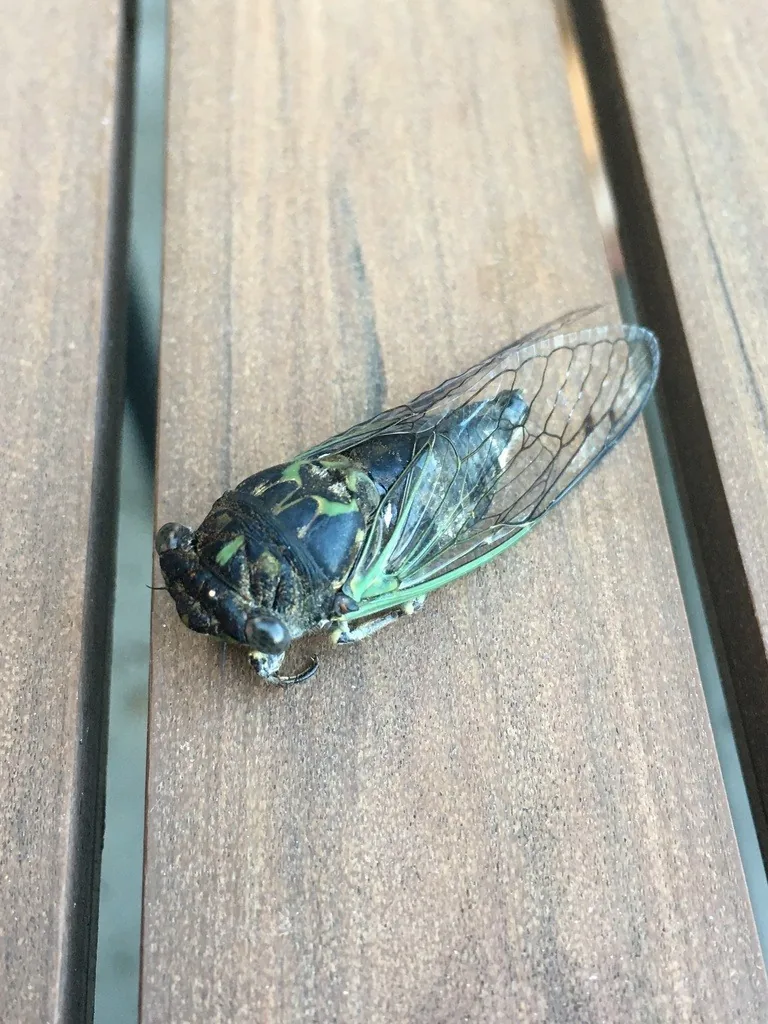
- Adults are stout insects about 1 to 2 inches long, with green, olive, brown or black bodies patterned in black, often with a whitish cast underneath.[1][3][4][5]
- They have large, wide-set black or brown eyes on the sides of the head, short antennae, and clear wings with noticeable veins held like a roof over the body.[1][5][3]
- The mouthpart is a short, sharp beak tucked under the head; they crawl and fly but don't jump.[1]
- Females carry a curved egg-laying tube at the tip of the abdomen. Only males make the loud call, and each species has its own song and time of day: Missouri's scissors grinder cicada calls mostly in the evening, the swamp cicada from about 8 to 11 in the morning.[1][5]
- Empty tan nymph skins are often left clinging to tree trunks, fences, posts and the sides of buildings; the skin looks like an insect but is hollow.[1][3][4]
Look-alikes
| Look-alike | How to tell them apart |
|---|---|
| Periodical cicadas | Smaller, with black bodies and reddish-orange eyes, legs and wing veins. They spend 13 or 17 years underground and emerge in huge synchronized broods in late spring or early summer, not every year.[1][5][4] |
| Cicada killer wasp | Not a cicada at all: a very large wasp that specializes in catching annual cicadas to feed its young.[1] |
Where it lives
Dog-day cicadas live wherever hardwood trees grow, in cities as well as the country. Clemson describes cicadas as found mainly in the southern and eastern United States. Most North American annual cicadas now belong to Neotibicen, a genus split from Tibicen in 2015, with some western species moved to Hadoa. In Missouri they occur statewide, mostly in forests, parks, wooded suburbs and along streams; they are seen every year in Minnesota; and Wisconsin has at least nine species, the dog-day cicada (Neotibicen canicularis) the most common. GBIF's public U.S. records since 1990 for Neotibicen (about 39,000) come from 37 states on the map, most from Texas, Mississippi and Virginia.[3][4][1][6][5][9]
Biology and life cycle
Females cut slits in twigs with a saw-edged egg-laying tube and lay small clusters of elongate eggs, favoring tender one-year-old growth; some species use living twigs and others dead ones.[5][1]
Eggs hatch in 6 to 10 weeks; the tiny nymphs drop to the ground and burrow down to feed on sap from tree roots, using enlarged front legs to dig.[5][4][1]
How long nymphs stay underground depends on the source: Missouri says 2 to 5 years, Clemson up to five, Minnesota four to eight, and UW-Madison 2 to 9 years for annual cicadas as a group, with the dog-day cicada normally finishing in two. Because generations overlap, some of each species mature every year.[1][4][3][5]
Grown nymphs dig their own exit tunnels, come out at night, climb a trunk or post, and split open to release the winged adult, which hangs on the empty skin while its wings expand and harden.[5][4][1]
Adults are out from about June or July through August or September, and live only a few weeks aboveground.[5][3][1]
Males sing by rapidly flexing drum-like membranes called tymbals on the abdomen, amplified by air chambers inside; some cicadas exceed 100 decibels. Females lack tymbals but can make a different sound by flicking their wings.[5][4][3]
Cicada species can be hard to tell apart even for specialists. A cryptic Neotibicen subspecies described in 2017 from forests of the Apalachicola region of the Southeast looks like its relatives and is recognized mainly by the male's song.[7]
Damage and signs
- Root feeding by nymphs is generally inconsequential, and Minnesota says cicada feeding on trees causes no noticeable injury.[5][3][4]
- The only real plant injury from cicadas is egg-laying. Slit twigs may split, wither and break (flagging), but established trees tolerate it and Missouri and UW-Madison call it a form of natural pruning. It matters mainly on young trees whose branches are the 1/4- to 1/2-inch size cicadas prefer.[5][1][4]
- Missouri adds that the burrowing nymphs help aerate the soil.[1]
Health risk
Cicadas can't sting and don't bite in defense. Very rarely, one left sitting on skin for a long time may jab with its beak, mistaking a person for a plant; Missouri calls it painful but a harmless accident. MedlinePlus advises washing any insect bite with soap and water and watching over the next few days for redness, swelling or pain that keeps increasing.[1][4][8]
Control
Prevention
No control is needed. UW-Madison says annual cicadas rarely need to be controlled because they don't emerge in huge numbers all at once, and Minnesota advises ignoring them; they go away on their own.[5][3]
Keep them out
Netting is the tool for the heavy egg-laying of periodical cicada years: Clemson suggests fine mesh netting over young trees and shrubs during mass emergences to keep females from laying eggs in twigs and stems.[4]
Common questions
- Why are they called dog-day cicadas?
- Adults are out during the dog days of July and August, a name tied to the late-summer prominence of Sirius, the Dog Star.[1]
- Do annual cicadas bite or sting?
- No. The female's egg-laying tube can look like a stinger, but cicadas can't sting and won't bite to defend themselves; their mouthparts are built for sucking sap.[1][4]
- What is the big wasp carrying cicadas around my yard?
- Likely a cicada killer, a large wasp that catches annual cicadas and stocks them as food for its young.[1]
- How long do annual cicadas live underground?
- Sources differ, from 2 to 5 years in Missouri's account to 4 to 8 in Minnesota's; UW-Madison says the dog-day cicada usually takes two years.[1][3][5]
Sources
- Missouri Department of Conservation, “Annual Cicadas (Field Guide).” mdc.mo.gov/discover-nature/field-guide/annual-cicadas (accessed 2026-11-11)
- iNaturalist, “Neotibicen canicularis taxon page (order and family).” www.inaturalist.org/taxa/469238 (accessed 2026-11-11)
- University of Minnesota Extension, “Cicadas.” extension.umn.edu/yard-and-garden-insects/cicadas (accessed 2026-11-11)
- Clemson University Home & Garden Information Center, “How to Identify, Understand, and Manage Cicadas (HGIC 2491).” hgic.clemson.edu/factsheet/cicadas/ (accessed 2026-11-11)
- University of Wisconsin-Madison Division of Extension (Wisconsin Horticulture), “Cicadas.” hort.extension.wisc.edu/articles/cicadas/ (accessed 2026-11-11)
- Zootaxa, via PubMed, “Molecular phylogenetics, diversification, and systematics of Tibicen and allied cicadas, with three new genera (Hill et al. 2015).” pubmed.ncbi.nlm.nih.gov/26250031/ (accessed 2026-11-11). Cited from the PubMed abstract.
- Zootaxa, via PubMed, “A new Neotibicen cicada subspecies from the southeastern USA forms hybrid zones with a widespread relative (2017).” pubmed.ncbi.nlm.nih.gov/28610271/ (accessed 2026-11-11). Cited from the PubMed abstract.
- MedlinePlus, U.S. National Library of Medicine, “Insect bites and stings (Medical Encyclopedia).” medlineplus.gov/ency/article/000033.htm (accessed 2026-11-11)
- Global Biodiversity Information Facility (GBIF), “Neotibicen: occurrence records in the U.S., 1990-2026 (GBIF occurrence search).” api.gbif.org/v1/occurrence/search?taxonKey=8537868&country=US&hasGeospatialIssue=false&occurrenceStatus=PRESENT&year=1990%2C2026&facet=stateProvince&facetLimit=400&limit=0 (accessed 2026-11-11). State counts are records reported (iNaturalist research-grade, museum specimens, surveys), not abundance.