On this page
How to identify it
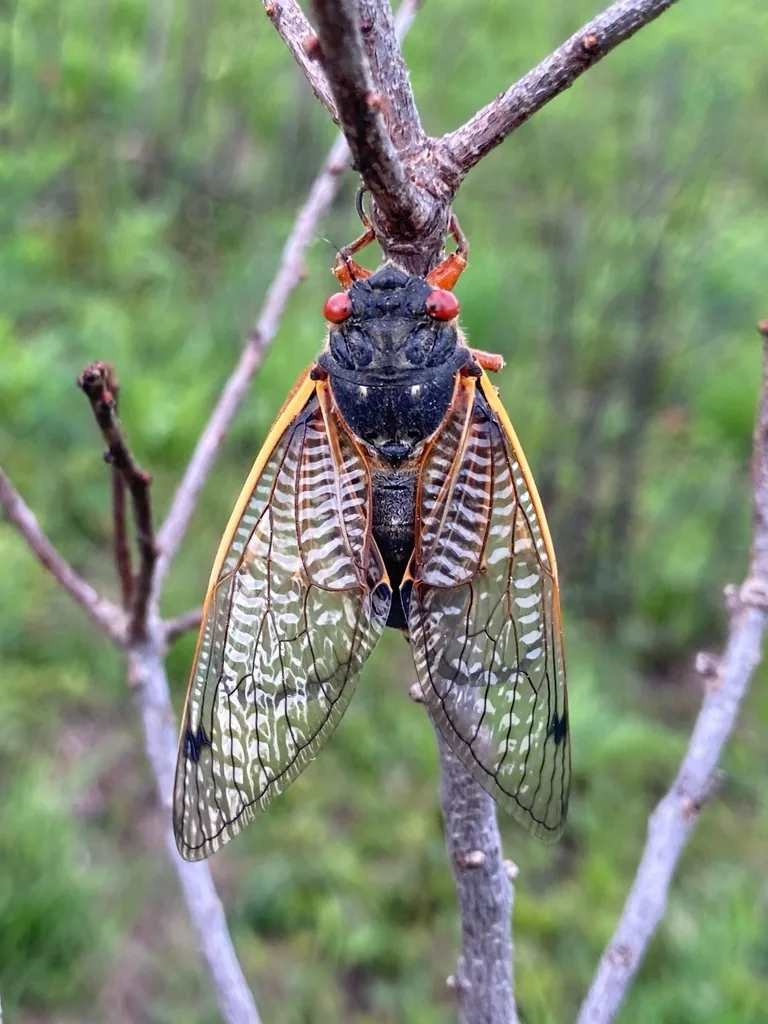
- Adults are blackish with red or reddish-orange eyes and orange-veined wings. Penn State puts them at about 1 1/2 inches long; Illinois Extension gives 3/4 to 1 1/2 inches.[1][4][2]
- The four clear wings have a gold, orange or red tinge and are held over the body like a roof.[2][5]
- Empty tan nymph skins, split down the back, cling to tree trunks, bark and twigs where the adults molted, and stay there a long time.[2][1]
- Before emerging, nymphs may build earthen turrets over their exit holes if the ground is too damp, which shows where cicadas will come up.[1]
- Freshly molted adults are soft and white and darken and harden overnight.[1][6]
Look-alikes
| Look-alike | How to tell them apart |
|---|---|
| Annual (dog-day) cicadas | Larger, about 1 1/2 to 2 1/2 inches, with green-and-brown or green-and-black bodies, greenish wing veins and dark eyes. They show up every summer, July through September, because their generations overlap.[4][1][3] |
| Cicada killer | A large wasp that hunts annual cicadas later in summer. Illinois Extension notes it is no help against periodical cicadas, which are dead by the time it emerges.[4] |
Where it lives
Periodical cicadas are native to eastern North America and found nowhere else. Seventeen-year cicadas are mostly northern and 13-year cicadas mostly southern, with overlap from North Carolina and Georgia west to Missouri. Each brood emerges in its own area and year, and broods fit together across the East like puzzle pieces.[1][5]
Biology and life cycle
Nymphs feed on sap from tree roots for 13 or 17 years, depending on the species. Penn State says they live 2 to 24 inches deep; Illinois Extension says they dig down 8 to 12 inches.[1][4]
Nymphs come out once the soil 8 inches down reaches 64 degrees F, often after a warm soaking rain. That is usually in May (Missouri), late May or early June (Pennsylvania and Illinois), or late April and May (North Carolina). The main emergence often happens over one or a few nights.[2][1][4][7]
Numbers can be huge. In 1956, Field Museum entomologists estimated as many as one million cicadas per acre in a forested floodplain near Chicago, and over 130,000 per acre on an upland site.[4][6]
Males sing by flexing drum-like membranes called tymbals on the underside of the abdomen; females are silent. About 10 days after emerging, females mate and start laying eggs.[5][1]
Adults live only a few weeks above ground: three to four weeks according to Penn State, with die-off beginning after about a month according to Illinois Extension.[1][4][2]
Egg counts vary by source. Penn State says a female lays 24 to 28 eggs per pocket and 400 to 600 in her life; Illinois Extension says 10 to 20 per spot and about 500 to 600 in all. Eggs hatch in six to seven weeks (Penn State) or six to ten weeks (NC State, Illinois, Wisconsin), and the tiny nymphs drop to the ground.[1][4][7][5]
Adults do feed. A gut-content study of Brood X in 2021 found plant DNA from 17 plant genera in nymphs and hardened adults, but none in freshly molted adults.[8][6]
Adults fly less than half a mile from where they emerge, so populations spread very slowly.[4]
Damage and signs
- Females cut slits in twigs to lay eggs. The twigs often split, die and turn brown, a condition called flagging, and may break off weeks, months or even years later.[7][4][5]
- They prefer twigs about the width of a pencil: 3/16 to 7/16 inch in diameter according to Penn State, 1/4 to 1/2 inch according to Wisconsin. More than 80 kinds of woody plants are used, oaks, maples and apples among the favorites; conifers are rarely used.[1][5]
- Large healthy trees outgrow flagging, which works as natural pruning. Small trees whose branches are mostly the preferred size, especially recently transplanted or balled-and-burlapped stock, can be badly damaged or killed.[1][4][2]
- Not every study agrees that the damage matters. In a planted experiment during Brood X in 2004, egg-laying did not generally reduce growth or reproduction of three native and three exotic host species.[9]
- Root feeding is a second disagreement: NC State says nymphs can reduce wood growth and flowering of trees and shrubs, while Illinois Extension says nymph feeding does not seem to harm the trees and Wisconsin calls it generally inconsequential unless numbers are very high on small plants.[7][4][5]
Health risk
Periodical cicadas don't bite or sting and aren't a threat to people or pets. MDC notes one exception: a cicada left sitting on your arm for a long time may rarely jab you with its beak, mistaking you for a plant.[3][4][2]
Control
Prevention
Avoid planting trees and shrubs the year before an emergence and in the spring of an emergence year. If you must plant, Illinois Extension suggests stock with a stem at least 2 1/2 inches in diameter. Penn State also advises holding off on pruning, since damaged branches can be cut out later.[4][1]
Keep them out
Cover small trees and shrubs (up to about 10 feet) with netting before the cicadas emerge and secure it at the base so they can't crawl up the trunk. The sources differ on mesh size: Penn State says 1/2 inch, Illinois Extension no larger than 1/4 inch. A frame helps keep branches from touching the net.[1][4]
Leave the netting on for the 4 to 6 weeks cicadas are active, then remove it.[1]
Traps and physical control
Prune out and destroy badly damaged twigs before the eggs hatch, so the nymphs never reach the ground.[5][4]
Pesticides
Insecticides are not recommended in home landscapes. They protect small trees less well than netting, often need reapplying every 2 to 3 days as new cicadas fly in, and kill beneficial mites and insects. Large healthy trees don't need treatment. MDC calls spraying pretty much useless.[4][1][2]
How broods work
Each brood has a Roman numeral: I to XVII for 17-year broods and XVIII to XXX for 13-year broods. The sources count the living broods differently. NC State says some have gone extinct, leaving twelve 17-year and three 13-year broods; Penn State says there are at least 13 broods of 17-year cicadas and five of 13-year cicadas.[7][1]
They also count species differently: Penn State lists seven (three 17-year and four 13-year), while NC State names Magicicada septendecim and five other species.[1][7]
Brood XIX, the 13-year Great Southern Brood, emerged in 2024; in Illinois it came out the same year as Brood XIII for the first time since 1803. NC State expects Brood X again in 2038, and MDC expects Brood XXIII in 2028.[2][6][7]
Stragglers are common. Penn State says individuals may emerge 1 to 4 years early or late, and MDC describes an early emergence in Ohio in 2007 after trees leafed out twice in one year.[1][2]
Why 13 or 17 years?
The leading explanation is predator satiation: millions emerge at once, birds and other predators eat their fill, and most cicadas survive to breed. Off-cycle stragglers rarely succeed because most are eaten.[1][2][4]
Other ideas remain open. Illinois Extension notes that 13 and 17 are prime numbers and that ice-age cooling may have lengthened the life cycle; a 2022 Annual Review of Entomology paper says newer studies have both supported and questioned the role of prime numbers.[4][10]
Broods are shrinking
MDC says periodical cicadas have been declining and their ranges contracting for as long as records exist. Brood XI, recorded in New England since 1699, dwindled to a few cicadas in 1954 and then disappeared.[2]
Paving, bulldozing and clearing land where nymphs live under trees wipe out local populations.[2]
Common questions
- Do periodical cicadas bite or sting?
- No. The female's ovipositor is only for laying eggs in twigs, and the mouthparts are for sucking plant sap.[3][2]
- Should I spray my trees during a cicada emergence?
- Generally no. Sprays need frequent reapplication because cicadas keep flying in, they kill beneficial insects, and netting protects small trees better.[1][4]
- Do adult cicadas eat?
- Yes. A study of Brood X found plant DNA in the guts of hardened adults, and MDC notes adults can suck plant juices during their few weeks above ground.[8][2]
- Why do they only come out every 13 or 17 years?
- Scientists aren't sure. Emerging all at once in huge numbers overwhelms birds and other predators so enough cicadas survive to breed, but other explanations are still being studied.[1][2][10]
Sources
- Penn State Extension, “Periodical Cicada.” extension.psu.edu/periodical-cicada (accessed 2026-11-11)
- Missouri Department of Conservation, “Periodical Cicadas (Field Guide).” mdc.mo.gov/discover-nature/field-guide/periodical-cicadas (accessed 2026-11-11)
- Clemson Cooperative Extension, Home & Garden Information Center, “How to Identify, Understand, and Manage Cicadas.” hgic.clemson.edu/factsheet/cicadas/ (accessed 2026-11-11)
- University of Illinois Extension, “Cicadas (Insects).” extension.illinois.edu/insects/cicadas (accessed 2026-11-11)
- University of Wisconsin-Madison Extension, Wisconsin Horticulture, “Cicadas.” hort.extension.wisc.edu/articles/cicadas/ (accessed 2026-11-11)
- University of Illinois Extension, “The cicadas are coming! Periodical cicadas in Illinois in 2024 (Good Growing).” extension.illinois.edu/blogs/good-growing/2024-02-22-cicadas-are-coming-periodical-cicadas-illinois-2024 (accessed 2026-11-11)
- NC State Extension, “Periodical Cicadas in the Landscape.” content.ces.ncsu.edu/periodical-cicadas (accessed 2026-11-11)
- Journal of Insect Science, via PubMed, “Do adult Magicicada feed? Historical perspectives and evidence from molecular gut content analysis (Hepler et al. 2023).” pubmed.ncbi.nlm.nih.gov/37850668/ (accessed 2026-11-11)
- Oecologia, via PubMed, “Response of host plants to periodical cicada oviposition damage (Flory and Mattingly 2008).” pubmed.ncbi.nlm.nih.gov/18327614/ (accessed 2026-11-11)
- Annual Review of Entomology, via PubMed, “Advances in the evolution and ecology of 13- and 17-year periodical cicadas (Simon et al. 2022).” pubmed.ncbi.nlm.nih.gov/34623904/ (accessed 2026-11-11)
- iNaturalist, “Magicicada septendecim taxon page (order and family).” www.inaturalist.org/taxa/1248681 (accessed 2026-10-06)