On this page
How to identify it
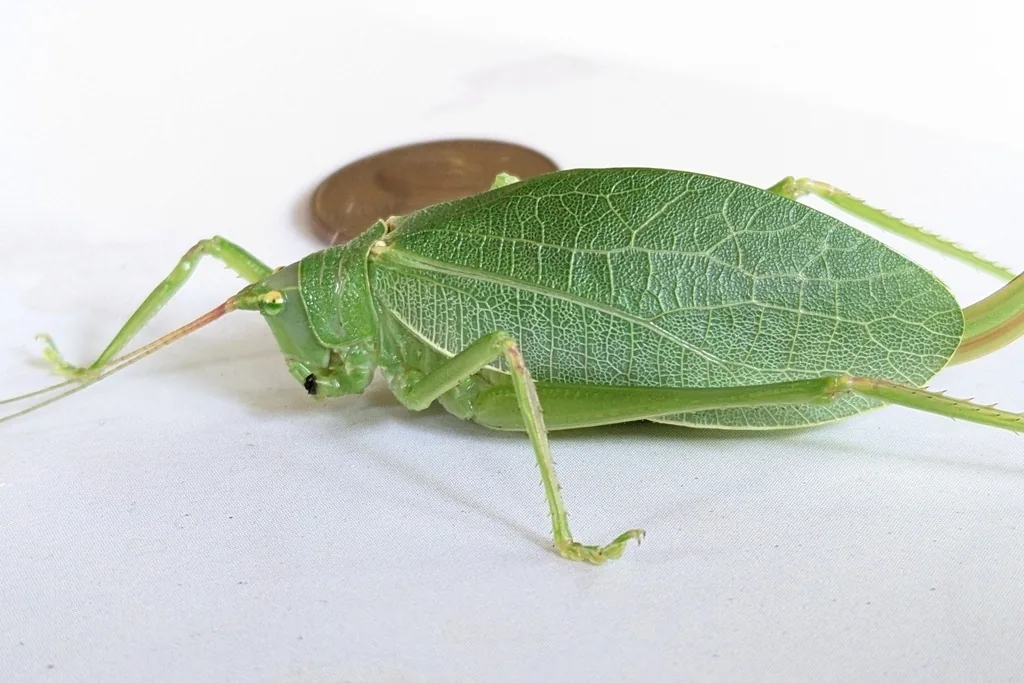
- Its leaf-like wings, veined like real leaves, bow out from the body to form a hollow chamber that amplifies the song, and its antennae are longer than its body.[1][2][4]
- Adults are about 2 inches long according to Clemson, up to about 2 1/2 inches according to Missouri (not counting legs, wings or antennae); females are larger than males.[4][2]
- Females carry an egg-laying tube (ovipositor) at the rear: Clemson calls it sickle shaped, while Missouri calls it sword shaped.[4][2]
- Males sing with a file-and-scraper organ in a brown triangular area at the base of the wings.[1]
- Katydids hear with ear-like organs (tympana) on their front legs.[4][5]
- Fun fact: some katydids are born pink instead of green. Pink ones are easy to spot and are quickly eaten by predators.[4]
Look-alikes
Where it lives
Common in trees across the eastern United States, including Mississippi and Missouri; Wisconsin Horticulture says its native range reaches into southern Wisconsin.[1][2][5]
Biology and life cycle
Males in one tree often synchronize, while nearby groups sing on a different beat, creating the 'debate'.[1]
The singing season typically starts in late June and peaks in July, though some keep calling until frost. Insects are cold-blooded, so the song is faster on warm evenings and slows as temperatures drop.[4][1]
Movement: Mississippi State says they can't fly despite their large wings; Clemson calls them poor fliers that usually walk or hop; Missouri says they walk slowly, jump only when frightened, and use their wings mainly as parachutes to break a fall.[1][4][2]
They are usually seen on the ground only after heavy wind or rain, when trees are felled or pruned, or in autumn when cool weather makes them clumsy.[1][2]
Late in the season females insert eggs into bark crevices or lay flattened eggs in rows on plant stems. The eggs overwinter and hatch in spring, and there is one generation a year.[2][4][5]
Birds, snakes, mammals and lizards eat them, and the great golden digger wasp paralyzes katydids to feed its young.[2][4]
In a 2009 lab choice study, common true katydids preferred plants of a wild grass, Festuca subverticillata, that were free of a fungal endophyte over plants carrying it.[6]
Damage and signs
Health risk
Mississippi State, Missouri, Clemson and Wisconsin describe it as a treetop leaf eater and mention no risk to people or pets.[1][2][4][5]
Control
Prevention
No control is needed: katydids rarely cause major or significant plant damage.[4][5]
Where sources disagree
Who sings: Mississippi State says the males make the sounds; Missouri says the calls come from both males and females; Clemson says both sexes can sing but the male is usually the one heard.[1][2][4]
Flight and size: see the movement and size notes above; Mississippi State, Clemson and Missouri each describe flight differently, and Clemson and Missouri give different lengths.[1][4][2]
Common questions
- What is making the loud 'katy-did' sound at night?
- Male common true katydids singing high in the trees.[1][2]
- Is it a cicada?
- No; cicadas usually sing by day, katydids at night.[1]
- Can it fly?
- Not well. Mississippi State says it can't fly, Clemson calls it a poor flier that usually walks or hops, and Missouri says its wings work mainly as parachutes when it leaps.[1][4][2]
- Why does the song slow down on cool nights?
- Katydids are cold-blooded, so they move and sing more slowly when it is cooler and faster on warm evenings.[1][4]
- I found a pink katydid. Is it a different species?
- Clemson says some katydids are simply born pink rather than green; they are easy to spot and usually eaten quickly by predators.[4]
Sources
- Mississippi State University Extension (Bug's Eye View), “Common True Katydid, Vol. 6, No. 19.” extension.msstate.edu/newsletters/bugs-eye-view/2020/common-true-katydid-vol-6-no-19 (accessed 2026-11-12)
- Missouri Department of Conservation, “Common True Katydid (Field Guide).” mdc.mo.gov/discover-nature/field-guide/common-true-katydid (accessed 2026-11-12)
- iNaturalist, “Pterophylla camellifolia taxon page (order and family).” www.inaturalist.org/taxa/118951 (accessed 2026-11-12)
- Clemson Cooperative Extension, Forestry and Wildlife, “Katy did what?.” blogs.clemson.edu/fnr/katy-did-what/ (accessed 2026-11-12)
- University of Wisconsin-Madison Extension, Wisconsin Horticulture, “Katydids.” hort.extension.wisc.edu/articles/katydids (accessed 2026-11-12)
- Environmental Entomology 2009;38(4):1086-95, via PubMed, “Endophyte-mediated resistance to herbivores depends on herbivore identity in the wild grass Festuca subverticillata.” pubmed.ncbi.nlm.nih.gov/19689887/ (accessed 2026-11-12). Cited from the PubMed abstract.